




403
Sorry!!
Error! We're sorry, but the page you were looking for doesn't exist.
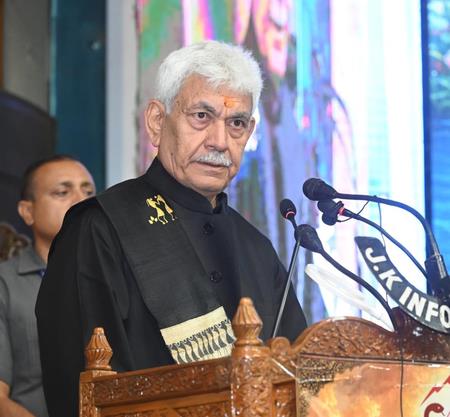
Those Attending Two-Day Srinagar Literary Fest Will Feel Cultural, Intellectual And Literary Depth Of Kashmir: L-G Sinha
(MENAFN- IANS) Srinagar, May 30(IANS) Jammu and Kashmir Lieutenant Governor (L-G) Manoj Sinha said on Saturday that those participating in the two-day literary festival in Srinagar will feel the cultural, intellectual and literary depth of Kashmir.
L-G Sinha inaugurated the two-day literary festival at the Sher-e-Kashmir International Convention Centre (SKICC) in Srinagar.
He said that writers, poets and scholars play a greater role in shaping civilisations than institutions.
L-G Sinha welcomed all guests who had arrived in Jammu and Kashmir from outside the Union Territory and said he was confident they would "feel and witness" the cultural, intellectual and literary depth of Kashmir during the festival being held on May 30 and 31.
"I welcome everyone who has come to Jammu and Kashmir from outside. I am confident that during these two days, you will not only see but also deeply feel the literary, cultural and intellectual soul of this land."
He said that India's literary world has still not fully realised or expressed the strength of the country's civilisational knowledge and heritage.
"India's literary world is still like Lord Hanuman Ji before realising his own strength. Just as Lord Hanuman was reminded of his powers before crossing Lanka, our literary and intellectual community, too, must realise the depth of India's civilisational strength and present it to the world," he added.
Calling writers immortal through their creations, L-G Sinha said that great poets, authors and creators never die because their works continue to inspire generations.
"Great poets, writers and creative minds become immortal through their knowledge and work."
"The human body is mortal, but creation becomes the symbol of immortality," the L-G added.
The Lieutenant Governor said he had witnessed many occasions where institutions spent crores of rupees but failed to create the impact that a single novel or literary work could create.
"I have seen institutions spending crores of rupees, yet failing to create the impact that one novel can create in society. Literature has the power to influence minds and generations in ways institutions often cannot," he added.
Referring to the Prime Minister Narendra Modi's speech from the ramparts of Red Fort in New Delhi, L-G Sinha said the time had come to completely erase the colonial mindset and reclaim India's true historical narrative.
"Some time ago, Prime Minister Narendra Modi, from the Red Fort, said that the time has come to remove the colonial mindset. We must ensure that our history is not presented in a distorted manner," he added.
The Lieutenant Governor said scholars and researchers must work towards taking authentic history to local readers and future generations.
"We must repeatedly remind the world that when many parts of the world were struggling in darkness, India was a major centre of science, culture and knowledge," he added.
He reminded that India laid the foundations of mathematics, science and astronomy that later influenced the Western world.
"India gave the world the foundations of mathematics, science and astronomy. Several civilisations learned from India's knowledge systems," he said.
The Lieutenant Governor added that one of the greatest failures of modern India was that it forgot to write and preserve its own history properly.
"In modern times, India forgot to write its own history correctly. Slowly, narratives emerged claiming that science and knowledge came to us from Persia or the Mughals," he said.
He added that many historical accounts deliberately ignored India's ancient scientific and intellectual contributions despite references available in Persian and Arab literature from the eighth century onwards.
"There are historical writings where India's contributions were not properly acknowledged. But references in Persian and Arab texts clearly show that Indian knowledge systems in medicine, mathematics and astronomy influenced many civilisations," he said.
L-G Sinha added that several researchers and scholars across the world had acknowledged India's contribution to medicine, mathematics and scientific thought.
"Indian medicinal systems, mathematics and scientific learning influenced scholars and civilisations across continents," he said.
Referring to Europe's intellectual awakening, the Lieutenant Governor added that many Western scholars themselves accepted that India possessed deep-rooted traditions of knowledge and scientific understanding.
"I want to say that the roots of our knowledge systems have always been extremely deep. Colonialism damaged confidence in our own civilisation and knowledge traditions," L-G Sinha said.
The Lieutenant Governor added that whenever discussions on history and science take place, names like Newton and the Theory of gravity are remembered, but India's scientific capabilities and maritime strength existed centuries earlier.
"People often mention Newton and the theory of gravity, but India, too, possessed deep scientific understanding and advanced capabilities long before many Western developments," he said.
Referring to Alexander and King Porus, L-G Sinha added that ancient India was globally respected for its steel and metallurgy.
"There are historical references showing that Alexander gifted special Indian steel associated with King Porus, which reflected the advanced metallurgical traditions of ancient India," he said.
The Lieutenant Governor added that not only India's past but also its present achievements must reach the people.
"We must take not just our past but also our present achievements to the people. India has risen strongly and today we have become the world's fourth-largest economy," he said.
He added that the country would achieve the dream of a 'Developed India' by 2047.
"By 2047, India will achieve the vision of a developed nation. A new emotional awakening has started in society and people are increasingly understanding their responsibility towards the nation," he said.
The Lieutenant Governor said writers and thinkers stand above nations in shaping public consciousness and civilisation.
"Always remember that writers are greater than nations because they shape the thinking and direction of societies and civilisations," he added.
Rejecting the notion that reading culture was declining, L-G Sinha said the world today was reading more than ever before.
"Today the world is not reading less, but more. Research in 2025 suggested that more than 40 lakh books were published globally," he added.
He said that digital platforms and open-access communication had created opportunities to build positive narratives globally.
"The doors have opened. We must use these platforms and mediums to build strong and positive narratives," he added.

Legal Disclaimer:
MENAFN provides the
information “as is” without warranty of any kind. We do not accept
any responsibility or liability for the accuracy, content, images,
videos, licenses, completeness, legality, or reliability of the information
contained in this article. If you have any complaints or copyright
issues related to this article, kindly contact the provider above.
Most popular stories
Market Research

More Story


Comments
No comment