




403
Sorry!!
Error! We're sorry, but the page you were looking for doesn't exist.
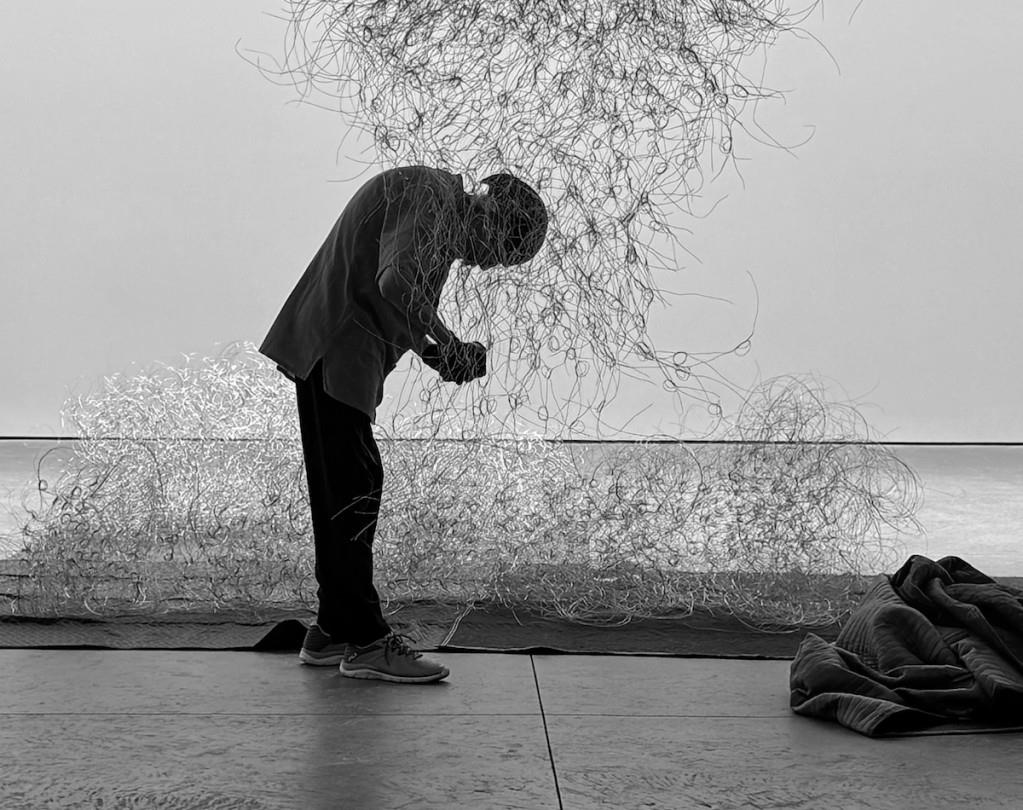
Alan Saret Dead: Elusive 'Anti-Form' Sculptor Dies At 81
(MENAFN- USA Art News)
Alan Saret, the artist who made disorder feel deliberate, has died at 81
Alan Saret, an American artist born on December 25, 1944, died on Tuesday at 81, according to Karma, the New York gallery that has presented three exhibitions of his work since 2022. For decades, Saret occupied a singular place in postwar American art: close to the anti-form ideas of the late 1960s, yet never fully contained by the labels that critics and historians attached to him.
His best-known works were wire sculptures built from bronze and steel, often using crushed, bent, or suspended material to create forms that seemed unstable, porous, and alive. Where Minimalism prized clarity and order, Saret's sculptures embraced contingency. He also made colored-pencil drawings known as“Gang Drawings,” in which multiple pencils dragged across a sheet at once produced dense abstractions that suggested migration, motion, and systems in flux.
Saret's work entered major institutions including the Museum of Modern Art (MoMA), the Whitney Museum, P.S.1 Contemporary Art Center, and the Drawing Center. A breakthrough came with his 1968 exhibition at Bykert Gallery in New York, which led to inclusion in Harald Szeemann's landmark 1969 exhibition“When Attitudes Become Form” at Kunsthalle Bern. In 1976, the inaugural P.S.1 exhibition included a Saret installation consisting only of an aperture cut into the building's brick wall - a gesture that still survives at MoMA PS1.
Though he remained a cult figure rather than a widely recognized name, Saret's influence was reinforced by later surveys, including a 1990 presentation at P.S.1 and a 2007 survey at the Drawing Center. Critics repeatedly noted the work's odd authority. Emily Wasserman wrote in Artforum that his 1968 Bykert show made him seem“a vital and promising talent,” while Michael Kimmelman later described him as“eccentric” in the best sense.
Saret studied architecture at Cornell University, graduating in 1966, before enrolling at Hunter College, where he studied under Robert Morris. Morris's 1968 essay“Anti Form” helped define a generation of process-based art, and Saret credited him with having“enabled my work to become known.” He also worked alongside Jeffrey Lew and Gordon Matta-Clark in the SoHo scene that helped shape downtown New York's experimental art culture. Among his later projects was“Ghosthouse” (1975), an outdoor wire installation shown at Artpark in Western New York.
Saret's career was never easy to categorize, and that may be part of its lasting appeal. He left behind a body of work that treated matter as something unstable, responsive, and quietly charged with force.

Legal Disclaimer:
MENAFN provides the
information “as is” without warranty of any kind. We do not accept
any responsibility or liability for the accuracy, content, images,
videos, licenses, completeness, legality, or reliability of the information
contained in this article. If you have any complaints or copyright
issues related to this article, kindly contact the provider above.
Most popular stories
Market Research

More Story




Comments
No comment