




403
Sorry!!
Error! We're sorry, but the page you were looking for doesn't exist.
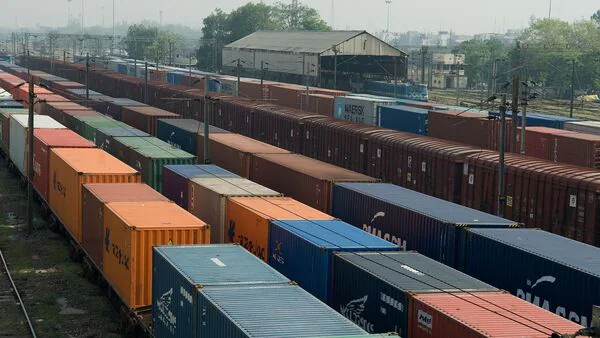
India Needs 215 Mega Cargo Hubs To Move 45% Of Goods By Train By 2047: Report
(MENAFN- Live Mint) India will need around 215 large multimodal logistics parks (MMLPs) by 2047 to support the sharp increase in rail-based cargo movement needed to meet the government's target of increasing railways' share in freight transport to from 27.4% at present to 45% by 2047, according to a report released by CII and Knight Frank India on Friday.
The report, titled 'Fast-Tracking MMLPs to Enable Modal Shift: India's Multimodal Logistics Transformation', said India's freight movement is projected to rise more than four-fold to about 28 billion tonnes a year by 2047, necessitating a major overhaul of logistics infrastructure and cargo aggregation systems.
To achieve the 45% target under the National Rail Plan, Indian Railways would need to handle nearly 12,649 million metric tonnes of freight a year by 2047, the report said. It added that MMLPs-integrated hubs connecting rail, road and ports with warehousing and mechanised handling systems-will be crucial in enabling the shift away from road-based freight movement.
Also Read | Railway finances: It's time for India to put them firmly on track Roads dominate“At present, India's freight ecosystem remains heavily dependent on roads, which account for nearly 70% of freight movement by tonne-kilometre despite rail freight costing almost half of road transport,” the report noted.
It added that India has only 30 operational MMLPs at present, which handle around 129 million metric tonnes of cargo a year, representing just 2% of total freight movement. Another 45 parks are under various stages of development.
The report estimated that if MMLPs were to handle even 30% of India's rail freight movement by 2047, they would need to process around 3,162 MMT of cargo annually. This would require the development of about 215 next-generation logistics parks with significantly higher throughput than existing facilities.
Integration is all-importantThe report said future logistics parks should be designed as high-density freight consolidation hubs integrated with dedicated freight corridors (DFCs), industrial clusters and ports to improve cargo aggregation and reduce logistics costs.
Knight Frank India chairman and managing director Shishir Baijal said India's logistics transformation was moving into a“scale-driven phase”, where integration of infrastructure networks would become more important than standalone asset creation.
“MMLPs can become the critical link between infrastructure creation and freight efficiency by lowering logistics costs, improving rail adoption and supporting India's long-term manufacturing and export competitiveness,” Baijal said.
The report highlighted that India's logistics efficiency improved by 59% between FY16 and FY26, citing Knight Frank's Operational Infrastructure Index, which rose from 0.39 to 0.62 over this period.
Also Read | E-truck localization: What do new norms mean for the industry?It also estimated that improvements in transport infrastructure have reduced India's logistics costs from 13-14% of GDP a decade ago to about 10-10.5% of GDP in FY26, generating annual savings of ₹10.8-11.7 trillion for the economy.
The study said combining DFC infrastructure with modern MMLPs could reduce overall door-to-door freight costs by nearly 43% compared with road-only transport systems. Cargo dwell times could also decline sharply-from 34 to 152 hours at conventional goods sheds to 2.5 to 8 hours at mechanised logistics parks.
The report noted that Indian Railways' freight basket remains dominated by bulk commodities, which account for nearly 80% of rail freight traffic. Future growth, however, is expected to increasingly come from containerised and non-bulk sectors such as manufacturing and consumer goods, which are projected to grow 8-12% annually.
How to accelerate the shiftTo accelerate the modal shift towards railways, the report recommended stronger central coordination for strategically important logistics parks under PM Gati Shakti, including faster land acquisition, parallel approvals and timely rail connectivity.
It also suggested using freight generated by central public sector enterprises such as Coal India, NTPC, Indian Oil, SAIL and FCI as anchor cargo during the initial years of MMLP operations to ensure commercial viability.
Another key recommendation was improving first- and last-mile connectivity through feeder rail sidings, access roads and integrated planning across rail, road and port agencies.“Without stronger first and last-mile connectivity, logistics parks risk functioning merely as road-fed warehouses instead of true multimodal hubs,” the report said.
The report added that early execution success in projects in Jogighopa, Chennai, Bengaluru, Nagpur and Indore will be crucial for building investor confidence in India's wider multimodal logistics programme.
Also Read | Five beaten-down railway stocks to watch
Legal Disclaimer:
MENAFN provides the
information “as is” without warranty of any kind. We do not accept
any responsibility or liability for the accuracy, content, images,
videos, licenses, completeness, legality, or reliability of the information
contained in this article. If you have any complaints or copyright
issues related to this article, kindly contact the provider above.
Most popular stories
Market Research

More Story







Comments
No comment