

UAE Researcher Develops App To Verify Photos, Videos As Deepfake Threat Grows


- By: Amal Alduwaila AlHashmi
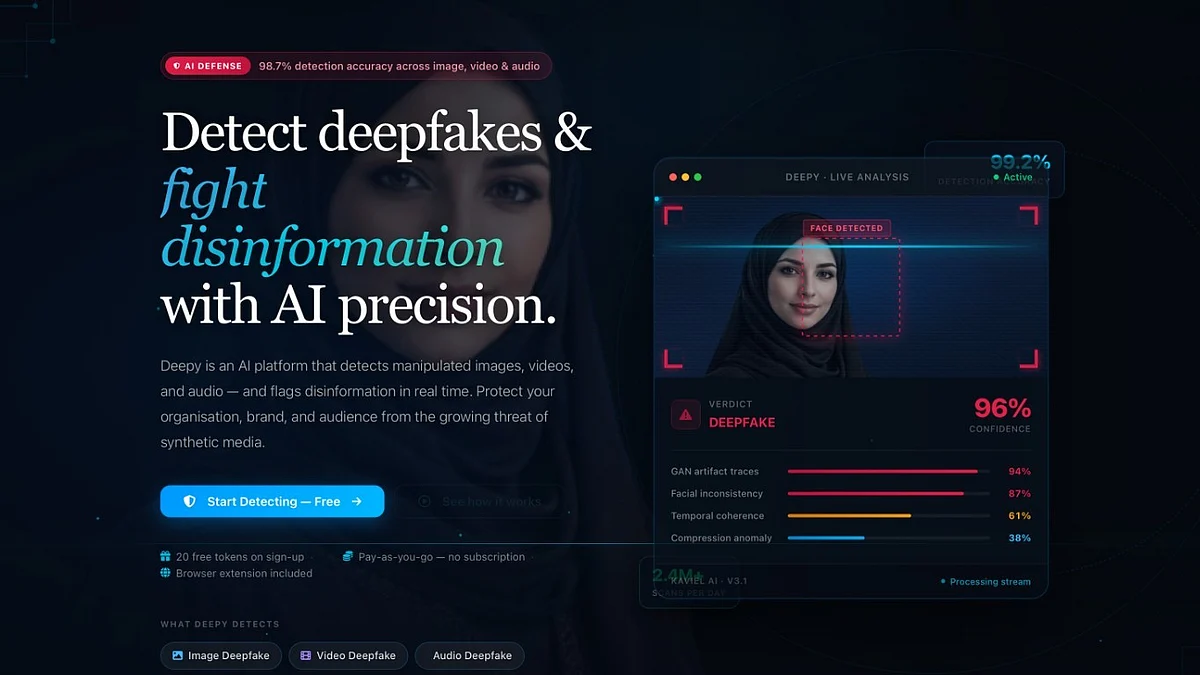
An Emirati cybersecurity researcher has developed an AI-powered platform that detects deepfakes in images, videos and audio, with the aim of curbing the rapid spread of fabricated content across social media.
Bashayer Al Salami built the platform, called Deepy, after her master's research at Zayed University focused on modern digital threats and the ways AI-generated manipulation has begun to outpace what ordinary users can recognise on their own.
Recommended For You"As AI advanced, deepfakes emerged as one of the most serious digital challenges, making it possible to alter images, videos and audio in ways the average viewer cannot easily detect," she said.
Stay up to date with the latest news. Follow KT on WhatsApp Channels.
Deepy analyses uploaded files and produces a credibility assessment, flagging the likelihood that AI manipulation has been used. "It relies on advanced AI algorithms to analyse images, videos and audio clips, examining technical indicators within the digital file, such as pixel patterns, inconsistencies in lighting, and distortions in movement or sound," Al Salami explained.
Detection itself draws on a set of indicators that humans rarely notice on their own, including asymmetry in lip movement or facial expressions, inconsistencies in lighting and shadow patterns, and subtle distortions at the pixel or frame level. The system also reads digital fingerprints left behind by image and audio generation algorithms, with deep learning models trained on thousands of samples of authentic and fabricated content allowing Deepy to flag manipulation at an early stage.
The platform targets government bodies and security agencies, media organisations and journalists, and companies whose work depends on digital content verification. It can also support entities working in digital security and social media. Versions for everyday users are currently in development, allowing anyone to check an image or video before sharing it.
Periods of crisis or political tension typically drive a sharp rise in the circulation of fabricated content, Al Salami said, with deepfake technology used to stoke anxiety or sway public opinion. Deepy aims to provide rapid verification so journalists, official bodies and ordinary users can examine material before passing it on.
"The role of technology does not stop at detecting manipulation," she said. "It extends to promoting digital awareness and building a more reliable and secure media environment in the digital age."
ALSO READ- Spot deepfakes: How to avoid AI scams and protect your money Deepfake fraud: How AI scams threaten Middle East businesses

Legal Disclaimer:
MENAFN provides the
information “as is” without warranty of any kind. We do not accept any
responsibility or liability for the accuracy, content, images, videos,
licenses, completeness, legality, or reliability of the information
contained in this article. If you have any complaints or copyright issues
related to this article, kindly contact the provider above.
Comments
No comment