




403
Sorry!!
Error! We're sorry, but the page you were looking for doesn't exist.
Electric Motors Market Size, Share, Growth, Analysis, 2034
| Company | Investment/ Funding | Timeline | Details |
|---|---|---|---|
| ABB | USD ~200 million investment in Europe | May 2026 | Expansion of medium-voltage manufacturing capacity supporting grid, industrial electrification, and high-power motor systems |
| ABB | USD ~75 million investment in India | March 2026 | Expansion of manufacturing and R&D capacity for electrification and automation solutions including motors, drives, and industrial electrification |
| ABB India | INR 140 crore (~USD 17M) investment | September 2025 | Expansion and modernization of low-voltage motor manufacturing; launch of IE5 ultra-efficient motors |
| Market Metric | Details & Data (2025-2034) |
|---|---|
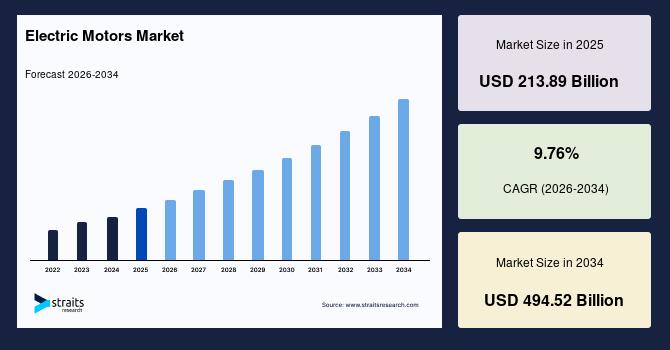
| 2025 Market Valuation | USD 213.89 Billion |
| Estimated 2026 Value | USD 234.77 Billion |
| Projected 2034 Value | USD 494.52 Billion |
| CAGR (2026-2034) | 9.76% |
| Study Period | 2022-2034 |
| Dominant Region | Asia Pacific |
| Fastest Growing Region | Europe |
| Key Market Players | ABB (Switzerland), Siemens (Germany), Nidec Corporation (Japan), WEG S.A. (Brazil), Toshiba Corporation (Japan) |
Download Free Sample Report to Get Detailed Insights.
Electric Motors Market Dynamics Market DriversGrowing Industrial Electrification and Integration of Variable Frequency Drive (VFD) Boosts Electric Motors Market Demand
Growing adoption of variable frequency drives enhances electric motor usage by enabling precise speed and torque control across diverse applications. Energy optimization becomes more achievable as motors operate only at required load levels, reducing unnecessary power consumption. Integration of VFDs supports smoother operation, reduced mechanical stress, and improved equipment lifespan. Industrial automation systems, HVAC installations, and pumping applications increasingly rely on VFD-compatible motors for performance flexibility. Rising focus on energy savings and process control efficiency continues to support demand for high-efficiency electric motor systems, supporting electric motors market growth.
Market RestraintsSupply Chain Disruptions and Complex Recycling Restraints Market
Electric motor production depends heavily on non-oriented electrical steel and high-grade copper windings, creating structural supply constraints. Limited global suppliers reduce procurement flexibility and increase exposure to raw material price volatility. Long certification timelines for alternative materials slow substitution. This leads to production risks, potential delays, and vulnerability to geopolitical disruptions affecting stable manufacturing and delivery schedules.
Electric motors are difficult to recycle due to multi-material construction, including copper windings, laminated steel, insulation polymers, and composite housings. Separation processes are complex and costly, reducing the recovery efficiency of valuable materials. Low recyclability increases reliance on virgin resources and raises disposal costs. This limits circular economy adoption and adds financial pressure on manufacturers in large-scale industrial and commercial applications.
Market OpportunitiesAdvancement of Axial Flux Architectures and SiC-based High-frequency Drive Systems Offers Growth Opportunities for Market Players
The electric motors market presents significant opportunities through the advancement of axial flux motor architectures and silicon carbide (SiC)-based high-frequency drive systems. Axial flux designs support higher torque density within a compact footprint by using disc-shaped magnetic flux paths instead of conventional radial configurations. This enables integration into space-constrained applications such as in-wheel automotive systems, aerospace propulsion units, and compact industrial actuators. It also drives demand for advanced manufacturing techniques, including precision laminated core stacking, segmented winding automation, and optimized thermal management systems.
At the same time, SiC-driven motor systems create opportunities for next-generation high-efficiency electrification. High switching frequencies enable more precise current control, reduced energy losses, and improved motor efficiency under dynamic load conditions. These systems support operation at higher power densities and faster response times, which is critical for robotics, high-speed compressors, and aerospace actuation systems. They also increase the need for advanced insulation materials, including nanocomposite dielectrics, and encourage the development of highly integrated motor-drive architectures optimized for extreme electrical and thermal performance.
Market ChallengesMechanical Fatigue in High-speed Rotor Operation and Thermal Saturation Challenges Electric Motors Market Growth
High rotational speed operation increases centrifugal stress across rotor components, laminations, adhesives, and retaining structures. Continuous exposure to dynamic forces accelerates mechanical fatigue and deformation risks over extended duty cycles. Bearing systems experience faster wear due to elevated friction and load variation, requiring high-precision materials and frequent servicing. Operational efficiency declines in continuous duty environments where long service life and stable torque delivery remain critical requirements in industrial applications.
Compact high-power-density motor designs generate intense heat within windings and stator cores during continuous operation. Limited surface area restricts natural heat dissipation, increasing reliance on complex cooling systems such as liquid or forced air mechanisms. Repeated thermal cycling weakens insulation materials and reduces winding durability over time. Performance stability becomes difficult to maintain under sustained heavy load conditions, limiting suitability for long-duration, high-torque industrial operations.
Electric Motors Regional Outlook Asia Pacific: Market Dominance Led by Rapid Localization of EV Drivetrain Production and Focus on Hybrid & Next-generation EV PlatformsThe Asia Pacific electric motors market accounted for the largest regional share of 42.18% in 2025 due to the rapid localization of EV drivetrain production across China, India, and South Korea, which increases demand for traction motors, hub motors, and auxiliary electric drive systems. Integration of battery manufacturing with motor assembly facilities improves supply chain coordination and supports efficient powertrain design. Strong focus on domestic EV manufacturing expands motor usage across two-wheelers, three-wheelers, passenger electric vehicles, and commercial fleets. Government support for electrification and rapid scaling of mobility platforms further accelerates adoption of high-efficiency electric motor systems across regional transportation applications.
China Electric Motors MarketThe China electric motors market was estimated to be valued at USD 24.6 billion in 2025, driven by strong demand for advanced electric motors, particularly traction motors, e-axle systems, and integrated motor-inverter units. In 2025, China produced about 16.52 million NEVs, representing nearly 47.5% of total vehicle output. NEV sales reached around 15.33 million units, growing roughly 25% year-on-year, reflecting strong and sustained demand for traction motors and electric drive systems. Government NEV adoption targets and localization policies further strengthen domestic motor production, supporting rapid scaling of high-efficiency, cost-optimized, and vertically integrated motor supply chains.
Japan Electric Motors MarketJapan's electric motor market was valued at USD 13.8 billion in 2025 through its strong focus on hybrid and next-generation electric vehicle platforms. Leading manufacturers develop compact, high-efficiency traction motors and integrated motor-generator systems to improve fuel economy and driving range. According to JAMA annual vehicle statistics, hybrid electric vehicles consistently account for around 40–50% of new passenger car sales in Japan, far higher than full battery electric vehicles. This emphasis on power-dense e-axles and lightweight motor designs supports continuous innovation in advanced motor architectures and precision engineering within the domestic supply chain.
India Electric Motors MarketThe India electric motor market was estimated to be valued at USD 14.2 billion in 2025, fueled by the growth of commercial real estate, IT parks, and residential skyscrapers, increasing the deployment of traction motors in elevators, escalators, and automated vertical transport systems across urban infrastructure. Expanding high-rise construction activity in tier 1 and tier 2 cities raises demand for reliable vertical mobility solutions in offices, shopping complexes, and residential towers. Continuous passenger movement requirements support adoption of high-efficiency motor systems with smooth acceleration and braking performance.
Europe: Fastest Growth Driven by Strong Nuclear Base and Large Circulation of Heat Transfer SystemsThe Europe electric motors market is expected to grow at a CAGR of 7.88% during the forecast period due to the expansion of district heating and cooling networks across Nordic countries and Central Europe. This increases deployment of electric motors in large circulation pumps, heat transfer systems, and centralized thermal distribution infrastructure. Urban energy frameworks rely on continuous fluid movement and pressure regulation to maintain stable thermal distribution across residential and commercial buildings. High-efficiency motor systems support consistent operation under varying load conditions and long duty cycles.
Germany Electric Motors MarketThe Germany electric motors market was estimated to be valued at USD 12.8 billion in 2025 due to the automotive shift toward electric and hybrid platforms, which drives strong demand for advanced electric motors. OEMs such as Volkswagen, BMW, and Mercedes-Benz integrate high-efficiency traction motors and compact e-drive systems into premium EV models. Volkswagen Group delivered over 1 million electrified vehicles in 2025, including BEVs and hybrids. BMW and Mercedes-Benz also expanded electrification, with electrified models accounting for around 30–45% of their EU sales mix in 2025, reflecting steady growth in premium EV and hybrid adoption across the German automotive market.
UK Electric Motors MarketThe UK electric motors market was estimated to be valued at USD 9.2 billion in 2025, driven by the rapid expansion of hyperscale data centers and increasing deployment of high-efficiency electric motors in cooling chillers, HVAC systems, and air handling units. Continuous operation requirements in digital infrastructure demand reliable thermal management systems with low failure tolerance. High-power computing loads generate consistent heat, increasing reliance on motor-driven cooling solutions.
France Electric Motors MarketFrance's electric motors market was estimated to be valued at USD 7.2 billion in 2025, driven by the strong nuclear energy base increasing demand for electric motors used in cooling pumps, turbine auxiliary systems, fuel handling equipment, and safety ventilation systems. Nuclear plants use high-reliability motors in cooling water circulation pumps, turbine auxiliary systems, and reactor support operations. Continuous, safety-critical operation requirements increase demand for durable, high-efficiency motors designed for long-life performance and strict operational reliability standards.
Electric Motors Market Segmentation Analysis By Motor TypeBy motor type, AC motors accounted for a share of 72.5% in 2025 due to their widespread adoption across industrial machinery, HVAC systems, pumps, compressors, conveyors, and manufacturing equipment. Their strong market position is supported by high operational reliability, simple design structure, low maintenance requirements, and cost effectiveness in continuous operations.
The DC motors segment is expected to register a CAGR of 8.5% in the electric motors market during the forecast period due to rising adoption in electric vehicles, robotics, drones, battery-powered tools, and industrial automation systems. Increasing demand for brushless DC motors is accelerating growth because of their high efficiency, compact size, precise speed control, and longer operational lifespan.
By Power OutputBy power output, the integral horsepower (IHP) motors segment is expected to grow at a CAGR of 5.68% during the forecast period due to their extensive usage in industrial equipment, heavy machinery, compressors, conveyors, and large-scale manufacturing operations that require high power output and continuous performance. Strong demand from oil & gas, mining, power generation, and process industries further supports market leadership.
The fractional horsepower (FHP) motors segment is expected to register a CAGR of 6.80% during the forecast period, driven by increasing demand from household appliances, HVAC equipment, medical devices, and compact consumer electronics. Their small size, lightweight design, energy efficiency, and low power consumption make them suitable for portable and space-constrained applications.
By VoltageBy voltage, low-voltage motors dominated the electric motors market with a share of 68.2% in 2025 due to their widespread utilization across industrial automation systems, commercial buildings, residential appliances, and HVAC equipment. Their broad compatibility with low-power infrastructure, energy-efficient performance, easy installation, and lower operational costs support strong adoption globally.
The medium-voltage motors segment is expected to grow at a CAGR of 5.72% during the forecast period, fueled by increasing investments in mining, power generation, water treatment facilities, and large industrial infrastructure projects. These motors are preferred for high-load industrial operations because they deliver greater operational efficiency, reduced energy losses, and reliable performance in demanding environments.
By End-use IndustryBy end-use industry, the industrial sector accounted for a share of 41.8% in 2025 due to large-scale deployment in manufacturing plants, material handling systems, pumps, compressors, conveyors, and automated production equipment. Rapid industrial automation, increasing factory modernization, and growing adoption of energy-efficient machinery are major growth drivers. Strong demand from sectors including chemicals, food processing, mining, and metal manufacturing further supports industrial segment leadership globally.
The automotive & transportation segment is projected to grow at a CAGR of 9.10% in the electric motors market during the forecast period due to rapid expansion of electric vehicles, electric buses, rail electrification, and e-mobility infrastructure globally. Increasing government incentives for clean transportation, stricter emission regulations, and rising investments in EV manufacturing are accelerating demand. Growing adoption of electric drivetrains and advanced mobility technologies further supports segment growth.
Competitive LandscapeThe electric motors market competitive landscape is highly fragmented, with a mix of global multinational corporations, regional manufacturers, and a large base of small and medium-sized suppliers operating across industrial, automotive, HVAC, and appliance applications. Established players compete on advanced technology integration, high efficiency standards, reliability, global supply chain strength, and strong aftersales service networks. Emerging players focus on cost competitiveness, localized production, customization for specific applications, and faster delivery cycles to gain market entry. The electric motors market ecosystem is also shaped by energy efficiency compliance, product innovation, and integration with digital monitoring systems, while evolving automation and electrification demand continues to redefine market dynamics.
List of Key and Emerging Players in Electric Motors Market-
ABB (Switzerland)
Siemens (Germany)
Nidec Corporation (Japan)
WEG S.A. (Brazil)
Toshiba Corporation (Japan)
Mitsubishi Electric (Japan)
Johnson Electric (Hong Kong, China)
Regal Rexnord Corporation (US)
TECO Electric & Machinery Co., Ltd. (Taiwan)
Wolong Electric Group (China)
Brook Crompton (UK)
Franklin Electric Co., Inc. (US)
SEW-EURODRIVE (Germany)
Hitachi, Ltd. (Japan)
Schneider Electric (France)
November 2025: Nidec Corporation inaugurated and ramped up production at its Orchard Hub motor manufacturing campus in Hubli, India, marking a major expansion in its global electric motor production capacity.
July 2025: Siemens completed the acquisition of ebm-papst's Industrial Drive Technology (IDT) business, integrating advanced mechatronic and motor systems into its automation portfolio under SIMOTICS E.
July 2025: Nidec announced a realignment of its battery and rare-earth magnet supply strategy, supporting growth in electric motors for energy storage systems and electrified applications across North America and Europe.
Report Scope| Report Metric | Details |
|---|---|
| Market Size in 2025 | USD 213.89 Billion |
| Market Size in 2026 | USD 234.77 Billion |
| Market Size in 2034 | USD 494.52 Billion |
| CAGR | 9.76% (2026-2034) |
| Base Year for Estimation | 2025 |
| Historical Data | 2022-2024 |
| Forecast Period | 2026-2034 |
| Report Coverage | Revenue Forecast, Competitive Landscape, Growth Factors, Environment & Regulatory Landscape and Trends |
| Segments Covered | By Motor Type, By Power Output, By Voltage, By End-use Industry |
| Geographies Covered | North America, Europe, APAC, Middle East and Africa, LATAM |
| Countries Covered | US, Canada, UK, Germany, France, Spain, Italy, Russia, Nordic, Benelux, China, Korea, Japan, India, Australia, Taiwan, South East Asia, UAE, Turkey, Saudi Arabia, South Africa, Egypt, Nigeria, Brazil, Mexico, Argentina, Chile, Colombia |
Download Free Sample Report to Get Detailed Insights.
Electric Motors Market Segments By Motor Type-
AC Motors
DC Motors
Hermetic Motors
-
Fractional Horsepower (FHP) Motors
Integral Horsepower (IHP) Motors
-
Low-voltage Motors
Medium-voltage Motors
High-voltage Motors
-
Industrial
Automotive & Transportation
Residential
Commercial
Energy & Utilities
Agriculture
-
North America
Europe
APAC
Middle East and Africa
LATAM

Legal Disclaimer:
MENAFN provides the
information “as is” without warranty of any kind. We do not accept
any responsibility or liability for the accuracy, content, images,
videos, licenses, completeness, legality, or reliability of the information
contained in this article. If you have any complaints or copyright
issues related to this article, kindly contact the provider above.
Most popular stories
Market Research

More Story








Comments
No comment