




403
Sorry!!
Error! We're sorry, but the page you were looking for doesn't exist.
Smart Lighting Market Size, Share, Growth, Analysis, Report, 2034
| Market Metric | Details & Data (2025-2034) |
|---|---|
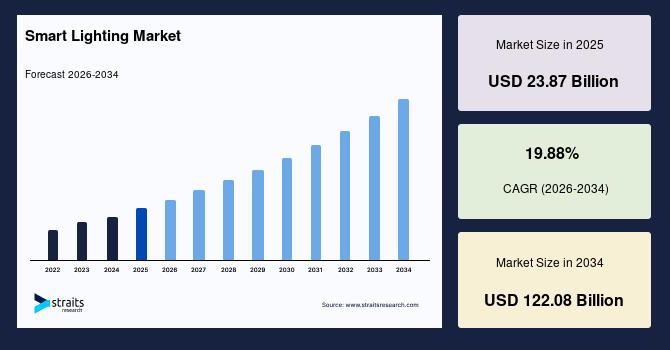
| 2025 Market Valuation | USD 23.87 Billion |
| Estimated 2026 Value | USD 28.62 Billion |
| Projected 2034 Value | USD 122.08 Billion |
| CAGR (2026-2034) | 19.88% |
| Study Period | 2022-2034 |
| Dominant Region | Asia Pacific |
| Fastest Growing Region | Europe |
| Key Market Players | Acuity Brands, Signify Holding, Honeywell International Inc., Itron Inc (Streetlight Vision), Ideal Industries Inc. |
Download Free Sample Report to Get Detailed Insights.
Smart Lighting Market Growth Factor Advancement in Integrated Lighting Control System to Favor Market GrowthThe integrated control system enables users to turn on or off from a single location. The market share of smart lighting is also growing due to the benefit of cost-effectiveness and the growing awareness of the need to save electricity among consumers and government alike. The development of an integrated lighting control system has allowed for an expansion in the market for smart lighting in international markets.
Market Restraint Security Issue with Iot Smart Lightning to Hinder Market GrowthConnected lights are a network of LED fixtures with sensors and cameras, and all data is stored in the cloud to be accessed anywhere. Hackers can exploit internet-connected smart lighting products, which could be disastrous. A hacker can remotely access a wireless network to control bright lighting, door unlocking, security camera systems, etc. Someone hacking a home's smart systems could unlock doors, monitor cameras, and turn them off.
An intruder can also remotely turn off the lights in hospitals and other public venues, causing severe damage. Wireless lighting solutions become less reliable as distance and number of obstacles increase. Each connected luminaire communicates with the nearest connected luminaire to create a mesh nodal network. In such cases, the data transfer rate is not significantly affected; however, when a large number of wireless sensors, data loss increases due to obstacles and interference caused by unlicensed signals can interfere with wireless communication.
Market Opportunity Growing Smart City Projects in Developing Nations to Spur Market OpportunitiesThe global smart lighting market is expected to grow significantly due to the increased penetration of smart lighting devices as a result of ongoing smart city projects. The development of smart cities is attracting significant financial investment from the governments of developing nations. This presents a significant business opportunity for a variety of vendors in the fields of information technology, utility services, and consulting. Smart lighting is coherent with smart city projects because one of the primary goals of smart city development is to make better use of available electricity, and smart lighting is gaining popularity due to its efficiency. It is anticipated that the application of smart lighting will play a significant role in the achievement of sustainability as well as energy savings.
Regional AnalysisThe Asia-Pacific dominates the global smart lighting market due to the increasing demand from the commercial and residential application sectors. China is projected to become the most significant contributor to global revenue and the country with the largest market share worldwide. It is anticipated that countries such as Japan, India, and South Korea will be at the forefront of smart lighting adoption due to their expanding economies and rising investments in smart city projects. The changing lighting scenario heavily influences the demand for smart lighting in Asia-Pacific in commercial sectors.
European Market TrendsEurope is setting the bar for developing performance and safety standards for specific indoor commercial smart lighting for parking lots, roads, and garages. In keeping with the ongoing developments in LED designs and technology, dedicated LED luminaires and LED smart replacement lamps are emerging as important growth areas in the lighting industry. Existing manufacturers diversify their product lines to enter the market. In contrast, established smart lighting manufacturers regularly update their product offers for applications including downlighting, task lighting, landscape lighting, general ambient illumination, and outdoor general area lighting. A growing excess of dedicated smart luminaire vendors can be recognized.
Due to consumers' increasing acceptance of smart lighting and the region's adoption of energy-efficient lighting, North America is predicted to have a significant CAGR during the forecast period. Also, several top businesses, like Honeywell International Inc., have unveiled smart lighting solutions using cutting-edge technology, promoting their use in the area.
Application InsightsThe market is segmented into residential, commercial, industrial, outdoor, and automotive. The indoor segment is expected to hold the largest share of the smart lighting market during the forecast period. This growth is primarily attributable to the increasing emphasis on green building construction and smart lighting installation in the commercial sector, particularly in developing nations.
Component InsightsThe market is divided into fixtures and control. The category of fixtures is anticipated to maintain its dominance during the forecast period. The fixtures are further subdivided into critical products, including compact fluorescent lights (CFL), light-emitting diodes (LED), organic light-emitting diodes (OLED), and high-intensity discharge (HID) lamps, and plasma lamps.
Over the forecast period, the outdoor segment will see the highest CAGR. The outdoor category is further divided into architecture, roads, highways, and others. The lighting for the patio, gardens, external walls and outside areas of the home or commercial space is part of the outdoor architectural application. The necessity to offer energy-efficient lighting and monitor outdoor activity is driving the rising demand for smart lighting in outdoor applications. Specifically, this phenomenon is used in smart street lighting. To collect and exchange information on outdoor activity, the government has invested in installing LED-based smart lighting connected to cameras and sensors.
Technology InsightsThe market is bifurcated into wired technology and wireless technology. The wireless segment dominates the global smart lighting market and is expected to maintain its dominance during the forecast period. In a smart lighting environment, consumers need connections within a small range to prefer wireless connectivity. Wi-Fi, Bluetooth, SmartThings, Z-Wave, or ZigBee wirelessly link light fixtures to smartphone apps that control the light bulb's functions.
In 2022, the wired connectivity market became the largest revenue contributor, and it is anticipated that it will continue to dominate during the forecast period. For the range above 30 feet, wired connections are necessary. Except for Ethernet, which allows for wired connections up to 100 meters away, connectivity is offered by DALI, DSI, and DLVP over distances greater than 1,000 feet. The demand for wired connectivity in the smart lighting industry is driven by the growing usage of smart lighting in commercial and industrial settings.
List of Key and Emerging Players in Smart Lighting Market-
Acuity Brands
Signify Holding
Honeywell International Inc.
Itron Inc (Streetlight Vision)
Ideal Industries Inc.
Häfele GmbH & Co KG
Wipro Consumer Lighting
YEELIGHT
Sengled Optoelectronics Co. Ltd.
Verizon
Schneider Electric SA.
-
In February 2023: The world leader in lighting, Signify (Euronext: LIGHT), provided connected lighting systems, smart poles, and LED street lighting to the industrial parks in Huanggang City, Hubei Province, China. With the help of this massive smart pole project, the province will be able to reduce energy use and emissions while also modernizing the city's infrastructure.
In February 2023: Honeywell Carbon Capture Technology to be Used by ExxonMobil
| Report Metric | Details |
|---|---|
| Market Size in 2025 | USD 23.87 Billion |
| Market Size in 2026 | USD 28.62 Billion |
| Market Size in 2034 | USD 122.08 Billion |
| CAGR | 19.88% (2026-2034) |
| Base Year for Estimation | 2025 |
| Historical Data | 2022-2024 |
| Forecast Period | 2026-2034 |
| Report Coverage | Revenue Forecast, Competitive Landscape, Growth Factors, Environment & Regulatory Landscape and Trends |
| Segments Covered | By Component, By Technology, By Application, By Offering, By Installation Type, By End-Use Application |
| Geographies Covered | North America, Europe, APAC, Middle East and Africa, LATAM |
| Countries Covered | US, Canada, UK, Germany, France, Spain, Italy, Russia, Nordic, Benelux, China, Korea, Japan, India, Australia, Taiwan, South East Asia, UAE, Turkey, Saudi Arabia, South Africa, Egypt, Nigeria, Brazil, Mexico, Argentina, Chile, Colombia |
Download Free Sample Report to Get Detailed Insights.
Smart Lighting Market Segments By Component-
Fixture
Control
-
Wired Technology
Wireless Technology
-
Residential
Commercial
Industrial
Outdoor
Automotive
-
Hardware
-
Lamp
Luminaire
-
New Installations
Retrofit Installations
-
Indoor
-
Residential
Commercial and Industrial
-
Highways and Roadways
Architectural
Others
-
North America
Europe
APAC
Middle East and Africa
LATAM

Legal Disclaimer:
MENAFN provides the
information “as is” without warranty of any kind. We do not accept
any responsibility or liability for the accuracy, content, images,
videos, licenses, completeness, legality, or reliability of the information
contained in this article. If you have any complaints or copyright
issues related to this article, kindly contact the provider above.
Most popular stories
Market Research

More Story







Comments
No comment