




403
Sorry!!
Error! We're sorry, but the page you were looking for doesn't exist.
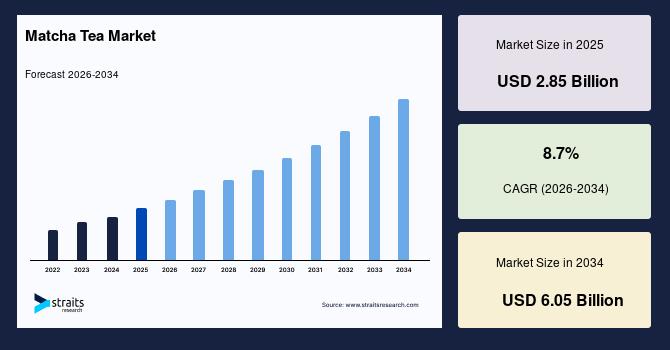
Matcha Tea Market Size, Share, Growth, Analysis, Report, 2034
| Market Metric | Details & Data (2025-2034) |
|---|---|
| 2025 Market Valuation | USD 2.85 Billion |
| Estimated 2026 Value | USD 3.10 Billion |
| Projected 2034 Value | USD 6.05 Billion |
| CAGR (2026-2034) | 8.7% |
| Study Period | 2022-2034 |
| Dominant Region | Asia Pacific |
| Fastest Growing Region | North America |
| Key Market Players | Aoi Tea Company, Encha Life LLC, Grace & Green, Green Foods Corporation, Ikeda Tea World |
Download Free Sample Report to Get Detailed Insights.
Matcha Tea Market Dynamics Market DriversGrowing Influence of Social Media-driven Wellness Aesthetics and Rising Popularity of Japanese Cultural and Tea Ritual Experiences Drives Market
Social media platforms such as TikTok and Instagram are significantly increasing the matcha tea market demand through viral wellness trends, aesthetically curated café content, and influencer-led morning routine videos. Younger consumers increasingly associate matcha with healthy living, mental focus, fitness culture, and premium lifestyle habits, encouraging frequent purchases across cafés, ready-to-drink beverages, and at-home preparation kits. The growing visibility of colorful iced matcha lattes, ceremonial whisking videos, and productivity-focused wellness content is also expanding demand among first-time tea consumers and non-traditional tea-drinking demographics.
Growing consumer fascination with Japanese culinary traditions, mindfulness practices, and authentic tea rituals is a key matcha tea market driver, shown in the stronger global demand for premium matcha products and café experiences. Consumers increasingly seek ceremonial-grade matcha prepared using traditional bamboo whisks, handcrafted bowls, and Japanese preparation techniques that emphasize authenticity and relaxation. Specialty tea houses and premium cafés are capitalizing on this trend by offering immersive cultural experiences, origin-focused storytelling, and educational tasting sessions, which are encouraging higher spending on artisanal and imported matcha varieties.
Market RestraintsHigh Product Cost Compared to Conventional Tea & Coffee and Risk of Adulteration Restrain Market
Premium matcha products command higher prices due to specialized shade-growing methods, selective harvesting, and labor-intensive stone-grinding processes used during production. Imported ceremonial-grade matcha from Japan also involves elevated packaging, transportation, and quality certification costs. These premium price points limit mass-market adoption, especially in price-sensitive economies where consumers often prefer lower-cost tea, coffee, or energy drink alternatives. As a result, matcha consumption remains concentrated among urban, wellness-focused, and higher-income consumer groups.
Rapid growth in global demand has increased the presence of low-grade matcha blends and artificially colored powders marketed as authentic premium products. Many consumers remain unfamiliar with grading systems, making it difficult to differentiate ceremonial-grade matcha from culinary or blended variants. Poor-quality products often deliver inferior taste, dull color, and reduced nutritional value, negatively impacting consumer satisfaction and repeat purchases. Inconsistent quality standards across online and international retail channels also create challenges for brand credibility and long-term customer trust.
Market OpportunitiesRapid Growth of RTD Matcha Beverages and Private-Label Expansion Offer Growth Opportunities
The rapid growth of ready-to-drink (RTD) matcha beverages is creating strong opportunities for beverage manufacturers, café chains, convenience retailers, and functional drink startups to expand premium wellness-focused product portfolios. Companies can capitalize on rising demand for portable, low-sugar, and plant-based energy drinks by introducing canned matcha lattes, sparkling matcha beverages, protein-infused formulations, and dairy-free RTD options. The trend is particularly attractive for brands targeting Gen Z professionals, fitness consumers, and urban commuters seeking healthier alternatives to carbonated soft drinks and traditional caffeine beverages. Foodservice operators and convenience stores can also benefit by expanding grab-and-go functional beverage offerings in high-traffic urban markets.
A significant matcha tea market opportunity stems from private-label expansion for supermarkets, specialty retailers, and e-commerce platforms increasingly launch their own branded matcha products. This strategy allows retailers to offer competitive pricing while capturing higher margins compared to third-party brands. Rising consumer trust in retailer-owned labels is further accelerating adoption, especially in premium wellness and organic tea segments. Additionally, private labels enable faster product customization and regional flavor innovation, helping retailers respond quickly to evolving health and lifestyle trends.
Regional Insights Asia Pacific: Market Dominance by Strong Cultural Revival and Rising Gen Z Demand for Aesthetic, Health-Oriented BeveragesThe Asia Pacific matcha tea market accounted for a share of 54.36% in 2025 due to its strong cultural integration of tea consumption, well-established production ecosystem, and deep-rooted expertise in traditional Japanese tea cultivation. Japan, particularly regions like Uji and Nishio, remains the global center for high-quality tencha farming and stone-ground matcha processing, supported by centuries-old agricultural practices and strict quality standards. The region benefits from highly developed supply chains, strong domestic demand for ceremonial tea culture, and continuous innovation in matcha-based food and beverage applications. Growing café culture in Japan, South Korea, and China, along with rising export-oriented production and government support for tea agriculture modernization, further strengthens Asia Pacific's leadership position in the global market.
The matcha tea market growth in Japan is being reshaped by a cultural revival where traditional tea ceremony practices increasingly blend with modern café culture and global food innovation. Key regions like Uji and Shizuoka are shifting from sencha to tencha cultivation to meet rising global demand for premium matcha. Tea masters are adapting ceremonial experiences for international audiences through immersive tastings and tea tourism. Meanwhile, producers are expanding processing capacity while preserving stone-ground artisanal methods to maintain quality.
The India matcha tea market is growing rapidly, driven by urban cafés, specialty tea chains, and wellness-focused consumers adopting Japanese-inspired beverages. Strong demand is emerging in metros like Mumbai, Bengaluru, Delhi, and Chennai, where matcha lattes, iced drinks, and desserts are increasingly popular. Café operators are expanding offerings due to Gen Z preference for aesthetic, health-oriented alternatives to coffee. This trend is further supported by wider Asian beverage adoption across cafés, bubble tea outlets, and D2C wellness brands.
North America: Fastest Growth Driven by Rising Functional Beverage Consumption and Strong Influence of Multicultural Food TrendsThe North America matcha tea market is expected to register the fastest growth with a CAGR of 10.42% during the forecast period due to rapid mainstream adoption of functional beverages and strong café culture penetration across the United States and Canada. Consumers are increasingly shifting toward low-sugar, antioxidant-rich alternatives to coffee, driving high demand for matcha lattes, ready-to-drink beverages, and plant-based formulations. Expansion of specialty coffee chains and third-wave cafés has normalized matcha as a daily wellness drink. Strong influence of social media wellness trends, fitness-oriented lifestyles, and growing vegan and clean-label consumption habits are further accelerating uptake. Retail innovation through private-label RTD matcha drinks in supermarkets and convenience stores is also expanding accessibility across urban and suburban markets.
The US matcha tea market is expanding due to strong café culture penetration, rising functional beverage consumption, and demand for low-sugar, antioxidant-rich coffee alternatives. Matcha is widely adopted across Starbucks, specialty cafés, and retail channels, driven by Gen Z and millennial wellness and social-media beverage trends. A 2026 Starbucks update reports US tea revenue rising over 70%, with matcha becoming a multimillion-dollar category in company-operated stores. Growth is further supported by RTD matcha expansion and increasing e-commerce penetration of health-focused beverage brands.
The matcha tea market in Canada is growing steadily due to café culture expansion, wellness-driven consumption, and rising demand for Japanese-inspired beverages in cities like Toronto, Vancouver, and Montreal. Matcha is increasingly included in specialty cafés, bakeries, and health-focused menus as consumers shift toward plant-based, low-caffeine functional drinks. This growth is further supported by multicultural influences, seasonal menu innovation, and strong demand for mindful, aesthetically driven beverage experiences.
Matcha Tea Market Segmentation Analysis By Product FormBy product type, the powdered segment is expected to grow at a CAGR of 7.63% due to its strong traditional consumption base and versatility across applications. It is widely used in households, cafés, and food manufacturing for its easy blending, shelf stability, and consistent flavor and color. Powdered matcha also forms the base for lattes, bakery products, desserts, and functional beverages, making it highly adaptable across industries.
The ready-to-drink segment is expected to grow at a CAGR of 10.87% during the forecast period, driven by rising demand for convenient, on-the-go functional beverages. Urban consumers increasingly prefer bottled and canned matcha drinks, especially for fitness, café, and workplace consumption occasions. Growth is further supported by innovation in flavors, dairy alternatives, and packaging, making RTD matcha highly appealing to younger, health-conscious consumers.
By FlavorBased on flavor, the unflavored segment is expected to grow at a CAGR of 7.42% due to its position as the purest and most traditional form of matcha. It is widely used in ceremonial practices, premium tea preparation, and culinary applications where natural taste, aroma, and color are essential. Its clean-label appeal and versatility also make it a preferred base for cafés and food manufacturers for customized beverage and recipe development.
The flavored segment is projected to grow at a CAGR of 11.18% during the forecast period, driven by increasing experimentation in cafés, beverage chains, and retail offerings. Consumers are increasingly drawn to fusion beverages combining matcha with flavors like vanilla, chocolate, fruit extracts, and plant-based milk alternatives. This segment is especially popular among younger consumers seeking milder, more approachable taste profiles compared to traditional matcha bitterness.
By ApplicationIn 2025, beverages accounted for a share of 66.83% in the matcha tea market, by application. This is due to widespread use in traditional tea preparation, cafe drinks, and modern functional beverages. Matcha lattes, iced drinks, smoothies, and tea-based beverages represent the largest consumption categories globally. Its natural caffeine content, antioxidant profile, and vibrant color make it highly suitable for both hot and cold beverage formulations. Cafes and food service chains play a major role in driving this dominance by continuously expanding matcha-based menu offerings.
The nutraceuticals segment is expected to grow at a CAGR of 12.38% during the forecast period due to increasing consumer interest in wellness, immunity, and functional nutrition products. Matcha is widely incorporated into dietary supplements, protein blends, detox formulations, and energy-boosting products. Its natural antioxidant and metabolism-supporting properties make it highly attractive for health-focused consumers.
By Distribution ChannelBy distribution channel, supermarkets & hypermarkets accounted for the largest share of 41.87% in 2025 due to their wide product accessibility, strong consumer reach, and established retail infrastructure. These outlets provide a broad range of matcha products, including powdered forms, RTD beverages, and flavored mixes, catering to both premium and mass-market consumers. Strong shelf visibility, promotional activities, and trust in organized retail formats further reinforce consumer preference for this channel.
The online stores segment is expected to grow at a CAGR of 12.09% due to rising digital adoption, convenience-driven purchasing, and expanding e-commerce penetration. Consumers increasingly prefer online platforms for wider variety, competitive pricing, and access to global specialty tea brands. Growth is further supported by social media influence, subscription models, and direct-to-consumer offerings that enhance access to premium matcha products.
Competitive LandscapeThe matcha tea market landscape is moderately fragmented, characterized by a mix of established Japanese tea producers, specialty tea brands, global beverage companies, café chains, and emerging wellness-focused startups. Traditional Japanese players and long-established tea houses maintain strong control over high-quality ceremonial and culinary-grade supply through expertise in cultivation, shading techniques, and stone-grinding processes. Established global beverage companies and café chains compete through large-scale distribution, branding strength, product standardization, and extensive retail and foodservice networks. Emerging players primarily focus on innovation-led positioning, introducing flavored variants, ready-to-drink formats, and functional blends targeting health-conscious and younger consumers. The matcha tea market competition is driven by product authenticity, sourcing transparency, pricing strategy, packaging innovation, and expansion of ready-to-consume formats across retail and foodservice ecosystems.
List of Key and Emerging Players in Matcha Tea Market-
Aoi Tea Company
Encha Life LLC
Grace & Green
Green Foods Corporation
Ikeda Tea World
Ito En, Ltd.
Marukyu Koyamaen Co., Ltd.
Tata Consumer Products Limited
The Hain Celestial Group, Inc.
Unilever Plc.
TheOther
La Colomba UK
Bree
Jade Leaf Matcha
Starbucks Corporation
In December 2025, TheOther (US) launched ceremonial-grade matcha.
In October 2025, La Colomba UK entered a joint venture with Green Soul to streamline matcha supply in Europe, providing retailers and hospitality operators direct access to traceable matcha amid rising global supply shortages.
In June 2025, Bree launched a matcha brand in association with nutraceutical and herbal contract manufacturing company Essenzaa Nutrition.
Report Scope| Report Metric | Details |
|---|---|
| Market Size in 2025 | USD 2.85 Billion |
| Market Size in 2026 | USD 3.10 Billion |
| Market Size in 2034 | USD 6.05 Billion |
| CAGR | 8.7% (2026-2034) |
| Base Year for Estimation | 2025 |
| Historical Data | 2022-2024 |
| Forecast Period | 2026-2034 |
| Report Coverage | Revenue Forecast, Competitive Landscape, Growth Factors, Environment & Regulatory Landscape and Trends |
| Segments Covered | By Product Form, By Flavor, By Application, By Distribution Channel |
| Geographies Covered | North America, Europe, APAC, Middle East and Africa, LATAM |
| Countries Covered | US, Canada, UK, Germany, France, Spain, Italy, Russia, Nordic, Benelux, China, Korea, Japan, India, Australia, Taiwan, South East Asia, UAE, Turkey, Saudi Arabia, South Africa, Egypt, Nigeria, Brazil, Mexico, Argentina, Chile, Colombia |
Download Free Sample Report to Get Detailed Insights.
Matcha Tea Market Segments By Product Form-
Powdered
Ready-to-Drink (RTD)
-
Unflavored
Flavored
-
Beverages
Food & Bakery
Nutraceuticals
Personal Care & Cosmetics
-
Supermarket & Hypermarket
Specialty Stores
Foodservice
Online Store
Others
-
North America
Europe
APAC
Middle East and Africa
LATAM

Legal Disclaimer:
MENAFN provides the
information “as is” without warranty of any kind. We do not accept
any responsibility or liability for the accuracy, content, images,
videos, licenses, completeness, legality, or reliability of the information
contained in this article. If you have any complaints or copyright
issues related to this article, kindly contact the provider above.
Most popular stories
Market Research

More Story








Comments
No comment