




403
Sorry!!
Error! We're sorry, but the page you were looking for doesn't exist.
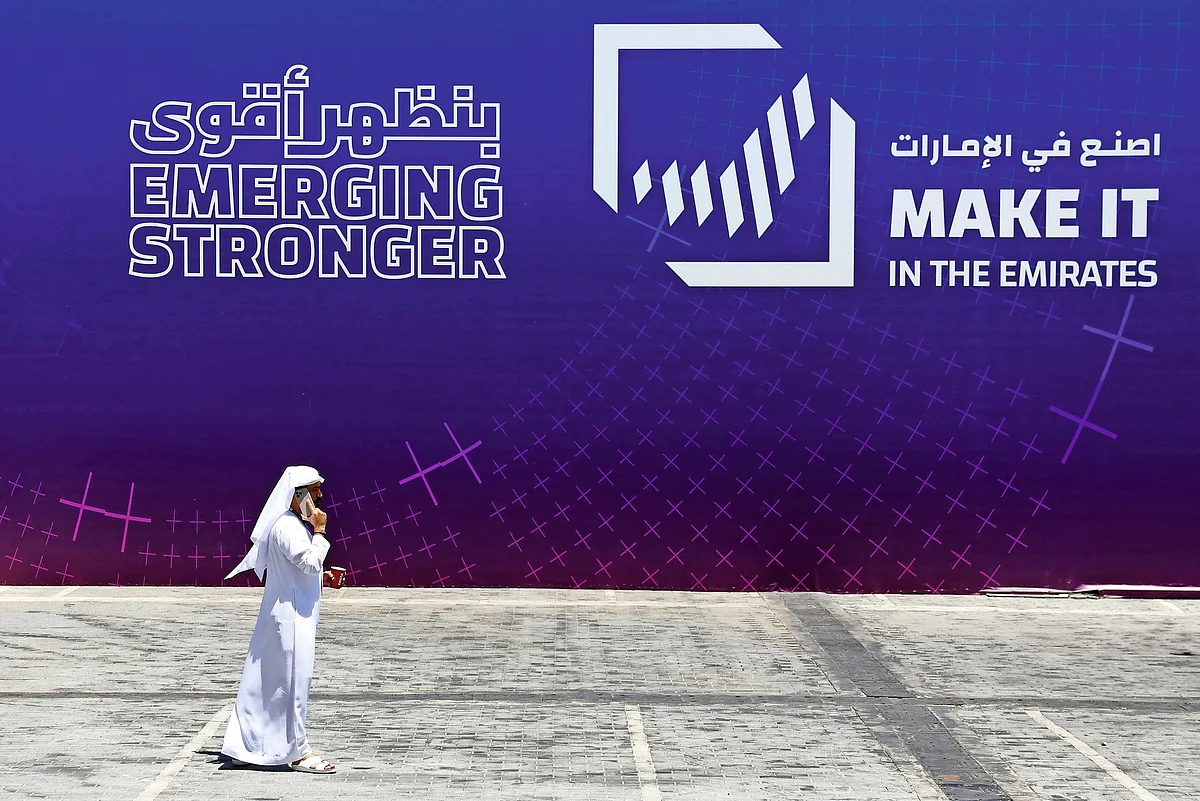
UAE Industrial Strategy Secures Dh171b Deals At Make It In The Emirates 2026
(MENAFN- Khaleej Times) At the ADNEC Centre Abu Dhabi from May 4-7, Make it in the Emirates 2026 reflected the growing confidence behind the UAE's industrial ambitions. More than 1,200 exhibitors occupied 88,000 square metres of exhibition space, bringing together advanced manufacturing systems, artificial intelligence applications, defence technologies, electric mobility solutions, pharmaceuticals, sustainable materials and smart industrial infrastructure under one roof.
Beyond the scale of the exhibition and the volume of government announcements, the event revealed how significantly the UAE's industrial narrative has evolved over recent years. The country is no longer positioning industrialisation as a distant economic objective; instead, it is framing advanced industry as a central pillar of economic resilience, competitiveness and long-term national identity.
Recommended For YouThe fifth edition of Make it in the Emirates arrived at a time when economies worldwide are facing supply chain instability, geopolitical uncertainty and growing pressure to localise production. Across many regions, industrial policy has returned to the centre of economic planning, but the UAE's approach has been notably distinct.
Rather than treating manufacturing as a standalone economic exercise, the Emirates has spent recent years building an ecosystem where industrial growth intersects with technology, logistics, finance and long-term national strategy. What has emerged is a broader industrial framework that now extends far beyond factories and industrial zones.
Industrial growth as national strategy
This year's event opened under the theme 'Advanced Industry. Emerging Stronger', a phrase that reflected the wider message repeated throughout the four-day forum.
Policymakers and industry leaders consistently emphasised that industrial resilience has become essential for economies seeking long-term stability in an increasingly volatile global environment. Since the launch of Operation 300bn in 2021, the UAE's industrial GDP has risen sharply, while industrial exports have climbed to Dh262 billion, including Dh92 billion in advanced industrial exports.
At Make it in the Emirates, those ambitions translated into investment announcements, procurement agreements and industrial expansion plans tied directly to the country's diversification agenda.
Over the course of the event, the UAE announced Dh171 billion in industrial agreements, including Dh48.5 billion in investments and Dh19.2 billion in financing initiatives. More than 200 agreements were signed across sectors including chemicals, healthcare, logistics, clean energy, food production and advanced manufacturing.
Localisation has also become one of the UAE's defining industrial priorities. Plans announced during the summit aim to localise more than 5,000 products over the coming years while expanding procurement opportunities from Dh168 billion to Dh180 billion over the next decade.
The shift reflects lessons learned during recent years. The pandemic exposed vulnerabilities in global logistics systems, while geopolitical tensions and regional instability reinforced why countries are prioritising self-sufficiency in strategic industries.
For the UAE, industrialisation is increasingly being treated as a strategic component of economic sovereignty.
Dr Sultan Al Jaber, Minister of Industry and Advanced Technology, framed the country's industrial ambitions around resilience and long-term competitiveness, arguing that economies capable of manufacturing locally are better positioned to navigate global disruption.
“Those who manufacture, own their decisions. Those who build, own their future. And those who combine both... secure their sovereignty and resilienc,” Al Jaber said while outlining the country's push towards industrial self-sufficiency and advanced manufacturing capabilities.
Rather than pursuing diversification purely as a way of reducing dependence on hydrocarbons, the UAE is attempting to build an economy capable of absorbing external shocks while remaining globally competitive across strategic industries.
One of the clearest examples of this shift was the newly introduced Intelligence Hub, which resembled a live operational environment built around the future of manufacturing rather than a conventional trade exhibition.
Artificial intelligence systems monitored industrial operations, while robotics, drone technologies, industrial cybersecurity systems and electric mobility solutions were integrated into live demonstrations.
Unlike many technology showcases focused on futuristic concepts disconnected from reality, the technologies displayed here were tied directly to procurement, supply chains and manufacturing applications.
Strategic Message
The positioning of the hub reflected a deliberate strategic message from policymakers and industry leaders. The UAE is increasingly positioning itself not simply as a consumer market for emerging industrial technologies, but as a regional testing ground, manufacturing base and deployment hub for advanced industrial systems.
The shift is especially visible across energy transition technologies, aerospace, pharmaceuticals and AI-enabled manufacturing.
The UAE's ability to connect industrial development with logistics infrastructure also gives it a competitive advantage many countries struggle to replicate. Ports, free zones, aviation connectivity and digital infrastructure have already positioned the country as a regional trade gateway, helping attract large-scale industrial partnerships.
At the summit, Abu Dhabi's Ta'ziz signed agreements worth billions to expand its industrial chemicals ecosystem. Mubadala announced new investments, while Emirates Global Aluminium expanded industrial partnerships and defence conglomerate Edge signed high-technology manufacturing contracts.
Healthcare company M42 also partnered with Global Medical Supply Chain to strengthen healthcare procurement and logistics systems, while Adnoc Distribution introduced AI-powered retail checkout systems.
Emirates Gold participated in Make it in the Emirates 2026 as a Platinum Group partner at ADNEC Centre Abu Dhabi, highlighting its contribution to the UAE's growing precious metals sector. The company attracted strong visitor interest with its Gold ATM, which enables instant purchases of certified gold and silver bars and coins, alongside a live laser engraving machine showcasing customised minting capabilities. CEO Abhijit Shah said the UAE's emergence as a global gold hub reflects decades of investment in refining infrastructure, regulatory standards and institutional credibility, reinforcing the country's position within the international precious metals trade.
Taken together, the agreements and technology showcases highlighted the breadth of the country's industrial transformation agenda. Industrialisation in the UAE is no longer confined to traditional heavy industries such as steel, cement and construction materials; it now extends across artificial intelligence, biotechnology, healthcare systems, robotics, clean energy infrastructure and digitally enabled manufacturing.
Rise of the SME industrial economy
One of the most significant developments at this year's Make it in the Emirates was the growing visibility of small and medium-sized enterprises.
SMEs, start-ups and entrepreneurs accounted for 61% of exhibitors at the event, reflecting the UAE's attempt to broaden industrial participation beyond large state-backed entities and multinational corporations.
The Industry NextGen Hub reflected this effort directly, connecting smaller businesses with procurement opportunities, investors and financing programmes. The shift suggests the UAE increasingly sees industrial development not only as a macroeconomic project but also as a mechanism for long-term private-sector expansion.
A business built with the city
When Shabbir Merchant arrived in Dubai in 1976 at the age of 17, the emirate was still in the early stages of its economic transformation.
He came to join his elder brother and eventually built Champion, a company that began with handcrafted neon signs before evolving into a multi-division business covering signage, exhibitions, digital technologies and interactive solutions.
“It takes years to find a customer and seconds to lose one,” was the principle that shaped the company's approach to business for decades.
That philosophy feels especially relevant in the UAE's current industrial phase. The country's industrial strategy is not being built solely through government policy or sovereign capital; it is also being sustained through generations of entrepreneurs who built businesses during earlier phases of the UAE's economic growth and continued adapting alongside it.
Stories such as Merchant's also help explain why many long-term business owners increasingly view the UAE not merely as a commercial destination, but as a permanent home.
“I am very thankful and grateful for the blessings this country has given me,” Merchant said while reflecting on the life he built in the Emirates.
Industry as part of the national identity
One of the most symbolic additions to Make it in the Emirates this year was the House of Industry, described as the UAE's first immersive industrial heritage exhibition.
The exhibition traced the country's journey from early trade networks to advanced manufacturing through interactive displays and historical timelines.
At first glance, the inclusion of a heritage-focused exhibition within a modern industrial forum appeared unconventional. However, it revealed an important shift in how the UAE increasingly frames industrialisation within its broader national narrative.
In earlier decades, much of the Gulf's global narrative revolved around hydrocarbons and infrastructure. Today, the UAE increasingly presents itself as a country capable of designing, manufacturing, innovating and exporting.
In an increasingly fragmented global economy, countries are competing not only for investment but also for technological relevance, talent attraction and supply chain positioning.
The UAE's industrial strategy therefore serves several purposes simultaneously. It strengthens resilience, expands non-oil GDP contribution, supports food and healthcare security and attracts global industrial partnerships.
ALSO READ- 'Time is now': UAE ramps up self-reliance, industry growth at Make it in the Emirates forum RAK emerges as UAE's industrial powerhouse, driving exports and growth UAE manufacturers ramp up production, fill import gaps during global shocks

Legal Disclaimer:
MENAFN provides the
information “as is” without warranty of any kind. We do not accept
any responsibility or liability for the accuracy, content, images,
videos, licenses, completeness, legality, or reliability of the information
contained in this article. If you have any complaints or copyright
issues related to this article, kindly contact the provider above.
Most popular stories
Market Research

More Story





Comments
No comment