




403
Sorry!!
Error! We're sorry, but the page you were looking for doesn't exist.
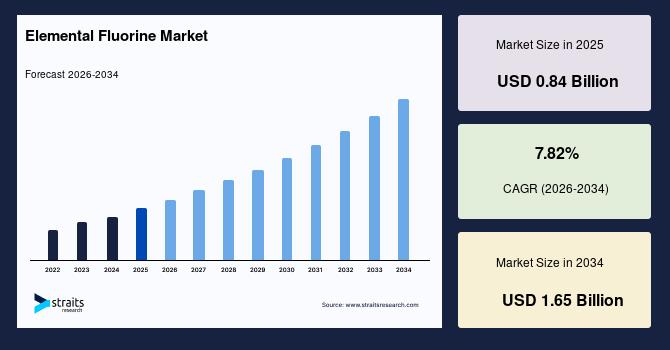
Elemental Fluorine Market Size, Share, Growth, Analysis, 2034
| Market Metric | Details & Data (2025-2034) |
|---|---|
| 2025 Market Valuation | USD 0.84 Billion |
| Estimated 2026 Value | USD 0.91 Billion |
| Projected 2034 Value | USD 1.65 Billion |
| CAGR (2026-2034) | 7.82% |
| Study Period | 2022-2034 |
| Dominant Region | Asia-Pacific |
| Fastest Growing Region | North America |
| Key Market Players | Solvay S.A., Kanto Denka Kogyo Co., Linde AG, Air Products and Chemicals Inc., Navin Fluorine International Limited |
Download Free Sample Report to Get Detailed Insights.
Elemental Fluorine Market Growth Drivers Rising Demand from the Pharmaceutical IndustryThe pharmaceutical industry utilizes elemental fluorine and its compounds, specifically synthesizing fluorinated organic molecules. The growing market is driven by the importance of elemental fluorine in manufacturing fluorinated drugs. Moreover, elemental fluorine's ability to improve medication stability, bioavailability, and therapeutic effectiveness through fluorine substitution is a key factor driving their demand.
Furthermore, the rising occurrence of chronic illnesses globally and the need for advanced pharmaceutical products are propelling the utilization of elemental fluorine in drug production procedures. For instance, chronic diseases result in the deaths of 41 million individuals annually, which accounts for around 74% of all global deaths. Moreover, there has been a growth in healthcare expenditure globally to advance the existing infrastructure, which is anticipated to drive the pharmaceutical industry. Therefore, the rapid expansion of the pharmaceutical industry is anticipated to drive the global elemental fluorine market.
Growing Utilization of Fluorine-Based RefrigerantsThe utilization of fluorine-based refrigerants has been a crucial catalyst for the substantial expansion of the global elemental fluorine market. Hydrofluorocarbons (HFCs), refrigerants based on fluorine, are extensively employed in the refrigeration and air conditioning industries. These substances are renowned for their exceptional cooling capabilities and have been employed as a substitute for chlorofluorocarbon (CFCs), which are eliminated because of their detrimental effects on the ozone layer.
Based on data provided by the US Environmental Protection Agency (EPA), there is a projected substantial increase in the worldwide usage of HFCs in the foreseeable future. According to the EPA, HFC consumption in developing nations is projected to grow 9% annually. In comparison, consumption in industrialized countries is expected to grow at 2% annually. The information above indicates that the expanding use of fluorine-based refrigerants is anticipated to drive growth in the global elemental fluorine market.
Market Restraint Availability of Safer AlternativeElemental fluorine exhibits a high reactivity level and can potentially engage in explosive reactions with numerous compounds. In addition, certain industries may opt for other sources of fluorine or fluorine-containing chemicals that are more manageable or less reactive and have a lesser negative impact on the environment.
In November 2018, a comprehensive EU life cycle assessment research conducted over three years determined that fluorinated formulations used in durable water and oil textile repellents (DWOR) have an environmental impact of "10 - 40 times greater" than those of fluorine-free alternatives. The demand for elemental fluorine could be affected by introducing fluorine substitutes or alternative technologies that offer cheaper costs or improved safety characteristics. This is anticipated to impede market growth.
Market Opportunity Growing Research and DevelopmentThere has been a surge in R&D pertaining to increasing the safety of elemental fluorine. The production of chemicals containing elemental fluorine can now be accomplished using a safer and more energy-efficient technique, as opposed to the traditional methods employed for millennia. All fluorochemicals are produced using the poisonous and corrosive gas hydrogen fluoride (HF) in a method that requires a significant amount of energy.
In July 2023, to create a more secure method, a group of chemists at the University of Oxford, in collaboration with researchers from FluoRok, a spin-off company from Oxford, University College London, and Colorado State University, drew inspiration from the inherent biomineralization mechanism responsible for the formation of teeth and bones. Hydrofluoric acid (HF) is typically generated by reacting a crystalline mineral known as fluorspar (CaF2) with sulfuric acid under severe circumstances. This acid is then utilized in the production of fluorochemicals. The novel approach involves directly synthesizing fluorochemicals from CaF2, eliminating the need to create HF. This breakthrough has been a long-standing goal of chemists for many years. Such research initiatives are anticipated to create opportunities for market expansion.
Regional Analysis Asia-Pacific Dominates the Global MarketBased on region, the global elemental fluorine market is bifurcated into North America, Europe, Asia-Pacific, Latin America, and the Middle East and Africa is the most significant global elemental fluorine market shareholder and is expected to expand substantially during the forecast period. The region plays a vital role in the elemental fluorine market, demonstrating strong growth due to various factors. There is now a significant increase in the demand for elemental fluorine in the region, mostly due to its essential role in important industries and applications. In addition, the Asia-Pacific region, specifically China, Japan, and South Korea, has emerged as a prominent center for electronics production worldwide. The need for elemental fluorine is increasing due to the rising manufacturing of consumer electronics, smartphones, and semiconductor devices. China, the foremost global electronics producer, extensively depends on fluorine compounds in manufacturing semiconductors, making a substantial contribution to the regional market's growth. For instance, the overall profit of electronics manufacturing businesses in China increased by 13 percent in 2022 compared to the previous year, reaching 73.9 billion yuan. This development rate represents the greatest point from 2012-2022.
Moreover, the pharmaceutical sector in the Asia-Pacific region is seeing significant expansion, propelled by factors such as population growth, heightened healthcare awareness, and the escalating prevalence of chronic diseases. Cancer, diabetes, and CVDs are the most common chronic illnesses in this region, and there has been a high growth of these diseases in the region. For instance, in 2020, the WHO South-East Asia Region recorded approximately 2.2 million new cases of cancer and 1.4 million fatalities attributable to cancer. These deaths constituted more than 10% of all deaths in the region. Elemental fluorine is essential in producing fluorinated pharmaceuticals, which is a significant aspect driving the market growth in the region.
North America is expected to grow significantly due to the growing demand for elemental fluorine from the end-user industries. The healthcare and pharmaceutical industry in the United States is highly advanced compared to other regions worldwide. The nation represents approximately 45% of the worldwide pharmaceutical market and 22% of global output. Pharmaceutical sales and output in the United States continue to be strong due to continuous vaccinations and increasing demand for essential and non-essential medical treatments. Similarly, the Centers for Medicare & Medicaid Services reported that healthcare spending in the United States increased by 9.7% in 2020, reaching a total of USD 4.1 trillion. Healthcare expenditure constituted approximately 19.7% of the nation's Gross Domestic Product (GDP). Thus, the growth of the pharmaceutical industry in the region subsequently fosters the North American elemental fluorine market.
Furthermore, the key participants in the region are taking several initiatives to increase their market share. For instance, in September 2020, Solvay announced that the distribution of Tecnoflon® fluoroelastomers (FKM) and perfluoroelastomers (PFR FFKM) in North America will henceforth be handled by Vanderbilt Chemicals, LLC. As a seasoned distributor, Vanderbilt Chemicals expands Solvay's customer reach by providing more avenues for clients to access expert guidance and technical advice on fluorine-based elastomeric materials. Moreover, Vanderbilt is well-equipped to guarantee prompt order processing using its extensive distribution hub network. Such initiatives to expand fluorine-based product share are estimated to stimulate regional market growth.
Segmental Analysis Based on TypeThe global elemental fluorine market is divided into α- fluorine and β- fluorine solidifies into beta-fluorine, a cubic structure, at -220 °C (363 °F). The molecules in this phase are highly disorganized and transparent, with a 1.70 g/cm3 density. Alpha-fluorine is formed when fluorine endures a solid-solid phase transition at -228 °C (378 °F) into a monoclinic structure. This phase is harder and more opaque, composed of densely packed layers of molecules, and has a 1.97 g/cm3 density. In addition to requiring more energy than the transition to the solid state, the solid-state phase change can be extremely violent, shattering samples and shooting out sample holder windows. Considerable research was devoted to solid fluorine during the 1920s and 1930s but to a lesser extent until the 1960s. The crystal structure of alpha-fluorine, whose details remain uncertain, was first described in a 1970 paper by Linus Pauling.
Based on ApplicationThe global elemental fluorine market is segmented into metallurgy, glass and ceramics manufacturing, sulfur hexafluoride and halogen fluoride, electronics and semiconductors, polymer manufacturing and processing, nuclear fuel, and others.
The increasing utilization of elemental fluorine in the production of uranium hexafluoride, which is subsequently employed as fuel in constructing nuclear reactors, is projected to propel the global elemental fluorine market during the forecast period. As per the World Nuclear Association (WNA), the global nuclear capacity is projected to expand further to meet the surging demand for nuclear fuel in the coming years. Moreover, the demand for uranium is projected to substantially increase by the conclusion of 2030, with an optimistic CAGR of 4.2%. In 2013, the global capacity for uranium hexafluoride was around 334 GWe. However, it is projected to increase to 700 GWe by 2030 to satisfy global demand. This increasing demand is anticipated to drive the growth of the nuclear fuel segment.
List of Key and Emerging Players in Elemental Fluorine Market-
Solvay S.A.
Kanto Denka Kogyo Co.
Linde AG
Air Products and Chemicals Inc.
Navin Fluorine International Limited
Pelchem SOC Ltd.
ADVANCE RESEARCH CHEMICALS. INC.
-
May 2023 - SynCrest Inc., a collaborative enterprise specializing in the CRDMO of peptides and nucleotides, formed by Otsuka Chemical Co., Ltd., and Yokogawa Electric Corporation, announced the expansion of its services to pharmaceutical firms and research institutes in Japan, Europe, North America, and South America. SynCrest also conducts active research on fluorine compounds and can incorporate fluorine into peptide and nucleotide compounds.
July 2023 - The KEZAD Group entered into a contractual agreement with its client, Global Fluorine Chemical Factory LLC (GFCF), to develop phase two of the KEZAD Mussafah facility. According to reports, this partnership will enable GFCF to increase its production capacity threefold.
| Report Metric | Details |
|---|---|
| Market Size in 2025 | USD 0.84 Billion |
| Market Size in 2026 | USD 0.91 Billion |
| Market Size in 2034 | USD 1.65 Billion |
| CAGR | 7.82% (2026-2034) |
| Base Year for Estimation | 2025 |
| Historical Data | 2022-2024 |
| Forecast Period | 2026-2034 |
| Report Coverage | Revenue Forecast, Competitive Landscape, Growth Factors, Environment & Regulatory Landscape and Trends |
| Segments Covered | By Type, By Applications |
| Geographies Covered | North America, Europe, APAC, Middle East and Africa, LATAM |
| Countries Covered | US, Canada, UK, Germany, France, Spain, Italy, Russia, Nordic, Benelux, China, Korea, Japan, India, Australia, Singapore, Taiwan, South East Asia, UAE, Turkey, Saudi Arabia, South Africa, Egypt, Nigeria, Brazil, Mexico, Argentina, Chile, Colombia |
Download Free Sample Report to Get Detailed Insights.
Elemental Fluorine Market Segments By Type-
α- Fluorine
β- Fluorine
-
Metallurgy
Glass and Ceramics Manufacturing
Sulphur Hexafluoride and Halogen Fluoride
Electronics and Semiconductor
Polymer Manufacturing and Processing
Nuclear Fuel
Others
-
North America
Europe
APAC
Middle East and Africa
LATAM

Legal Disclaimer:
MENAFN provides the
information “as is” without warranty of any kind. We do not accept
any responsibility or liability for the accuracy, content, images,
videos, licenses, completeness, legality, or reliability of the information
contained in this article. If you have any complaints or copyright
issues related to this article, kindly contact the provider above.
Most popular stories
Market Research

More Story








Comments
No comment