




403
Sorry!!
Error! We're sorry, but the page you were looking for doesn't exist.
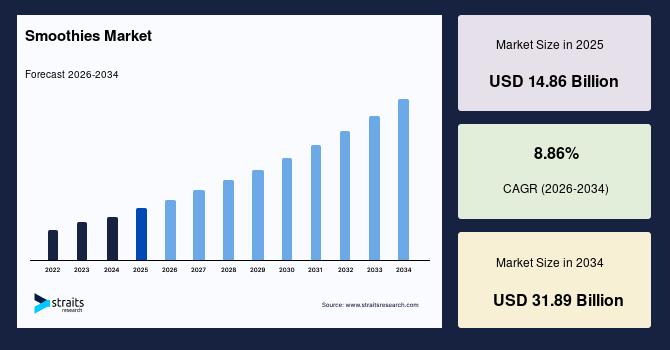
Smoothies Market Size, Share, Growth, Analysis, Report, 2034
| Market Metric | Details & Data (2025-2034) |
|---|---|
| 2025 Market Valuation | USD 14.86 Billion |
| Estimated 2026 Value | USD 16.18 Billion |
| Projected 2034 Value | USD 31.89 Billion |
| CAGR (2026-2034) | 8.86% |
| Study Period | 2022-2034 |
| Dominant Region | North America |
| Fastest Growing Region | Asia-Pacific |
| Key Market Players | Smoothie King Franchises Inc., Barfresh Food Group Inc., J Sainsbury Plc, PepsiCo Inc., The Coca-Cola Co |
Download Free Sample Report to Get Detailed Insights.
Market Dynamics Global Smoothies Market Drivers Health and Wellness TrendThe global emphasis on health and well-being is a significant driving force in the smoothies market. Consumers are becoming more conscious of their food choices and are looking for healthful options. Smoothies, commonly created with fresh fruits and vegetables and other healthy components, are a nutritious and convenient way to get key nutrients into one's diet. Consumer polls show a high desire for healthier food and beverage options. According to a Nielsen survey, 48% of respondents actively seek out food and beverage products with health-related qualities. This includes things considered nutritional, such as smoothies made from whole foods.
Furthermore, McKinsey & Company reports that consumers spend more on wellness than ever. Wellness is now a USD 1.5 trillion worldwide sector, rising 5 to 10% annually. The usage of functional ingredients in smoothies, such as those known for their health advantages, has increased in the market. For example, adding turmeric for anti-inflammatory qualities or probiotic for digestive health has become a widespread practice. This trend will continue altering the industry as customers prioritize well-being and nutrition in their food and beverage choices.
Global Smoothies Market Restraints Competition from Homemade SmoothiesThe popularity of homemade smoothies puts the commercial smoothie sector under pressure. Many consumers prefer to prepare their smoothies at home, tailoring the ingredients to their tastes, which can compete with pre-packaged commercial smoothie sales. According to the NPD Group, 57% of Americans prefer to make their smoothies. This emphasizes the appeal of customized recipes and the cost-effectiveness of making smoothies without purchasing pre-made options.
Ingredients in homemade smoothies, such as fresh fruits and vegetables, yogurt, and protein powders, are selling well. This information represents consumers' willingness to invest in the ingredients required for DIY smoothies. In addition, there has been an increase in searches and activity on online platforms and social media for smoothie recipes and ideas for producing homemade smoothies. Consumers are actively seeking inspiration and direction to create their works of art.
Global Smoothies Market Opportunities Sustainable Packaging SolutionsAddress environmental issues by using sustainable and eco-friendly smoothie packaging. Invest in recyclable or biodegradable containers to help reduce plastic waste and meet the needs of environmentally aware customers. According to a Nielsen poll, 81% of global respondents believe businesses should do more to aid the environment. Consumers choose brands that value sustainability; this environmental consciousness extends to packaging choices.
Many regions and countries are enacting single-use plastic rules and bans. This creates a regulatory need and a business opportunity for brands to move to more sustainable packaging materials. According to a poll conducted by Trivium Packaging, 74% of consumers are willing to pay more for environmentally friendly packaging. Brands that use sustainable packaging can attract and retain environmentally aware customers. Furthermore, companies that value sustainability are increasingly viewed as good corporate citizens. This strategy is consistent with global sustainability goals, such as the Sustainable Development Goals (SDGs) of the United Nations. As a result, brands that pioneer sustainable packaging are likely to gain a competitive advantage and meet rising customer demand for ecologically responsible practices.
Regional AnalysisThe global smoothies market analysis is conducted in North America, Europe, Asia-Pacific, the Middle East and Africa, and Latin America.
North America Dominates the Global MarketNorth America is the most significant global Smoothies market shareholder and is estimated to grow at a CAGR of 5.5% over the forecast period. The increased use of smoothies to manage body metabolism is fueling market expansion. Increasing R&D to procure innovative organic beverages is crucial for propelling regional market growth. The primary players in the United States are selling smoothies cheaper to reward citizens for leading a healthy lifestyle. Smoothie King is one of the world's largest smoothie companies. It plans to open 263 new stores in 2020, including 71 in the United States.
Furthermore, the consumption of fresh veggies is rapidly increasing as people become more aware of their health advantages. As a result, some smoothie companies are releasing products containing vegetables such as kale, spinach, pumpkins, beets, carrots, and cabbages. For example, in September 2021, Clean Energy, a clean-label, plant-based sports nutrition firm, announced the debut of its first product, on-the-go smoothie packs featuring exclusively organic fruits and vegetables. It is also available in its original taste combination of banana, strawberry, blueberry, spinach, and flaxseed. Clean Energy has the nutrition of a handmade smoothie. Consumers in the region are consuming fruit-blend smoothies that contain additional ingredients such as whey powder, herbal supplements, and nutritional supplements to meet their nutritional needs. In response to the growing demand for healthy smoothies, the market is seeing the introduction of post-workout fruit powders, meal-replacement fruit powders, nutrient-rich fruit powders, and low-carb powders.
Asia-Pacific is anticipated to exhibit a CAGR of 5.8% over the forecast period. This can be attributable to the region's increased demand for organic soft drinks. The increased awareness of the importance of maintaining long-term health in China and India is driving market expansion. The increasing use of the product to treat diseases such as diabetes is expected to fuel business growth during the predicted period. The region's significant growth rate is expected mostly due to increased product awareness in nations such as India, China, Japan, South Korea, and others. Increasing disposable money and a changing lifestyle in the region drive up demand for processed goods.
Europe has a sizable smoothies market share due to rising disposable income and a changing lifestyle in the region. The German smoothies market held the biggest market share, while the UK smoothies industry was the fastest-growing market in the European region. During the projection period, demand for smoothies in Germany is expected to rise. The increasing use of smoothies for body metabolism management drives smoothie demand. Furthermore, expenditures in R&D operations to develop novel organic drinks contribute to lucrative potential for market players.
Segmental AnalysisThe global smoothies market is segmented based on type, distribution channel, and region.
Type is further segmented into Fruit-Based and dairy-based.
Fruit-based holds the major market share. Fruit-based smoothies are created with fruit as the primary ingredient. These smoothies are often made with a combination of fruits such as berries, bananas, mangoes, and citrus fruits. The fruits provide natural sweetness and a refreshing flavor. Fruit smoothies may contain extra components such as yogurt, ice, or fruit juice. In 2022, the fruit-based segment had the biggest share of more than 55%. Rising investment in the food and beverage industry to obtain fruit-based organic smoothies is expected to fuel market demand in the future years. Increased demand for vitamins and the need to curb sugar cravings will boost sales of fruit-based products throughout the predicted period.
Dairy-based smoothies have dairy products as a main ingredient, usually yogurt or milk. Dairy is frequently combined with fruits, vegetables, and other substances. The dairy component gives the smoothie creaminess and a little tangy flavor.
The segment can be further bifurcated by distribution channels into Supermarkets and Hypermarkets, Smoothie- Elated Bars, and Convenience Stores.
Supermarkets and Hypermarkets influenced the market growth. Supermarkets and hypermarkets are big retail establishments that sell various goods, including pre-packaged smoothies. Bottled or canned smoothies can be found in the chilled or beverage areas. These establishments make it easier for customers to do their usual supermarket shopping. In 2022, supermarkets and convenience stores accounted for more than half the global smoothies market revenue. This expansion can be ascribed to cold chain management and the availability of a diverse selection of items at a reasonable price. Supermarkets and convenience stores have a larger market share due to their long-established character and extensive availability worldwide.
Smoothie-related bars are businesses that specialize in smoothies and similar items. Customers can choose from various ingredients and customize their orders at these bars, which offer a menu of freshly produced smoothies.
List of Key and Emerging Players in Smoothies Market-
Smoothie King Franchises Inc.
Barfresh Food Group Inc.
J Sainsbury Plc
PepsiCo Inc.
The Coca-Cola Co
Happy Planet Foods Inc.
International Dairy Queen Inc.
Jamba Juice Franchisor SPV LLC
The Hain Celestial Group Inc
Tropical Smoothie Cafe LLC.
-
October 2023- Smoothie King, the world's largest smoothie company, introduced two new, decadent Smoothie Bowls: Açai Cocoa HazeTM and Coco Pitaya-YahTM.
September 2023- Sainsbury's invests an additional £6 million in its dairy farmers each year, ensuring long-term support for the industry.
| Report Metric | Details |
|---|---|
| Market Size in 2025 | USD 14.86 Billion |
| Market Size in 2026 | USD 16.18 Billion |
| Market Size in 2034 | USD 31.89 Billion |
| CAGR | 8.86% (2026-2034) |
| Base Year for Estimation | 2025 |
| Historical Data | 2022-2024 |
| Forecast Period | 2026-2034 |
| Report Coverage | Revenue Forecast, Competitive Landscape, Growth Factors, Environment & Regulatory Landscape and Trends |
| Segments Covered | By Type, By Distribution Channel |
| Geographies Covered | North America, Europe, APAC, Middle East and Africa, LATAM |
| Countries Covered | US, Canada, UK, Germany, France, Spain, Italy, Russia, Nordic, Benelux, China, Korea, Japan, India, Australia, Singapore, Taiwan, South East Asia, UAE, Turkey, Saudi Arabia, South Africa, Egypt, Nigeria, Brazil, Mexico, Argentina, Chile, Colombia |
Download Free Sample Report to Get Detailed Insights.
Smoothies Market Segments By Type-
Fruit-based
Dairy-based
Other product-based types.
-
Supermarkets and hypermarkets
Smoothie- elated bars
Convenience stores
-
North America
Europe
APAC
Middle East and Africa
LATAM

Legal Disclaimer:
MENAFN provides the
information “as is” without warranty of any kind. We do not accept
any responsibility or liability for the accuracy, content, images,
videos, licenses, completeness, legality, or reliability of the information
contained in this article. If you have any complaints or copyright
issues related to this article, kindly contact the provider above.
Most popular stories
Market Research

More Story








Comments
No comment