




403
Sorry!!
Error! We're sorry, but the page you were looking for doesn't exist.
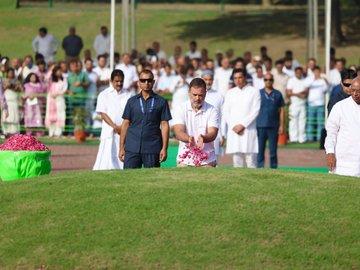
Rahul Gandhi, Kharge Pay Homage To India's First PM Jawaharlal Nehru On His Death Anniversary
(MENAFN- IANS) New Delhi, May 27 (IANS) Congress leaders on Wednesday paid floral tributes to India's first Prime Minister, Jawaharlal Nehru, on his 62nd death anniversary at his memorial, Shanti Van.
Leader of Opposition in the Lok Sabha and Congress MP Rahul Gandhi paid floral tributes to Nehru, his great-grandfather, at Shanti Van on the occasion of his death anniversary.
Congress National President Mallikarjun Kharge also paid floral tributes to Nehru at the memorial.
Kharge took to social media 'X' and said, "The defence of the nation, the progress of the nation, and the unity of the nation - these constitute the national duty of us all. We may follow different faiths, reside in different regions, or speak different languages; yet, no barrier should ever be allowed to rise between us... Every individual must be accorded an equal opportunity for advancement. We do not desire a nation where a privileged few amass immense wealth while the vast majority remains impoverished-Pandit Jawaharlal Nehru.)
"On the death anniversary of Bharat Ratna Pandit Jawaharlal Nehru - the architect who laid the strong foundations of modern India, an unwavering guardian of democratic values, a guiding light for scientific temper, industrial growth, and economic self-reliance, and the visionary who carried the message of 'Unity in Diversity' to every corner of the land - we offer our humble and heartfelt tributes," he said.
Kharge said that any vision of 21st-century India remains incomplete without acknowledging the invaluable contributions of Nehru.
"His visionary outlook, his unwavering commitment to institution-building, and his progressive leadership secured for India a distinct and prominent identity on the global stage. Indeed, any vision of 21st-century India remains incomplete without acknowledging the invaluable contributions of Pandit Nehru," he said.
The Goa Congress took to the social media platform X, saying,“Remembering Pandit Jawaharlal Nehru, India's first Prime Minister and the true architect of modern India, on his death anniversary. His visionary leadership laid the foundation of a strong, democratic, and progressive nation. From building world-class institutions to strengthening India's scientific, industrial, and global standing, Pandit Nehru shaped the India we know today. He placed India firmly on the world stage with dignity, confidence, and a voice that commanded global respect. Tributes to a leader whose vision continues to inspire generations.”
Jawaharlal Nehru was born in Allahabad on November 14, 1889. He received his early education at home with the help of private tutors. At the age of 15, he travelled to England for higher studies. After studying at Harrow, he joined Cambridge University, where he completed his studies in Natural Sciences. Later, he qualified as a barrister from the Inner Temple in London.
Nehru returned to India in 1912 and soon became actively involved in politics. Even during his student years, he was deeply interested in movements against foreign rule across the world. He closely followed the Sinn Féin movement in Ireland, which strengthened his commitment to India's struggle for freedom.
In 1912, he attended the Bankipore session of the Congress as a delegate. By 1919, he had become the Secretary of the Home Rule League in Allahabad. His first meeting with Mahatma Gandhi took place in 1916, and Gandhi's ideas left a lasting impact on him. In 1920, Nehru organised the first Kisan March in the Pratapgarh district of Uttar Pradesh. During the Non-Cooperation Movement between 1920 and 1922, he was imprisoned twice.
In September 1923, Nehru was appointed General Secretary of the All India Congress Committee. A few years later, in 1926, he travelled to several European countries and the Soviet Union. He represented the Indian National Congress at the Congress of Oppressed Nationalities held in Brussels, Belgium. In 1927, he also attended the celebrations marking the tenth anniversary of the October Socialist Revolution in Moscow.
At the Madras Congress in 1926, Nehru strongly supported the demand for complete independence for India. In 1928, while protesting against the Simon Commission in Lucknow, he was injured in a police lathi charge. That same year, he participated in the All-Party Congress and signed the Nehru Report on constitutional reforms, prepared under the leadership of his father, Motilal Nehru. He also founded the Independence for India League, which demanded a complete break from British rule, and served as its General Secretary.
In 1929, Nehru was elected President of the Lahore Session of the Indian National Congress. Under his leadership, the Congress officially adopted complete independence as its ultimate goal. Between 1930 and 1935, he was imprisoned several times for participating in the Salt Satyagraha and other freedom movements. During his imprisonment in Almora Jail, he completed his autobiography on February 14, 1935. After his release, he visited Switzerland to meet his ill wife and later travelled to London in 1936. In 1938, he visited Spain during the Civil War and also travelled to China shortly before the outbreak of the Second World War.
On October 31, 1940, Nehru was arrested for participating in the Satyagraha against India's forced involvement in World War II. He was released in December 1941 along with other national leaders. On August 7, 1942, he moved the historic Quit India Resolution at the All India Congress Committee session in Bombay. The following day, he was arrested and imprisoned at Ahmednagar Fort along with other leaders. This became his longest and final imprisonment. Altogether, he was jailed nine times during the freedom struggle.
After being released in January 1945, Nehru helped organise the legal defence of officers and soldiers of the Indian National Army who were charged with treason. In 1946, he toured Southeast Asia and was elected Congress President for the fourth time. He continued to hold the position for several more terms between 1951 and 1954.
Pandit Jawaharlal Nehru passed away on May 27, 1964, after suffering a heart attack. His death was officially announced in the Lok Sabha later that day. Because of his great love and affection for children, his birthday on November 14 is celebrated every year in India as Children's Day.

Legal Disclaimer:
MENAFN provides the
information “as is” without warranty of any kind. We do not accept
any responsibility or liability for the accuracy, content, images,
videos, licenses, completeness, legality, or reliability of the information
contained in this article. If you have any complaints or copyright
issues related to this article, kindly contact the provider above.
Most popular stories
Market Research

More Story

Comments
No comment