




403
Sorry!!
Error! We're sorry, but the page you were looking for doesn't exist.
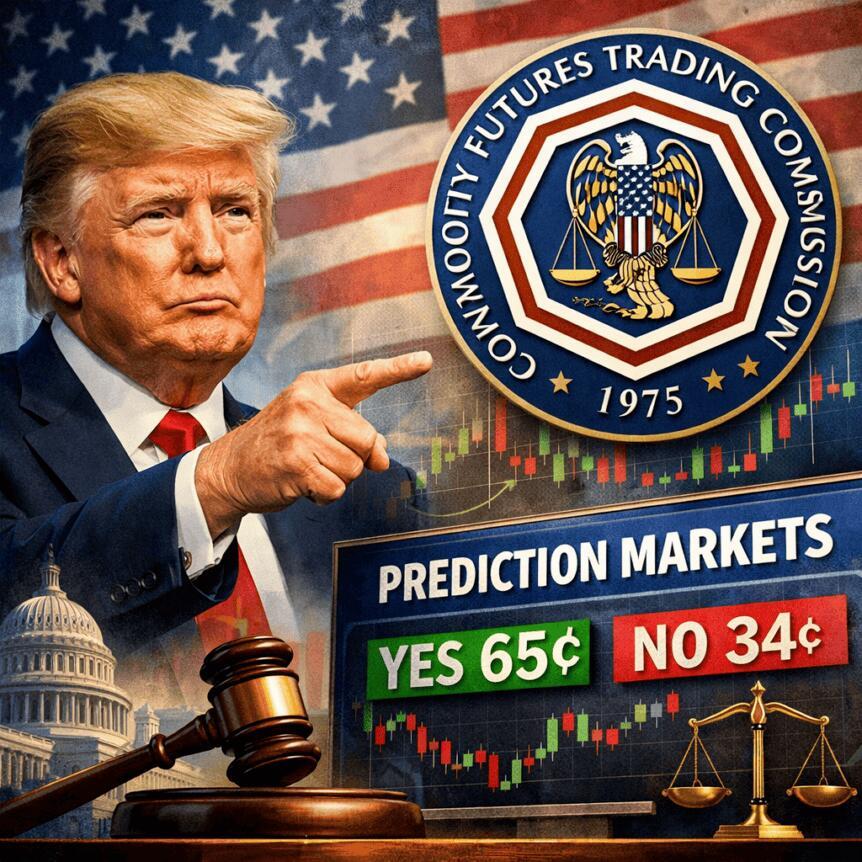
Trump Backs CFTC Control Of Prediction Markets, Signaling Shift
(MENAFN- Crypto Breaking) Regulatory tensions over prediction markets have escalated in the United States, as a former president publicly backs federal oversight and state authorities press legal actions against Kalshi, Polymarket, Crypto and Robinhood. The clash centers on who should regulate this rapidly growing crypto-adjacent sector and how rules should be enforced.
In a post on Truth Social on Tuesday, Donald Trump argued that the CFTC must retain exclusive jurisdiction over prediction markets and urged that the industry“thrive” under federal oversight. He also took aim at several state officials and lawmakers pursuing action against prediction-market platforms, saying that“we cannot have SCUM like Chris Christie, Letitia James, Tim Walz, and JB Pritzker setting the rules.” Trump 's comments add a high-profile political dimension to a case that has already seen courts and regulators circle the space.
Trump's call comes amid a broader regulatory fight in which state authorities say prediction markets violate local gambling laws, while market participants contend they fall under the CFTC's federally regulated derivatives framework. Kalshi and Polymarket-two of the most prominent players in this space-have pressed back against state enforcement efforts, arguing that the CFTC alone should regulate this market activity.
At the center of the regulatory battle is a dispute over jurisdiction. CFTC Chair Mike Selig has opposed the states' actions, arguing that prediction markets fall within the agency's exclusive purview as federally regulated designated contract markets. The agency has pursued legal action against several states for attempting to curb or ban these platforms, highlighting the ongoing friction between state and federal regulators in this evolving niche of financial markets.
Meanwhile, state authorities have pursued legal actions or cease-and-desist orders against platforms such as Kalshi, Polymarket, Crypto and Robinhood, arguing that these platforms operate gambling-like ventures without the proper licensing. Kalshi and Polymarket have responded by suing state authorities, asserting that the CFTC is the sole regulator for prediction market activity.
In parallel, Trump's governance team and family ties have become part of the narrative. Reports have highlighted that Donald Trump Jr. is invested in Polymarket and serves on its advisory board, while he also acts as an adviser to Kalshi. Coverage in recent days noted that Trump Jr.'s stance on prediction markets had softened, arguing that the United States would risk being left out if it does not permit these platforms to operate. The context around these remarks underscores how political calculations may influence regulatory outcomes in this area.
Trump's broader remarks reflect a familiar pattern in the debate over prediction markets: supporters argue that a clear federal framework fosters innovation and investor confidence, while opponents call for tighter control to address potential manipulation and consumer protections. The CFTC's position has consistently framed prediction markets as a subset of the derivatives market governed by the Commodity Exchange Act, a view that has been used to justify federal oversight and enforcement against state-level restrictions.
Key takeaways- Trump publicly reinforces the CFTC's exclusive authority over prediction markets, signaling support for a federal framework amid ongoing state actions against Kalshi, Polymarket, Crypto and Robinhood. States including Minnesota, Illinois, New York and Arizona have pursued enforcement actions against prediction-market platforms, drawing legal battle lines with the federal regulator. Kalshi and Polymarket have countersued state authorities, asserting that regulation of prediction markets should be handled by the CFTC rather than by states' gambling or securities laws. CFTC leadership has argued for preemption of state actions, positioning prediction markets within the agency's designated contract market regime and its broader anti-manipulation and market-integrity standards. The ecosystem's growth is tempered by regulatory uncertainty, as the CFTC moved to formalize oversight with a dedicated advisory team on event contracts and market integrity standards.
The social-media post from the former president framed the issue as a national regulatory test: safeguard a robust, federally governed market and resist the encroachment of disparate state rules. The post cited his intent to establish“rules of the road” that would serve as a Gold Standard for states, reflecting a broader push to unify the regulatory approach to prediction markets under federal supervision. The argument for federal primacy is grounded in the CFTC's claim that these markets operate as derivatives and should be regulated as part of the national derivatives framework rather than by localized gambling laws.
On the other side of the debate, state officials argue that prediction markets can operate in a legal gray area, potentially circumventing stricter consumer protections if left under a federal umbrella without state involvement. The dispute has drawn attention to a broader question: how to balance innovation and consumer protection in a space where novel financial instruments intersect with gambling-related concerns in multiple jurisdictions.
In coverage surrounding Trump's evolving stance, outlets noted that his own family has financial ties to Kalshi and Polymarket. Donald Trump Jr.'s involvement has fed commentary about how personal interests can intersect with policy positions, particularly as the administration or its successors weigh regulatory options for this class of markets. A separate report highlighted that Trump Jr. publicly signaled a softer stance on prediction markets, arguing that the U.S. risks losing out if it excludes these platforms from the financial landscape.
State actions, platform responses, and the federal frameworkThe enforcement push from state regulators has included cease-and-desist orders and licensing scrutiny aimed at Kalshi, Polymarket, and compatible platforms like Crypto and Robinhood. The core accusation is that these platforms offer gambling-like contract markets without the requisite licenses under state law. Kalshi and Polymarket have responded by asserting that their activities fall under the CFTC's jurisdiction and that states lack the authority to regulate them as gambling or betting markets.
The CFTC, for its part, has pursued multiple lawsuits against states pursuing action against these platforms. The agency argues that the prediction-market market is a tightly regulated derivatives space, and that state-by-state interventions risk creating a patchwork of rules that could hinder innovation and cross-border participation. The agency's posture emphasizes a federal standard-one designed to preserve market integrity, reduce manipulation risk, and provide consistent compliance expectations for participants and developers alike.
Beyond enforcement, the CFTC signaled a structural approach to oversight by forming an advisory team in March focused on the listing and trading of event contracts. The team is tasked with evaluating listing standards, surveillance measures, anti-manipulation controls, and overall market integrity, reinforcing a move toward formalized governance of prediction markets within the existing derivatives regime.
These developments come at a moment when participants, developers, and investors are weighing how the regulatory backdrop will shape product design, liquidity, and user access. Platforms like Kalshi and Polymarket have already built communities around real-world event contracts, and their ability to operate at scale could hinge on future court rulings, enforcement priorities, and any potential regulatory clarification from federal or state authorities.
Looking ahead: what to expect and what matters for the marketThe immediate question is how the ongoing jurisdictional battle will be resolved. Courts could clarify the balance of power between federal and state authorities, potentially establishing a clearer boundary for prediction-market activities. If the federal framework prevails, platforms may enjoy greater regulatory consistency and a more predictable path to liquidity and product expansion. If state authorities maintain leverage, platforms could face continued licensing costs, compliance fragmentation, or even restricted access in certain jurisdictions.
Investors and builders should watch for regulatory clarity on several fronts: any court rulings that define the scope of the CFTC's authority; potential settlements or settlements-in-principle between states and platforms; and any federal regulatory updates or guidance that further delineate permissible activities, licensing requirements, or safeguards against market manipulation. The coming months are likely to reveal how much of the current tension is strategic posturing and how much will translate into concrete, enforceable rules for prediction markets.
Readers should stay alert to evolving legal decisions, policy statements from the CFTC, and any new guidance that could influence platform viability, user participation, and the speed at which prediction-market products can scale across borders.
Risk & affiliate notice: Crypto assets are volatile and capital is at risk. This article may contain affiliate links.
Legal Disclaimer:
MENAFN provides the
information “as is” without warranty of any kind. We do not accept
any responsibility or liability for the accuracy, content, images,
videos, licenses, completeness, legality, or reliability of the information
contained in this article. If you have any complaints or copyright
issues related to this article, kindly contact the provider above.
Most popular stories
Market Research

More Story








Comments
No comment