




403
Sorry!!
Error! We're sorry, but the page you were looking for doesn't exist.
Hair Serum Market Size, Share, Growth, Analysis, Report, 2034
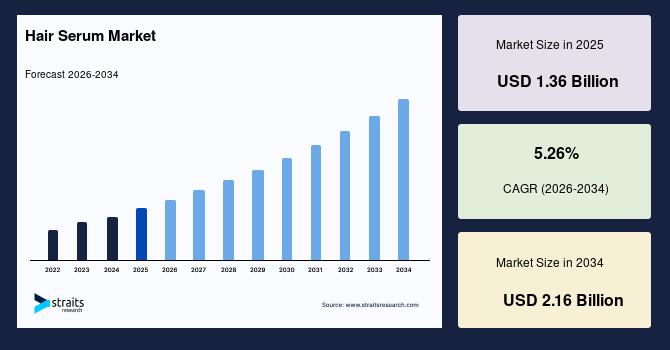
| Market Metric | Details & Data (2025-2034) |
|---|---|
| 2025 Market Valuation | USD 1.36 Billion |
| Estimated 2026 Value | USD 1.43 Billion |
| Projected 2034 Value | USD 2.16 Billion |
| CAGR (2026-2034) | 5.26% |
| Study Period | 2022-2034 |
| Dominant Region | Europe |
| Fastest Growing Region | North America |
| Key Market Players | L'Oréal S.A., The Procter & Gamble Company (P&G), Unilever PLC, Kao Corporation, Moroccanoil Israel Ltd. |
Download Free Sample Report to Get Detailed Insights.
Hair Serum Market Drivers Rising Consumer Awareness about Hair Health and Damage PreventionThe global market is significantly driven by increasing consumer awareness regarding hair health, scalp care, and damage prevention. Factors such as pollution, frequent heat styling, chemical treatments, and poor diet are contributing to hair thinning, breakage, and loss of shine, prompting consumers to seek effective hair care solutions.
-
For instance, according to the National Council on Aging (NCOA), by the age of 50, around 50% of men globally experience noticeable hair loss or thinning, primarily due to androgenetic alopecia. Similarly, the Cleveland Clinic reports that over 40% of women show visible signs of hair loss by the age of 40.
This growing awareness is pushing consumers toward preventive care, with hair serums offering protection, nourishment, and restorative benefits becoming an essential part of daily grooming routines.
Market Restraint High Competition and Market SaturationThe global market faces significant restraint from intense competition and market saturation, particularly in developed regions like North America and Europe. Established brands such as L'Oréal, Procter & Gamble, and Unilever dominate shelf space, making it challenging for new entrants to gain visibility.
Additionally, a flood of regional and private-label products creates price wars, forcing companies to compromise on margins. The similarity in product offerings often limits differentiation, leading to brand switching among consumers. As a result, even innovative formulations struggle to capture lasting market share. This competitive environment demands heavy marketing investments, which may not be sustainable for small and mid-sized players.
Market Opportunity Development of Eco-Friendly, Sustainable, and Refillable PackagingThe development of eco-friendly, sustainable, and refillable packaging for these serums offers substantial growth potential, driven by increasing consumer demand for environmentally responsible products. Brands are shifting towards biodegradable materials, recycled plastics, and glass packaging to reduce environmental impact and appeal to eco-conscious buyers.
-
For instance, in June 2025, L'Oréal rolled out a global campaign promoting refillable packaging across its haircare, skincare, and fragrance lines under the hashtag #JoinTheRefillMovement. The company claims these refill pouches can reduce plastic use by up to 80% and packaging intensity by up to 70%. Examples include Lancôme fragrance refills and Garnier Ultra Doux hair care pouches, offering significant savings in plastic and material usage.
This approach not only supports global sustainability goals but also helps brands differentiate in an increasingly competitive personal care market.
Regional AnalysisIn Europe, the market benefits from strong consumer inclination toward eco-friendly, cruelty-free, and sustainably packaged products. Demand is fueled by growing awareness of pollution-related hair damage and a preference for botanical and organic ingredients. The region's regulatory emphasis on product safety and ingredient transparency supports high-quality innovations. These serums addressing seasonal dryness and color protection are in demand, with multifunctional and lightweight textures gaining traction. Professional salon partnerships and luxury hair care branding strengthen the market presence, while social media and fashion trends drive consumer purchasing patterns.
-
The UK's hair serum industry is expanding due to strong consumer interest in multi-benefit and sustainable hair care products. Brands like John Frieda and L'Oréal Paris lead with serums offering repair, hydration, and color protection. The shift toward vegan, cruelty-free formulas aligns with UK sustainability trends. Online platforms like Boots and Superdrug enhance accessibility, while influencer-driven marketing fuels product adoption among younger consumers.
Germany's market for hair serum is witnessing growth driven by rising demand for premium and natural hair care solutions. Consumers are opting for serums with botanical oils like argan and jojoba for frizz control and shine. Brands such as Schwarzkopf and Wella Professionals dominate salon segments, while e-commerce channels like Douglas expand reach. Increasing awareness of heat protection products among German consumers further boosts sales.
The North American market is witnessing growth driven by high consumer preference for premium, multifunctional formulations addressing frizz control, heat protection, and hair strengthening. Rising adoption of clean-label, vegan, and silicone-free products aligns with growing sustainability trends. E-commerce and subscription-based beauty services are expanding product reach, while the influence of beauty influencers fuels demand. Increased awareness of scalp health and anti-aging hair solutions further drives innovation. The region also sees growth in gender-neutral and men's grooming segments, supported by advanced R&D in haircare technology.
-
The US market thrives on innovation, with high adoption of multifunctional products offering frizz control, heat protection, and shine. Major players like Olaplex, Paul Mitchell, and Moroccanoil dominate through salon partnerships and influencer marketing. Clean beauty trends boost sales of plant-based serums, while e-commerce giants like Sephora and Ulta enhance nationwide reach, supported by celebrity endorsements and social media-driven campaigns.
The Canadian hair serum sector is witnessing growth due to rising demand for natural, silicone-free formulations and premium haircare. Brands like Marc Anthony and AG Care are popular for incorporating argan oil and botanical extracts. E-commerce platforms such as Amazon Canada and Well drive accessibility, while salon chains like Chatters promote professional-grade serums, catering to both urban consumers and the growing men's grooming segment.
The Asia Pacific market is expanding rapidly due to increasing beauty consciousness, urban pollution challenges, and growing disposable incomes. Rising demand for targeted solutions addressing hair fall, dryness, and scalp issues drives product diversification. Consumers prefer herbal, natural, and lightweight serums, blending traditional remedies with modern formulations. E-commerce growth, beauty influencers, and K-beauty-inspired trends amplify brand visibility. Premiumization of haircare, along with small-sized travel-friendly packs, appeals to younger demographics. The region also witnesses rising adoption of male grooming and innovative serums infused with region-specific botanical extracts.
-
China's market is witnessing rapid growth driven by rising urban pollution, increased hair damage concerns, and a booming e-commerce sector. Brands like L'Oréal, Schwarzkopf, and local players such as See Young are introducing serums enriched with herbal and botanical extracts. The influence of KOLs (Key Opinion Leaders) on platforms like Xiaohongshu and Douyin is further boosting consumer awareness and adoption, especially among young urban women seeking premium haircare.
India's hair serum industry is expanding due to rising disposable incomes, growing grooming awareness, and increased heat styling usage. Popular brands such as Livon, Streax, and international players like L'Oréal are innovating with lightweight, non-greasy formulations suited for humid climates. Herbal-based serums containing ingredients like amla, bhringraj, and argan oil are gaining traction, driven by Ayurveda's popularity and strong retail penetration in both urban and semi-urban areas.
Hair treatment serums hold the dominant share in the global market, driven by rising concerns over hair fall, dandruff, and scalp health. Increasing exposure to pollution, heat styling, and chemical treatments has boosted demand for targeted solutions like hair growth and scalp repair serums. Innovative formulations with active ingredients such as biotin, argan oil, and keratin further attract consumers. Growing awareness about preventive hair care, coupled with the expansion of specialized treatment ranges by leading brands, supports this segment's strong market position.
Nature InsightsSynthetic hair serums dominate the market due to their affordability, longer shelf life, and consistent performance. These products are widely preferred for their smooth texture, ease of application, and quick results in addressing frizz, dullness, and styling needs. Mass production capabilities allow brands to cater to diverse hair concerns at competitive prices, making them accessible across varied income groups. Additionally, synthetic variants are easily available in retail outlets and online platforms, further reinforcing their leading position in the global market.
Gender InsightsThe women's segment leads the global market, fueled by a higher inclination toward personal grooming and hair care. Women are more likely to invest in serums for hair treatment, styling, and protection from environmental damage. Social media beauty trends, influencer marketing, and celebrity endorsements significantly impact female buying behavior. The rising number of working women, coupled with increased disposable incomes, boosts premium product adoption. Moreover, brands are increasingly launching women-focused formulations, catering to diverse hair types and styling preferences, ensuring this segment's continued dominance.
Distribution Channel InsightsPharmacy and drug stores represent the dominant distribution channel for the global market, driven by consumer trust in these outlets for quality and authenticity. These stores often stock dermatologist-recommended and clinically tested serums, particularly for hair fall control, dandruff, and scalp repair. The presence of knowledgeable staff enhances product guidance, encouraging purchases. Accessibility in urban and semi-urban areas, along with availability of both premium and affordable brands, makes pharmacies and drug stores a preferred choice for treatment serum buyers globally.
Company Market ShareCompanies in the hair serum market are focusing on expanding product portfolios with innovative, multifunctional formulations addressing diverse hair concerns. They are investing in R\&D for natural, vegan, and sustainable ingredients to meet eco-conscious consumer demands. Strategic partnerships with salons, influencers, and e-commerce platforms enhance brand visibility. Additionally, firms are targeting emerging markets, offering personalized solutions, and adopting premium, eco-friendly packaging to strengthen customer loyalty and capture a larger market share.
L'Oréal S.A.
L'Oréal S.A. is a leading global cosmetics and beauty company headquartered in Clichy, France, with operations in over 150 countries. Founded in 1909, it offers a diverse portfolio across haircare, skin care, makeup, and fragrances. In the hair serum market, its brands like L'Oréal Paris, Kérastase, and Matrix provide innovative products targeting various hair concerns, from frizz control to damage repair. The company invests heavily in R&D, sustainability, and digital marketing, strengthening its position as a trendsetter in premium and mass haircare segments.
-
In August 2025, L'Oréal Paris launched the Elvive Glycolic + Gloss line exclusively at Walmart in the U.S. The collection includes a high-shine leave-in serum alongside shampoo and conditioner, delivering up to 14× smoother hair and a viral-level glossy effect. The campaign resonated across social media-garnering over 15 million views and featuring Gen Z influencer Ariana Greenblatt.
-
L'Oréal S.A.
The Procter & Gamble Company (P&G)
Unilever PLC
Kao Corporation
Moroccanoil Israel Ltd.
Vogue International LLC
Estée Lauder Companies Inc.
John Paul Mitchell Systems
Briogeo
Olaplex Holdings, Inc.
-
August 2025- VERB Products launched its Density Peptide Hair Serum, a lightweight leave-in treatment designed to enhance hair thickness and visible density. Formulated with Saw Palmetto Extract and a proprietary Density Complex, it nourishes the scalp, reduces shedding, and promotes fuller-looking hair, addressing the growing demand for effective hair-thinning solutions.
August 2025- Virtue Labs launched its Overnight Scalp and Hair Elixir, gaining attention after Jennifer Garner endorsed it for delivering luminous, thick hair. Formulated with Alpha Keratin 60KU, peptides, hyaluronic acid, ceramides, and prebiotics, the serum nourishes the scalp, strengthens strands, and promotes growth, reflecting rising demand for premium, science-backed haircare solutions.
August 2025- Dyson unveiled its first-ever hair products, an innovative leave-in conditioning spray and a hair oil, touted for their sustainable credentials and performance. Both use the new Oil7 blend, containing sunflower seed oil sourced from Dyson's own farm, alongside nourishing oils like olive, macadamia, abyssinian, corn, sesame, and avocado.
| Report Metric | Details |
|---|---|
| Market Size in 2025 | USD 1.36 Billion |
| Market Size in 2026 | USD 1.43 Billion |
| Market Size in 2034 | USD 2.16 Billion |
| CAGR | 5.26% (2026-2034) |
| Base Year for Estimation | 2025 |
| Historical Data | 2022-2024 |
| Forecast Period | 2026-2034 |
| Report Coverage | Revenue Forecast, Competitive Landscape, Growth Factors, Environment & Regulatory Landscape and Trends |
| Segments Covered | By Product Type, By Nature, By Gender, By Distribution Channel |
| Geographies Covered | North America, Europe, APAC, Middle East and Africa, LATAM |
| Countries Covered | US, Canada, UK, Germany, France, Spain, Italy, Russia, Nordic, Benelux, China, Korea, Japan, India, Australia, Taiwan, South East Asia, UAE, Turkey, Saudi Arabia, South Africa, Egypt, Nigeria, Brazil, Mexico, Argentina, Chile, Colombia |
Download Free Sample Report to Get Detailed Insights.
Hair Serum Market Segments By Product Type-
Hair Treatment Serum
-
Hair Fall Control
Hair Growth
Dandruff Control
Scalp Repair
Others
-
Frizz Control
Smoothing and Straightening
Heat Protection
Others
-
Synthetic Hair Serum
Natural & Organic Hair Serum
-
Women
Men
Unisex
-
Supermarkets & Hypermarkets
Pharmacy & Drug Store
Online Retail
Others
-
North America
Europe
APAC
Middle East and Africa
LATAM

Legal Disclaimer:
MENAFN provides the
information “as is” without warranty of any kind. We do not accept
any responsibility or liability for the accuracy, content, images,
videos, licenses, completeness, legality, or reliability of the information
contained in this article. If you have any complaints or copyright
issues related to this article, kindly contact the provider above.
Most popular stories
Market Research

More Story







Comments
No comment