




403
Sorry!!
Error! We're sorry, but the page you were looking for doesn't exist.
How Automated Merchant Onboarding Reduces PSP Activation Time And Improves Payment Processing Efficiency
(MENAFN- AsiaNet News)
For payment service providers, fintech companies, acquirers, and payment facilitators, merchant onboarding has become one of the most important operational stages in the payment lifecycle.
It determines how quickly a merchant can start accepting payments, how efficiently compliance and risk teams can review applications, and how easily a payment business can scale without increasing manual workload.
As payment ecosystems become more complex, PSPs and acquiring platforms are under pressure to onboard merchants faster while maintaining strong compliance standards. According to payment infrastructure providers like Akurateco ( ), automation is becoming essential for scalable merchant operations, especially for companies working across multiple regions, payment providers, and acquiring partners.
What is automated merchant onboarding?
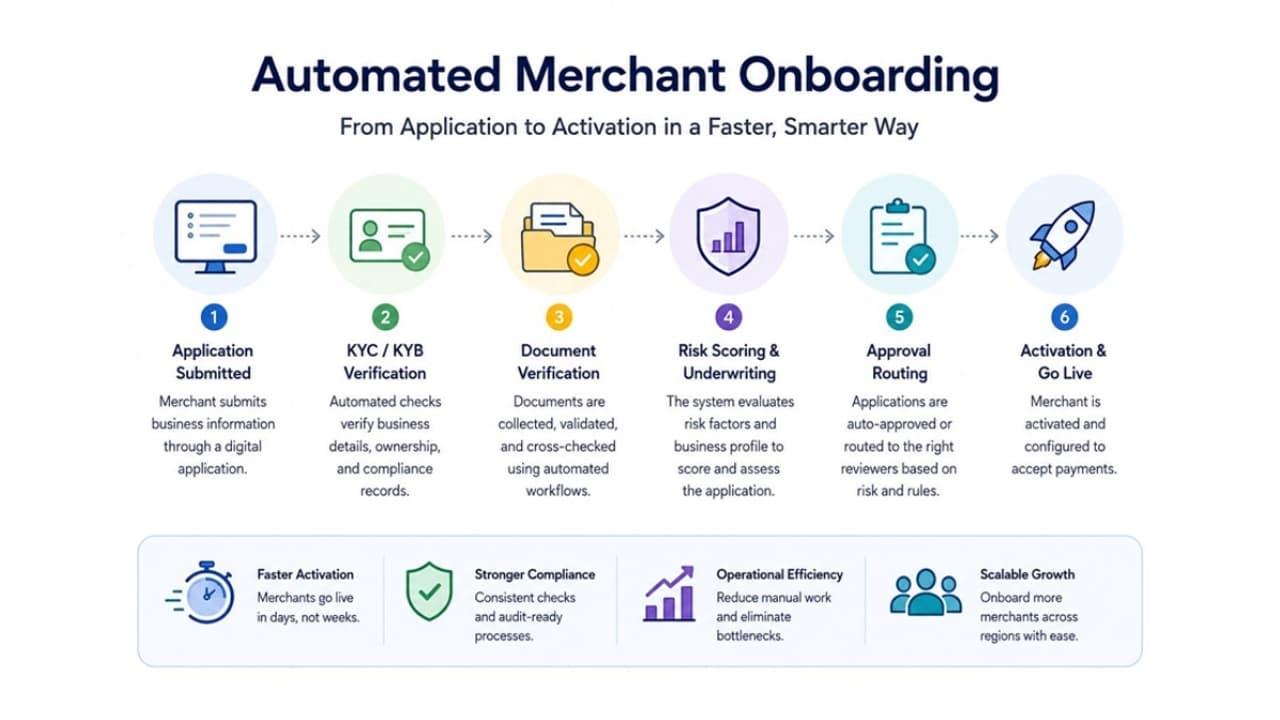
Automated merchant onboarding is the process of using digital workflows, APIs, and compliance automation to verify, approve, and configure merchants with limited manual intervention. It typically includes KYC and KYB checks, document collection, fraud screening, underwriting, risk scoring, approval routing, and payment gateway configuration.
The goal is not to remove compliance oversight. The goal is to reduce repetitive manual work, standardize decision-making, and help teams focus their attention on higher-risk cases that require human judgment.
In payment processing, onboarding is more than an administrative step. It is the bridge between merchant acquisition and live transaction processing. If onboarding is slow, merchants wait longer to generate revenue. If onboarding is inconsistent, compliance risk increases. If onboarding is fragmented, operational teams spend more time coordinating tasks than enabling growth.
That is why automated merchant onboarding is becoming a core part of modern PSP infrastructure.
Why traditional merchant onboarding creates bottlenecks
Traditional merchant onboarding often depends on manual communication, scattered documentation, and disconnected internal systems.
- A typical process may look like this: A merchant submits an application. The compliance team reviews business details. Additional documents are requested by email. Risk teams assess the merchant's activity and business model. Operations teams manually update internal systems.
The merchant is finally approved and configured for payment processing.
This process may be familiar, but it becomes difficult to scale.
When merchant volumes grow, teams spend more time collecting documents, checking company details, verifying ownership information, escalating approvals, and updating multiple platforms. The result is a slower activation cycle, higher operational costs, and greater pressure on compliance teams.
Manual onboarding also creates consistency problems. Different reviewers may apply requirements differently, especially when workflows are not clearly structured. This can weaken audit readiness and make it harder to prove that the same controls were applied across all merchant applications.
For merchants, the experience can feel slow and unclear. Repeated document requests, long response times, and limited visibility into application status create friction at the very beginning of the relationship.
Why PSPs are automating merchant onboarding in 2026
In 2026, payment businesses are facing several pressures at once: higher merchant expectations, stricter compliance requirements, multi-market expansion, and growing competition among PSPs and payment facilitators.
Merchants increasingly expect onboarding to feel like a modern digital process. They want clear requirements, fast feedback, and quick activation. At the same time, PSPs cannot compromise on compliance, risk assessment, or due diligence.
Automation helps payment organizations balance both needs.
Instead of choosing between speed and control, automated onboarding allows PSPs to create structured workflows that accelerate low-risk applications while escalating complex or high-risk merchants for deeper review.
This is especially important for payment companies operating across multiple regions. Different jurisdictions may require different documents, verification checks, risk rules, and approval flows. Without automation, regional complexity quickly becomes an operational burden.
Key components of automated merchant onboarding
A strong automated merchant onboarding process usually includes several connected components.
- Digital application workflows
Structured digital forms help merchants submit the required information in a consistent format. Real-time validation can detect missing fields, formatting errors, or inconsistent data before the application reaches the compliance team.
This reduces back-and-forth communication and helps merchants complete applications correctly the first time.
- KYC and KYB automation
Know Your Customer and Know Your Business checks help payment providers verify merchant identity, company registration, ownership structure, and business legitimacy.
Automated KYC and KYB workflows can support company registry checks, identity verification, beneficial ownership review, sanctions screening, and AML checks.
- Document collection and verification
Automated onboarding systems can collect, classify, and validate documents such as business registration certificates, proof of address, bank account details, licenses, ownership documents, and identity files.
AI-assisted document review can also extract information, compare submitted details, and flag inconsistencies for human review.
- Risk scoring and underwriting
Merchant risk scoring helps PSPs assess whether a business should be approved, declined, or escalated for manual review.
Factors may include industry type, transaction volume, geography, ownership structure, processing history, chargeback exposure, and business model complexity.
- Approval routing
Automated approval routing ensures that applications move to the right team or reviewer based on predefined rules.
Low-risk applications may move through the process quickly, while higher-risk merchants can be automatically escalated to compliance, risk, or management teams.
- Payment gateway configuration
Merchant onboarding does not end with approval. Once a merchant is accepted, they still need to be configured for payment processing.
This may include setting up payment methods, currencies, limits, fees, routing rules, acquirer connections, fraud settings, and reporting access.
Platforms like Akurateco increasingly combine payment orchestration with onboarding automation to help PSPs centralize compliance checks, acquirer integrations, and merchant configuration inside one payment infrastructure ecosystem.
How automated onboarding improves payment processing efficiency
Automated onboarding improves payment processing efficiency by reducing one of the most common delays in merchant activation: the time between application submission and live processing.
When onboarding workflows are digitized, payment businesses can validate merchant information earlier, identify missing documents faster, and route applications more intelligently.
This has several direct efficiency benefits.
- Faster merchant activation
The faster a merchant is reviewed, approved, and configured, the sooner they can start processing transactions. For PSPs, this shortens time-to-revenue. For merchants, it reduces waiting time and improves the first experience with the payment provider.
- Lower manual workload
Compliance and operations teams often spend a large amount of time on repetitive checks. Automation reduces the need to manually collect documents, compare information, send reminders, and update systems. This allows teams to focus on complex cases rather than routine validation.
- More consistent compliance processes
Standardized workflows apply the same logic across merchant applications. This improves consistency, strengthens audit trails, and reduces the risk of subjective or incomplete reviews. In regulated payment environments, this consistency is essential.
- Better scalability
Manual onboarding may work at low volumes, but it becomes harder to maintain as merchant acquisition grows. Automated onboarding helps PSPs increase onboarding capacity without increasing operational headcount at the same pace.
- Stronger merchant experience
A smoother onboarding process helps merchants understand what is required, submit information correctly, and move toward activation faster. For payment businesses, this can improve conversion from signed merchant to active merchant.
The role of AI in merchant onboarding
AI is making automated merchant onboarding more intelligent than traditional workflow automation alone.
One of the most practical applications is document intelligence. AI can classify uploaded files, extract relevant information, compare data across documents, and flag inconsistencies that may require additional review.
AI can also support risk analysis by identifying suspicious application behavior, detecting duplicate submissions, highlighting unusual ownership structures, or flagging documents that appear altered or unreliable.
This does not mean AI replaces compliance teams. Instead, it helps them work more efficiently.
The Akurateco team summarizes the shift this way: merchant onboarding is no longer only a compliance process. It directly affects conversion, scalability, and time-to-revenue for PSPs.
That distinction matters because onboarding sits at the intersection of risk control and business growth. A faster process can improve commercial performance, but only if compliance standards remain strong.
How payment orchestration supports automated onboarding
Payment orchestration plays an important role in automated merchant onboarding because merchant approval is only one part of the payment lifecycle.
After approval, the merchant still needs to be connected to the right payment infrastructure. This may include payment service providers, acquirers, fraud tools, reporting systems, tokenization services, routing logic, and settlement workflows.
When onboarding and orchestration are disconnected, internal teams may still need to configure merchants manually after approval. This creates a second bottleneck.
A more efficient model connects onboarding workflows with the broader payment infrastructure. Once a merchant is approved, the system can support faster setup of payment methods, processing rules, limits, provider connections, and reporting access.
This is especially relevant for PSPs and payment facilitators using white-label infrastructure. A white-label payment gateway can help payment businesses manage merchant configuration, processing logic, and operational workflows under their own brand while relying on established payment infrastructure. More details on how this model works are available at white-label-payment-gateway
In this context, automated onboarding becomes part of a larger operating model: acquire merchants, verify them, approve them, configure them, and enable payment processing with less manual coordination.
Common challenges in automated merchant onboarding
Automation can improve onboarding efficiency, but it needs to be implemented carefully.
The most common challenges include:
- Fragmented systems that do not exchange data properly. Unclear document requirements across regions or merchant types. Overly rigid workflows that cannot handle exceptions. Poor integration between compliance tools and payment infrastructure. Lack of audit trails for internal and regulatory review. Manual merchant configuration after approval. Limited visibility into application status for internal teams and merchants.
The best automated onboarding systems do not simply digitize forms. They connect compliance, risk, operations, and payment setup into one structured workflow.
What to look for in an automated merchant onboarding solution
A strong automated merchant onboarding solution should support the full merchant lifecycle from application to activation.
Important capabilities include:
- Digital merchant application forms. Document collection and validation. KYC and KYB automation. AML and sanctions screening. Merchant risk scoring. Approval workflows and escalation rules. Audit logs and compliance records. Merchant status tracking. API-based integrations. Payment gateway and acquirer configuration. Connection to payment orchestration tools. Support for multi-region and multi-provider operations.
For PSPs, acquirers, fintech companies, and payment facilitators, the most valuable onboarding solutions are those that reduce operational friction while supporting long-term infrastructure growth.
Final thoughts
Automated merchant onboarding is no longer just a process improvement initiative. It is becoming a strategic requirement for payment businesses that want to scale efficiently, reduce manual compliance workload, and activate merchants faster.
As payment providers expand across regions, industries, and acquiring partners, manual onboarding becomes harder to sustain. It slows merchant activation, increases operational pressure, and creates unnecessary friction for both internal teams and merchants.
Automation offers a more scalable path.
By combining structured onboarding workflows, KYC and KYB automation, document verification, risk scoring, approval routing, and payment orchestration, PSPs can create a more efficient merchant activation process without weakening oversight.
Companies such as Akurateco are helping payment providers connect onboarding automation, payment orchestration, and white-label payment infrastructure into unified ecosystems capable of supporting merchant growth across multiple markets and acquiring partners.

Legal Disclaimer:
MENAFN provides the
information “as is” without warranty of any kind. We do not accept
any responsibility or liability for the accuracy, content, images,
videos, licenses, completeness, legality, or reliability of the information
contained in this article. If you have any complaints or copyright
issues related to this article, kindly contact the provider above.
Most popular stories
Market Research

More Story








Comments
No comment