


Thermal Cycler Market Size, Share, Growth, Analysis, Report, 2034


| Market Metric | Details & Data (2025-2034) |
|---|---|
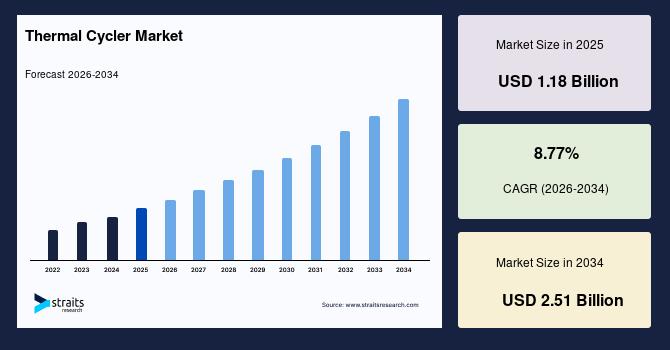
| 2025 Market Valuation | USD 1.18 Billion |
| Estimated 2026 Value | USD 1.28 Billion |
| Projected 2034 Value | USD 2.51 Billion |
| CAGR (2026-2034) | 8.77% |
| Study Period | 2022-2034 |
| Dominant Region | North America |
| Fastest Growing Region | Asia Pacific |
| Key Market Players | Thermo Fisher Scientific, Bio-Rad Laboratories, Agilent Technologies, Eppendorf AG, Qiagen |
Download Free Sample Report to Get Detailed Insights.
Market Drivers Rising Demand for Molecular Diagnostics, Routine PCR Testing, and Genomics R&DRising demand for molecular diagnostics, routine PCR testing, and genomics R&D is a key driver of the global market. Advances in healthcare, personalized medicine, and genetic research have significantly increased the reliance on PCR-based methods for accurate and rapid detection of diseases. The global rise in infectious disease monitoring, oncology diagnostics, and genetic screening is accelerating adoption in both clinical and research settings.
-
For instance, Labcorp raised its 2025 profit forecast, citing strong diagnostic testing demand, with diagnostic lab revenue rising ~8.9% in Q2 and contract research services up ~11%. This reflects demand not just for urgent tests (like during COVID) but also non-urgent and routine diagnostics.
As a result, thermal cyclers remain indispensable in laboratories, driving sustained market growth.
Market Restraint Price Sensitivity in Emerging MarketsThe high cost of advanced thermal cyclers poses a major restraint in emerging markets, where laboratories often operate under limited budgets. Premium models with features like real-time PCR, multiplexing, and automation require significant upfront investments, in addition to recurring expenses for proprietary reagents and consumables. This creates affordability challenges for small research institutions, diagnostic labs, and academic facilities in cost-sensitive regions.
Many opt for low-cost alternatives or refurbished systems, slowing the adoption of cutting-edge technologies. Furthermore, limited government funding and uneven reimbursement structures intensify the issue, restricting market penetration. Addressing affordability through lower-cost models and financing solutions remains crucial for broader uptake.
Market Opportunity Technological InnovationsTechnological innovations are creating significant growth opportunities in the global thermal cycler market as laboratories increasingly demand faster, more reliable, and automation-ready solutions. Manufacturers are focusing on integrating features such as advanced temperature control, multiplexing, connectivity, and compatibility with robotic workflows to meet evolving research and diagnostic requirements.
-
For instance, in September 2023, Bio-Rad launched the PTC Tempo 48/48 and PTC Tempo 384 thermal cyclers. The dual-block PTC Tempo 48/48 enables simultaneous independent protocols, while the automation-friendly PTC Tempo 384 features a motorized lid, catering to high-throughput laboratory needs.
Such advancements are reshaping workflows by enhancing scalability and efficiency, particularly in genomics, clinical diagnostics, and pharmaceutical R&D. This ongoing innovation trend positions thermal cycler manufacturers to capture expanding opportunities across academic, industrial, and healthcare sectors.
Regional AnalysisThe North American market is growing due to strong demand in molecular diagnostics, genomics research, and biopharmaceutical R&D. Laboratories are increasingly adopting high-throughput and real-time PCR systems, such as automated qPCR platforms used in vaccine development and disease screening. Educational institutions are using portable PCR units for STEM programs, while biopharma companies integrate thermal cyclers with laboratory information management systems (LIMS) for streamlined workflows. Investments in personalized medicine and public health testing programs continue to drive market growth.
The United States thermal cycler market is driven by strong investment in molecular diagnostics, genomics research, and biopharmaceutical R&D. High adoption of real-time PCR and high-throughput systems is evident in academic institutions and clinical labs. For example, Thermo Fisher Scientific and Bio-Rad have launched advanced qPCR platforms to meet the growing demand for COVID-19 testing, cancer research, and personalized medicine applications across the country.
Canada's thermal cycler industry is fueled by increasing government initiatives in healthcare infrastructure and research funding. Academic and clinical laboratories are expanding molecular testing capabilities using portable and automated thermal cyclers. Companies like Eppendorf and Qiagen are providing innovative qPCR solutions to support genomics studies, infectious disease diagnostics, and biopharma R&D, contributing to the country's growing molecular diagnostics and life sciences research ecosystem.
Asia-Pacific Market TrendsAsia Pacific's market is rapidly growing, driven by expanding healthcare infrastructure, pharmaceutical R&D, and molecular diagnostics. High-throughput and automated PCR systems are widely utilized in clinical laboratories for infectious disease testing and drug discovery programs. Portable and cost-effective thermal cyclers support education and decentralized testing in rural areas. Collaborations between regional manufacturers and global brands facilitate adoption. Government-funded research initiatives and increasing investment in biotechnology accelerate market expansion, creating opportunities for integrated PCR platforms in diagnostics and academic research.
China's thermal cycler market is driven by strong biotech research, hospital diagnostics, and local pharmaceutical R&D. Chinese firms such as Shanghai Titan Scientific and Nanjing Vazyme Biotech dominate domestic supply, reducing reliance on imports. Government programs supporting genomics and infectious disease testing fuel demand, and international companies like Eppendorf and Agilent collaborate with local partners to offer high-throughput and automated PCR solutions for research and clinical labs.
India's market for thermal cycler is expanding rapidly due to rising molecular diagnostics, genomics research, and government initiatives like Ayushman Bharat. Educational and research institutions increasingly adopt compact PCR systems for academic purposes. Companies such as Thermo Fisher Scientific and Bio-Rad have strengthened their presence with localized sales and service networks, while domestic players like Transasia Bio-Medicals provide cost-effective thermal cyclers suited for emerging labs and diagnostic centers.
Europe Market TrendsEurope's market is expanding with rising demand in clinical research, infectious disease testing, and biotechnology. Laboratories are adopting integrated high-throughput thermal cyclers, for example, for oncology biomarker analysis and viral pathogen detection. Partnerships between instrument manufacturers and diagnostic labs enhance accessibility to automated PCR solutions. Portable PCR systems are increasingly used in academic settings for practical training. Government initiatives supporting molecular diagnostics, along with growing personalized medicine programs, are accelerating adoption across research and clinical environments.
Germany's thermal cycler industry thrives on the country's leadership in biotechnology and precision diagnostics. Eppendorf's high-throughput PCR systems and Analytik Jena's qPCR instruments are widely adopted across universities and pharma labs. Growing investments in personalized medicine and clinical research, such as the Charité University Hospital's genomics initiatives, are driving demand for automated, data-integrated thermal cyclers, positioning Germany as a hub for advanced molecular testing solutions.
The UK's thermal cycler market benefits from increasing government-backed genomics research and NHS diagnostic programs. Thermo Fisher Scientific's real-time PCR systems and Bio-Rad's portable cyclers are used extensively in universities and biotech startups. Initiatives like the UK Biobank project and rapid COVID-19 testing campaigns highlight the country's reliance on reliable, high-throughput thermal cyclers, fostering the adoption of automation and laboratory integration technologies across clinical and research sectors.
Product Type InsightsWith a 44.34% share, the real-time PCR (qPCR) thermal cyclers segment emerged as the leading product type in the global market due to their high sensitivity, accuracy, and ability to provide quantitative results in real time. They are widely adopted in genomics, infectious disease testing, and biopharmaceutical research. Their automation, multiplexing capabilities, and integration with data analysis software make them indispensable for high-throughput laboratories and advanced molecular research applications.
Application InsightsMolecular diagnostics, with a 38.16% share, stands as the leading application area in the market, driven by the growing need for rapid and accurate detection of genetic disorders, infectious diseases, and cancers. Thermal cyclers enable precise amplification of DNA/RNA, making them crucial for diagnostics. Rising prevalence of chronic and infectious diseases, coupled with government initiatives to strengthen diagnostic infrastructure, further fuels the adoption of thermal cyclers in this segment.
End-user InsightsThe hospitals & diagnostic labs segment dominated the market by end-user and is projected to grow at a CAGR of 8.25%, leveraging these instruments for routine testing, pathogen detection, and patient-specific molecular analysis. The demand is driven by increasing patient volumes, the need for rapid diagnostics, and integration with advanced laboratory workflows. Growing investments in hospital laboratories and the adoption of automated and real-time PCR systems enhance efficiency and accuracy in clinical decision-making.
Company Market ShareKey companies in the thermal cycler market are focusing on expanding their product portfolios with high-throughput, real-time, and portable PCR systems. They are investing in automation, software integration, and cloud-enabled data management to enhance lab efficiency. Strategic collaborations, partnerships, and targeted regional expansions are being pursued to capture emerging market demand. Additionally, companies are emphasizing consumables, service contracts, and innovative applications to drive recurring revenue and market growth.
Bio-Rad LaboratoriesBio-Rad Laboratories, founded in 1952 and headquartered in California, is a leading global provider of life science research and clinical diagnostic products. In the thermal cycler industry, the company is recognized for its innovative PCR instruments, including high-throughput, real-time, and portable systems. Bio-Rad focuses on enhancing laboratory efficiency through automation, advanced software, and integrated workflows. With a strong presence in academic, pharmaceutical, and clinical sectors worldwide, the company continues to drive growth through technology development, strategic partnerships, and expanding global distribution networks.
-
In September 2025, Bio-Rad Laboratories launched its next-generation digital PCR system, designed to enhance precision, sensitivity, and efficiency in molecular diagnostics and research. The system supports high-throughput applications and provides reliable quantitative analysis for complex samples. This development strengthens Bio-Rad's product portfolio, enabling advanced solutions for genomics, clinical diagnostics, and life sciences research markets globally.
-
Thermo Fisher Scientific
Bio-Rad Laboratories
Agilent Technologies
Eppendorf AG
Qiagen
Takara Bio
PerkinElmer
Analytik Jena
Danaher Corporation
GENEWIZ
ThermoGenesis
Corbett Life Science
Abbott Laboratories
LGC Limited
SCTbio
-
July 2025- CYCLERtest B.V. introduced the MTAS®-Temperature & Optical Calibration System (July 2025), an ISO 17025-accredited solution designed for precise calibration of qPCR thermocyclers. Featuring 19 temperature sensors and 15 optical channels, it ensures enhanced accuracy, compliance, and reliability in thermal cycler performance validation.
June 2025- QIAGEN and GENCURIX announced a partnership to develop multiplex oncology assays for tissue and liquid biopsies using QIAcuity digital PCR technology. This collaboration aims to broaden the adoption of QIAcuityDx, offering clinical diagnostic laboratories a range of clinical oncology assays.
April 2025- At the 2025 ADLM conference, Seegene unveiled CURECATM, the world's first fully unattended PCR automation system, and STAgoraTM, a real-time data analytics platform. These innovations aim to revolutionize diagnostics by enhancing automation and data analysis capabilities.
| Report Metric | Details |
|---|---|
| Market Size in 2025 | USD 1.18 Billion |
| Market Size in 2026 | USD 1.28 Billion |
| Market Size in 2034 | USD 2.51 Billion |
| CAGR | 8.77% (2026-2034) |
| Base Year for Estimation | 2025 |
| Historical Data | 2022-2024 |
| Forecast Period | 2026-2034 |
| Report Coverage | Revenue Forecast, Competitive Landscape, Growth Factors, Environment & Regulatory Landscape and Trends |
| Segments Covered | By Product Type, By Application, By End User |
| Geographies Covered | North America, Europe, APAC, Middle East and Africa, LATAM |
| Countries Covered | US, Canada, UK, Germany, France, Spain, Italy, Russia, Nordic, Benelux, China, Korea, Japan, India, Australia, Taiwan, South East Asia, UAE, Turkey, Saudi Arabia, South Africa, Egypt, Nigeria, Brazil, Mexico, Argentina, Chile, Colombia |
Download Free Sample Report to Get Detailed Insights.
Thermal Cycler Market Segments By Product Type-
Conventional/Standard Thermal Cyclers
Real-Time PCR (qPCR) Thermal Cyclers
High-Throughput / Automated Thermal Cyclers
Portable / Mini PCR Devices
-
Molecular Diagnostics
Research & Development
Pharmaceutical & Biopharmaceutical
Education & Training
Others
-
Hospitals & Diagnostic Labs
Academic & Research Institutes
Pharmaceutical & Biotech Companies
CROs (Contract Research Organizations)
Others
-
North America
Europe
APAC
Middle East and Africa
LATAM

Legal Disclaimer:
MENAFN provides the
information “as is” without warranty of any kind. We do not accept
any responsibility or liability for the accuracy, content, images,
videos, licenses, completeness, legality, or reliability of the information
contained in this article. If you have any complaints or copyright
issues related to this article, kindly contact the provider above.


Comments
No comment