




403
Sorry!!
Error! We're sorry, but the page you were looking for doesn't exist.
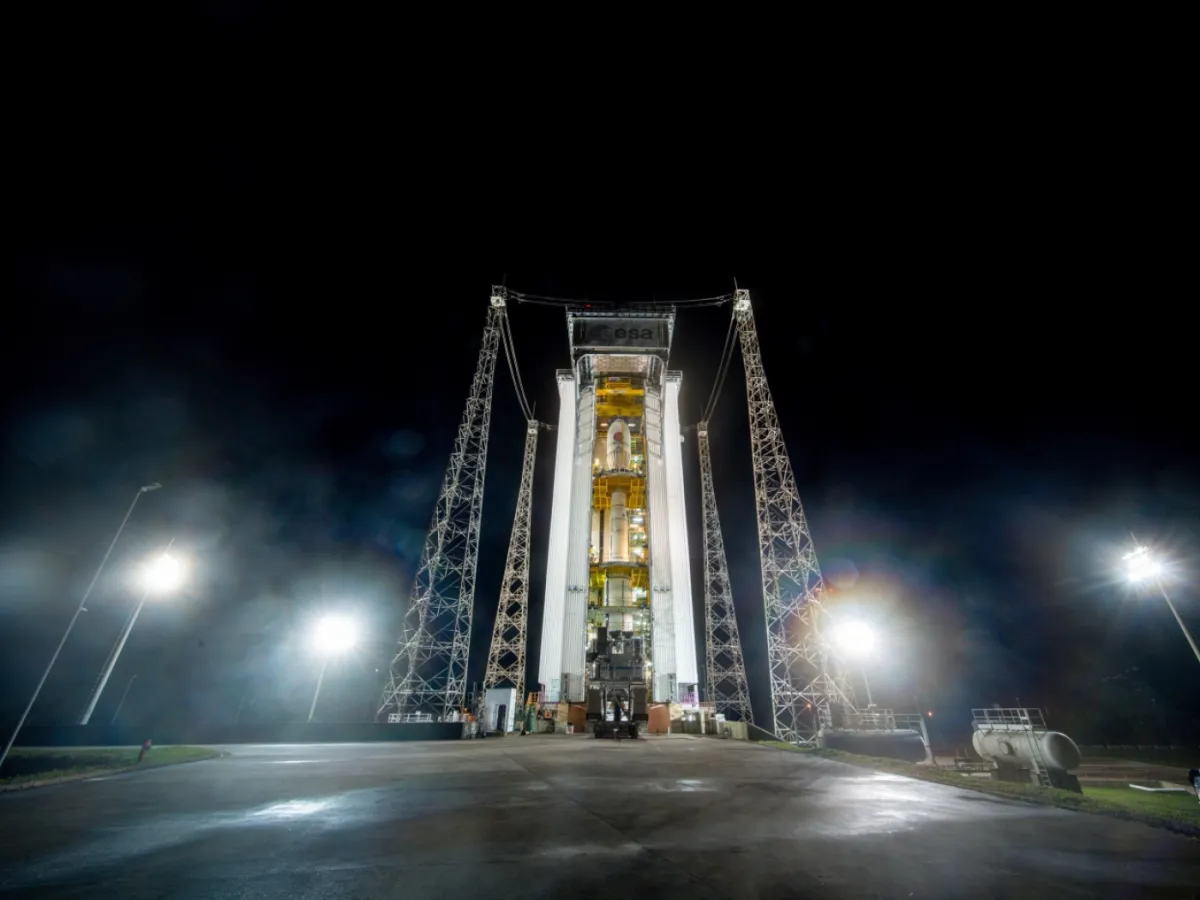
'Smile' Space Weather Satellite Ready For Take Off With Swiss Tech On Board
(MENAFN- Swissinfo)
On May 19 at 05:52 Swiss time, the 'Smile' satellite will be launched into space to study solar storms.
This content was published on
May 17, 2026 - 12:15
5 minutes
Keystone-SDA
-
Deutsch
de
Satellit“Smile” hebt bald mit Schweizer Technik ab
Original
Read more: Satellit“Smile” hebt bald mit Schweizer Techn
For the researchers involved, the launch is a special moment – and nerve-wracking at the same time.
“I would love hide in the basement during the launch and wait until it's all over,” said André Csillaghy from the University of Applied Sciences Northwestern Switzerland (FHNW) in an interview with the Keystone-SDA news agency.
+Get the most important news from Switzerland in your inboxUnder his leadership, a Swiss consortium developed software for the mission as well as a crucial component of the hardware without which the telescope would not work.
“A launch like this is a great moment – but your thoughts go to these very delicate parts that you have developed and built yourself and that are then on the rocket when everything is vibrating,” said Csillaghy.
His team from the University of Applied Sciences Northwestern Switzerland (FHNW), the Zurich University of Applied Sciences (ZHAW) and the Swiss companies KOEGL Space and Space Acoustics began working on the mission eight years ago.
The launch was initially scheduled for April 9 but was postponed due to a technical problem.
Understanding space weather'Smile' (Solar wind Magnetosphere Ionosphere Link Explorer) is a project of the European and Chinese space organisations. The aim of the mission is to better understand – and perhaps even predict – space weather.
The weather in space is determined by solar winds and solar storms, in which charged particles are hurled out of the sun. The particles are hurled towards the earth at speeds of up to 2 million kilometres per hour. There they encounter an invisible protective shield, the magnetosphere, that deflects the particles.
However, when the particles hit the Earth's magnetic field, not only do auroras occur, but also complex interactions. Satellites can be damaged, navigation systems disrupted and even power grids on Earth can be affected. Smile wants to comprehensively measure these processes.
The satellite is equipped with four scientific instruments for this purpose: an X-ray camera, an ultraviolet camera, an ion spectrometer and a magnetometer. While the UV camera can observe auroras for up to 45 hours at a time, the X-ray camera – known as the“Soft X-ray Imager (SXI)” – is the largest of the four instruments and will visualise the Earth's otherwise invisible magnetic field for the first time.
Technology from SwitzerlandSwitzerland has made a significant contribution to this X-ray camera. The cooling system for the telescope was developed, manufactured and tested at the FHNW in Windisch. The Rocket Science radiator is responsible for bringing the detectors to the required operating temperatures of around -110°C. The inconspicuous, rectangular panel measures around 30 by 40 centimetres and is mounted on the side of the telescope facing away from the sun.
“Without this cooling, the camera would not work,” emphasises Csillaghy. The extreme conditions in space – it can get up to 160°C on the sunny side and down to -200°C on the shady side – make the development of the radiator particularly challenging.
More In space exploration, Switzerland punches above its weightNobel laureates, an exoplanet telescope, and instruments on board 50 space missions: In space, Switzerland is everywhere.
Read more: In space exploration, Switzerland punches above its w
Legal Disclaimer:
MENAFN provides the
information “as is” without warranty of any kind. We do not accept
any responsibility or liability for the accuracy, content, images,
videos, licenses, completeness, legality, or reliability of the information
contained in this article. If you have any complaints or copyright
issues related to this article, kindly contact the provider above.
Most popular stories
Market Research

More Story






Comments
No comment