




403
Sorry!!
Error! We're sorry, but the page you were looking for doesn't exist.
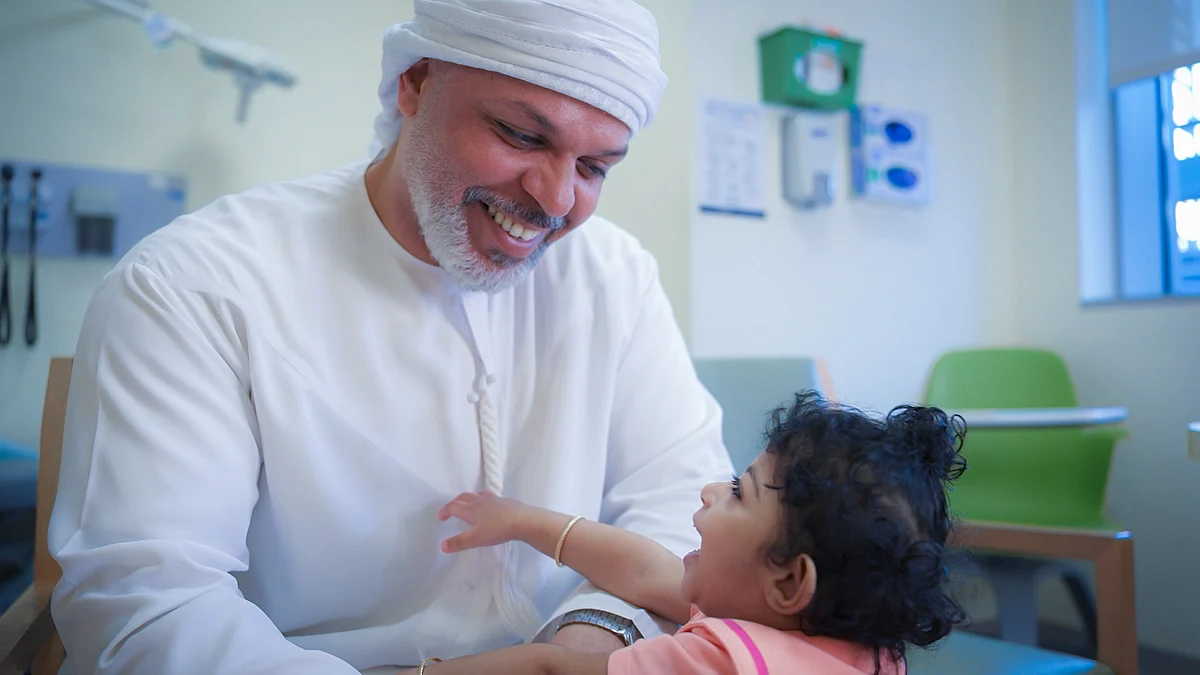
'For Months I Whispered Into Her Ears': UAE Father Recalls Daughter Hearing For First Time
(MENAFN- Khaleej Times) After nearly a year of searching for answers, Abu Dhabi family took a leap of faith on the emirate's first paediatric auditory brainstem implant
- By: Haneen Dajani
For months, Ali Ismail and his family feared that their daughter, Salama, might grow up in silence. The baby never startled at loud noises, never turned when her siblings called her name, never reacted when her father leaned close and raised his voice beside her ears.
“We kept hoping maybe she just needed more time,” he said.
Recommended For You Iran sends response to US proposal via Pakistan, state media saysBut at six months old, the family knew something was wrong, setting them on a nine-month search that would lead to one of Abu Dhabi's most complex paediatric hearing surgeries.
“We noticed she didn't cry when there were loud sounds. She didn't turn her head,” the 44-year-old father of four told Khaleej Times.“Sometimes I would go close to her ear and call her, even raise my voice a little, just to see if she would react. I tried again and again, but there was nothing.”
Stay up to date with the latest news. Follow KT on WhatsApp Channels
Salama, now two, was eventually diagnosed with incomplete cochleae in both ears - meaning traditional cochlear implants would not work.
The family moved between hospitals in Dubai, undergoing scans, hearing tests and even a procedure to remove fluid from her ears after doctors initially thought that might be causing the problem.
“Nothing worked,” Ali said.“At one point, we started thinking maybe we would have to travel abroad for treatment.”
Instead, a chance recommendation led them to Sheikh Shakhbout Medical City, where ENT specialists confirmed there was only one option left: an auditory brainstem implant.
The 'only solution'Unlike cochlear implants, which rely on a functioning hearing nerve, an auditory brainstem implant bypasses that pathway entirely, sending sound signals directly to the brainstem.
Dr Ahmad Al Shamsi, Chair of the Otolaryngology, Head and Neck Surgery (ENT) Division at SSMC, said the procedure is reserved for a small subset of children born without a hearing nerve or with severe inner-ear abnormalities.
“These children otherwise have no hearing solution available,” he explained.“Without intervention, they would remain profoundly deaf for life.”
Globally, about one to three in every 1,000 children are born with significant hearing loss, though only a small fraction are candidates for an ABI.
Timing, doctors say, can make all the difference.
“The brain develops most rapidly during the first few years of life,” Al Shamsi said.“If implantation is delayed for several years, the auditory centres may not develop properly, making it much harder for the child to understand sound or develop spoken language later.”
By the time Salama's family received the recommendation, she was still under two, young enough for doctors to intervene during what specialists call the critical window for auditory and language development.
'She was so tiny'Despite being told the operation offered their daughter her best chance of hearing, Ali and his wife did not immediately agree.
Doctors told them the surgery would be the first of its kind for a child in Abu Dhabi.
“We hesitated,” Ali admitted.“We took almost two or three months thinking about it.”
Their biggest fear was not whether the procedure would work, but whether Salama, who had been born prematurely and was smaller than other babies her age, would survive it.
“She was tiny,” he said.“We kept thinking: can she handle a surgery like this? They would open her skull... would her body handle it?”
Eventually, after prayer and family discussions, they made what Ali called“a leap of faith”.
“We said we would trust God and do it.”
The first soundThe surgery was performed by SSMC's multidisciplinary team, alongside visiting German neurosurgeon Robert Behr.
But for Ali, the most unforgettable moment came weeks later, when Salama returned to the hospital for the device to be activated for the first time.
Doctors programmed the external processor while Ali held his daughter in his arms.
Then someone tapped on a table.
“The first time, nothing,” he recalled.
“They tried again... and then suddenly she turned.”
Doctors tapped once more.
“She turned again. Then she started making little sounds with her mouth, like she was trying to answer.”
Ali pauses when describing what came next.
“It's impossible to describe that feeling,” he said.“For almost a year, your daughter has lived in silence... and then suddenly you see her hearing.”
<Learning to hear
Eight months later, Salama is still learning what sound means. She wears an external processor, magnetically attached to her head, which connects to the implant inside her skull. Without it, no sound reaches her brain.
At first, children with an ABI often hear tones or unfamiliar signals rather than natural sounds, doctors say. Over time, through repeated exposure, therapy and regular device programming, the brain learns to interpret those signals.
“The goal is not necessarily normal hearing,” Al Shamsi explained.“It is giving the child meaningful access to sound, enough to support communication, speech development and awareness of the world around them.”
Salama now responds to some sounds, turns toward voices and has begun making early speech sounds. "She says 'ma ma ma' now,” Ali said with a laugh. "We're still waiting for 'baba'."
She has also started attending therapy sessions in Abu Dhabi, Dubai and Fujairah, where specialists gradually increase the volume and complexity of the sounds she receives.
“She loves people,” her father said.“If we go anywhere, she reaches out to shake hands with strangers. She plays with other children even if she doesn't know them.”
'Never stop searching'Ali says his biggest dream now is simple: For Salama to attend mainstream school alongside her siblings.
“I want her to be like them, studying in a normal school, living a normal life.”
His message to other parents facing similar diagnoses is equally straightforward.
“Never give up,” he said.
“There is always a solution. Maybe here, maybe somewhere else. But don't stop searching.”
ALSO READ- UAE mother who gave birth in coma faces worsening health, lung transplant urgency Misdiagnosed for decades: UAE experts on why rare disease patients struggle for answers How UAE-based geneticist helped identify previously unknown rare genetic disorder

Legal Disclaimer:
MENAFN provides the
information “as is” without warranty of any kind. We do not accept
any responsibility or liability for the accuracy, content, images,
videos, licenses, completeness, legality, or reliability of the information
contained in this article. If you have any complaints or copyright
issues related to this article, kindly contact the provider above.
Most popular stories
Market Research

More Story








Comments
No comment