






403
Sorry!!
Error! We're sorry, but the page you were looking for doesn't exist.
Coppernico Advances Multi-Kilometre Tipicancha Copper-Gold Target Ahead Of Initial Drilling
| Pit ID | Sulfide / Mixed Zone Interval (m) | Description | Peak Cu (%) |
| 26SRT-076 | 1.0 – 2.0 | Mixed oxide-sulfide breccia: massive pyrite with covellite and native sulfur. | 0.44 |
| 26SRT-077 | 0.7 – 1.2 | Mixed zone breccia: massive pyrite with trace native sulfur in matrix. | 0.42 |
| 26SRT-082 | 1.5 – 2.0 | Sulfide zone: porphyritic andesite with massive pyrite and native sulfur. | 0.14 |
| 26SRT-091 | 1.95 – 2.20 | Sulfide zone: strongly altered andesite with massive pyrite. | 0.12 |
| 26SRT-095 | 1.6 – 2.0 | Sulfide zone: porphyritic andesite with disseminated to massive pyrite and trace covellite on fractures | 0.12 |
| 26SRT-106 | 1.57 – 2.15 | Sulfide zone: porphyritic andesite with disseminated to massive pyrite and trace covellite patches. | 0.12 |
Table notes: Reported values represent the highest individual ICPMS Cu assay returned from each pit. True widths are unknown. See Quality Control section below for analytical methodology.
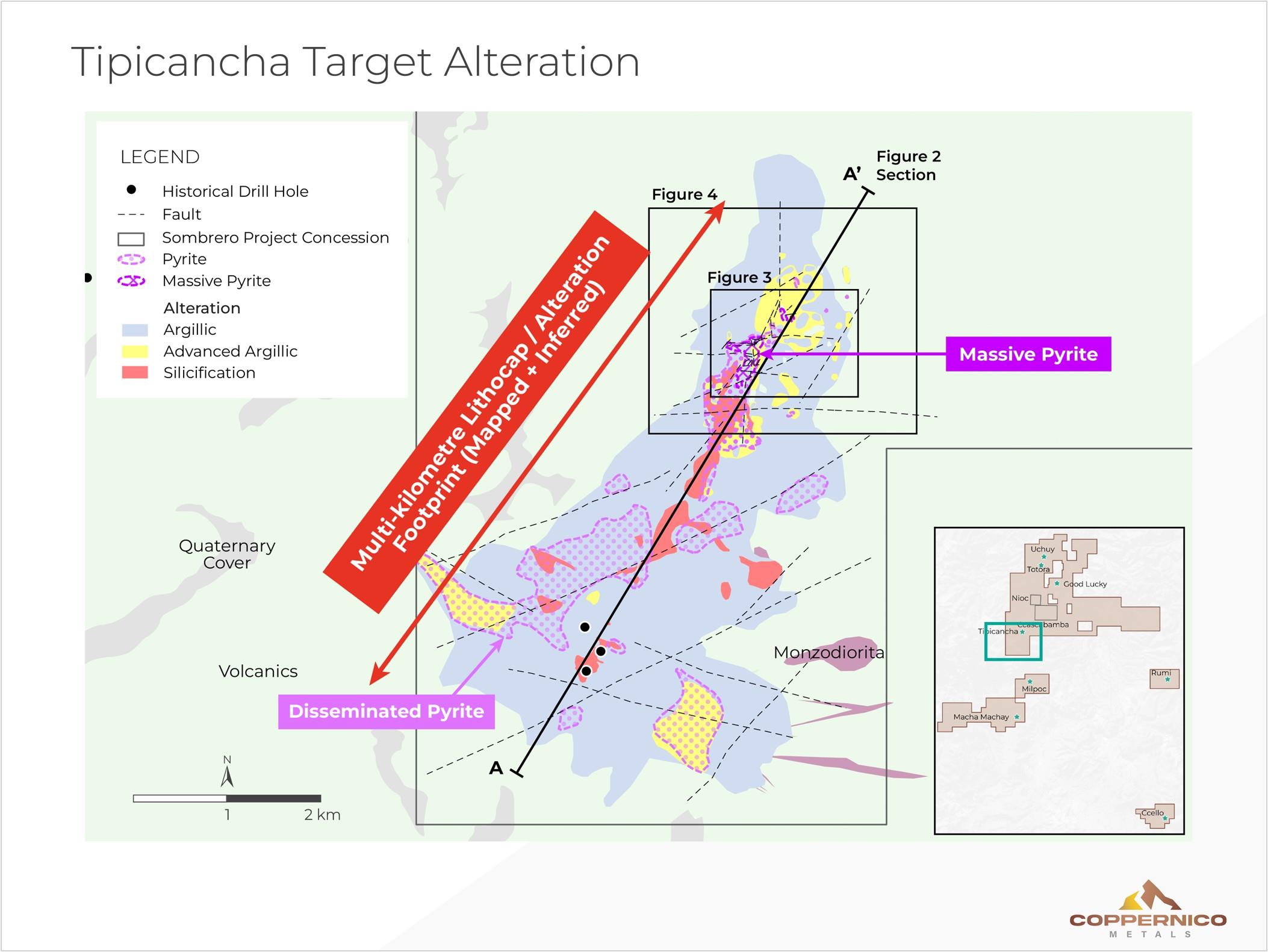
Importantly, the program locally improved definition of the southern extent of the mapped pyrite-rich horizon. Confirmed continuity of the horizon along structurally focused trends, supports interpretation of a laterally extensive, structurally controlled, sulfide-rich body developed beneath the Tipicancha lithocap. Copper mineralization within the pyrite horizon is primarily hosted in covellite and other secondary copper sulfides, consistent with the supergene-modified upper expression of a magmatic-hydrothermal source.
Figure 4: Map of geochemical zonation patterns in the N-Tipicancha target area.
Multi-element geochemistry is revealing that Cu-Mo-Se-S anomalism is concentrated within sulfide-rich horizons and adjacent alteration zones, while pathfinder elements (As, Sb, Sn) characteristic of high-sulfidation epithermal environments are more widely and variably distributed within the lithocap. Together, these observations support the presence of a robust, vertically and horizontally zoned magmatic-hydrothermal framework with potential for deeper porphyry-related mineralization. Structural interpretation has identified ENE-WSW corridors and NNE-SSW intersections that focus alteration (Figures 1 and 4), sulfide deposition, and copper enrichment, consistent with the structural framework outlined by the Company's recent geophysical surveys.
Expanded Mapping and District-Scale Geological Model
The Company's recent expansion of its Sombrero land position, including the Horizonte concessions, has enabled systematic geological mapping, surface sampling and structural interpretation across the broader Tipicancha hydrothermal system. This work is helping define the nature and scale of alteration and structural framework, with the hydrothermal footprint now interpreted to extend over more than 4 km in strike length and up to approximately 1.5 km in width (Figures 1 and 2).
Surface mapping is increasingly defining vertical zonation within the broader Tipicancha hydrothermal footprint. This evolving geological framework will allow the Company to transition from broad target definition toward more explicit drill vectoring based on converging structural, geochemical and alteration indicators:
- Higher-elevation exposures in the central and southern portions of the lithocap are dominated by vuggy and residual silica, native sulfur, silicified hydrothermal breccia, and quartz-alunite ± kaolinite alteration, characteristic of high-sulfidation lithocap environments. Mid-elevation exposures host the laterally persistent pyritic horizon described above, with localized, fracture-controlled copper enrichment and structurally focused covellite, interpreted to represent exposure at a lower erosional level within the broader and strongly leached hydrothermal footprint. Lower elevation exposures near the northern limit of the lithocap footprint include sheeted quartz-pyrite veining, providing a vector toward potentially hotter and deeper parts of the hydrothermal system.
In large lithocaps globally, mineralization is commonly heterogeneously distributed and typically exhibits both vertical and horizontal zonation and structural focusing, with porphyry centers often laterally or structurally offset from the most intensely altered portions of the lithocap, rather than directly beneath the surface alteration footprint. Improved understanding of lithocap geometry, structural corridors, vertical alteration transitions, and geochemical zoning is therefore central to vectoring toward potential deeper mineralized centers.
Structural interpretation has identified NNE-trending structures that focus alteration intensity particularly at intersections with ENE-WSW corridors; locally, these intersections appear to have focused sulfide deposition (pyrite) and copper enrichment. At Tipicancha, the convergence of major structural intersections, sulfide-rich hydrothermal horizons, and Cu ± Mo ± Se geochemical signatures is being used by the Company to refine drill targeting ahead of initial drilling.
Tim Kingsley, VP Exploration of Coppernico, commented,“Our recent mapping across the expanded Tipicancha land position has materially refined our understanding of the broader hydrothermal footprint. We are now mapping a multi-kilometre, vertically zoned magmatic-hydrothermal system. The shallow pit program provides valuable near-surface continuity for the pyrite-copper horizon and has improved our local geochemical characterization of the near-surface pyrite bearing horizon. The program has also highlighted structural controls that will be directly tested during the initial drill program. These independent observations are converging on a clear set of geological vectors that will guide our initial drill targeting at Tipicancha.”
Technical Disclosure and Qualified Person
The scientific and technical information contained in this news release was reviewed and approved by Tim Kingsley, M.Sc., CPG, Coppernico's Vice President of Exploration, who is a“Qualified Person” as defined in NI 43-101. Mr. Kingsley supervised the sampling program and verified the data disclosed herein.
Quality Control
Samples were typically between 1 and 2 metres in length; however, sample lengths could be reduced to as little as 0.5 metres where lithological or significant mineralogical changes were observed, in order to accurately reflect the apparent width of mineralization. Analytical samples were collected by cutting a continuous channel into bedrock with a portable rock saw. Individual samples weighed between 3 and 7 kilograms. Samples were collected in plastic bags, given a unique reference number and sent to the ALS Laboratories in Lima, Peru for preparation and analysis. Preparation included crushing the sample to 90% < 2 mm and pulverizing 1,000 g of crushed material to better than 95% < 106 microns. All samples are assayed using 30 g nominal weight fire assay with atomic absorption finish (Au-AA23) and multi-element using a four-acid digest ICP-AES/ICP-MS method (ME-MS61). Where MS61 results were greater than or near 10,000 ppm Cu, or 10,000 ppm Zn, assays were repeated using an ore-grade four-acid digest method (Cu-OG62). QA/QC programs for 2025 channel samples included internal standard samples, blanks, and duplicates, lab duplicates, lab standards, and laboratory blanks indicate good overall accuracy and precision.
ON BEHALF OF THE BOARD OF DIRECTORS
Ivan Bebek
Chair & CEO
For further information, please contact:
Coppernico Metals Inc.
Phone: +1 778 729 0600
Email: ...
Website:
Twitter: @CoppernicoMetal
LinkedIn:
About Coppernico
Coppernico is a mineral exploration company focused on creating value for shareholders and stakeholders through diligent project evaluation and exploration, in pursuit of the discovery of large-scale high-grade copper-gold deposits in the Americas. The Company's management and technical teams have a successful track record of raising capital, discovery and the monetization of exploration successes. The Company's objective is to become a leading advanced copper and gold explorer, and through its wholly owned Peruvian subsidiary Sombrero Minerales S.A.C., is currently focused on the Ccascabamba (previously referred to as Sombrero Main) and Nioc target areas within the Sombrero Project in Peru, its flagship project, while regularly reviewing additional premium projects to consider for acquisition.
The Sombrero Project is a land package of approximately 57,000 hectares (570 square kilometres) located in the north-western margins of the world-renowned Andahuaylas-Yauri trend in Peru. It consists of a number of prospective exploration targets characterized by copper-gold skarn and porphyry systems and precious metal epithermal systems. The Company's NI 43-101 technical report, with an effective date of April 17, 2024, and as filed on SEDAR+ on May 23, 2024, focuses on the Ccascabamba and Nioc target areas of the Sombrero Project. The Tipichanca target was determined subsequent to the date of that report.
Common shares of Coppernico Metals Inc. are listed on the Toronto Stock Exchange under the symbol“COPR”, trades on the OTCQB Venture Market under symbol“CPPMF” and is quoted over the counter by certain dealers in the Unofficial Market of the Frankfurt Stock Exchange under the symbol“9I3”. More information about Coppernico can be found on the Company's profile on SEDAR+ ( ).
Cautionary Note
No regulatory organization has approved the contents hereof.
This news release contains forward-looking statements and forward-looking information within the meaning of Canadian securities legislation (collectively,“ forward-looking statements”). Forward-looking statements are often identified by terms such as“may”,“should”,“anticipate”,“expect”,“intend” and similar expressions and include, but are not limited to, statements with respect to: the interpretation of recent and historical geological, geochemical and geophysical data; the prospectivity of the newly added concessions, including the Horizonte Concessions, and their strategic importance to the Sombrero Project; the Company's plans for future exploration, including drilling; the potential to identify porphyry-related mineralization at depth; and the Company's ability to secure the necessary financing to fund such exploration activities. No certainty can be given that these expectations will prove to be correct and such forward-looking statements included in this news release should not be heavily relied upon. Forward-looking statements are based on a number of assumptions and are subject to a number of risks and uncertainties, many of which are beyond the Company's control, which could cause actual results and events to differ materially from those that are disclosed in or implied by such forward-looking statements. Readers should refer to the risks discussed in the Company's 2025 Annual Information Form and other continuous disclosure filings with the Canadian Securities Administrators, available at . These factors are not, and should not be construed as being, exhaustive. Accordingly, readers should not place heavy reliance on forward-looking statements. The forward-looking statements contained in this new release are expressly qualified by this cautionary statement. Any forward-looking information and the assumptions made with respect thereto speaks only as of the date of this news release. The Company does not undertake any obligation to publicly update or revise any forward-looking information after the date of this news release to conform such information to actual results or to changes in the Company's expectations except as otherwise required by applicable legislation.
Photos accompanying this announcement are available at:

Legal Disclaimer:
MENAFN provides the
information “as is” without warranty of any kind. We do not accept
any responsibility or liability for the accuracy, content, images,
videos, licenses, completeness, legality, or reliability of the information
contained in this article. If you have any complaints or copyright
issues related to this article, kindly contact the provider above.
Most popular stories
Market Research

More Story








Comments
No comment