




403
Sorry!!
Error! We're sorry, but the page you were looking for doesn't exist.
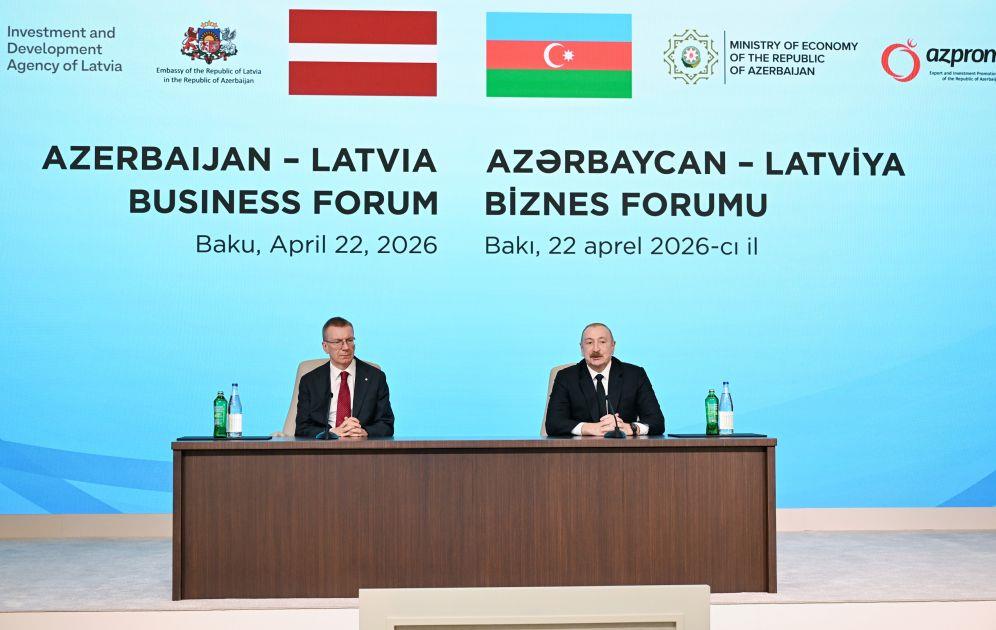
Trade, Transit And Trust: Latvia's Strategic Turn Towards Azerbaijan
(MENAFN- AzerNews)
Elnur Enveroglu
Read more
The official visit of Latvian President Edgars Rinkēvičs to Azerbaijan upon the invitation of President Ilham Aliyev is more than a diplomatic courtesy. It is a clear statement that relations between Baku and Riga matter not only bilaterally, but strategically across a rapidly changing Eurasian landscape.
At a time when Europe is rethinking supply chains, transport security, energy resilience and geopolitical partnerships, Azerbaijan and Latvia increasingly find themselves on the same page. One stands on the shores of the Caspian Sea, the other on the Baltic coast. Despite geography, once seen as a distance, is now becoming an advantage.
Since the collapse of the Soviet Union, both Azerbaijan and Latvia have pursued a path centred on sovereignty, state-building and integration into wider international systems. Both nations emerged from the same imperial wreckage with a determination to define their own futures. Both understand the value of independence because both know the cost of losing it.
That shared historical memory has often translated into political understanding. Latvia, like the other Baltic states, has consistently recognised and respected Azerbaijan's sovereignty and territorial integrity. This principle was particularly significant during the difficult years following the First Karabakh War in the 1990s.
Those were years of chaos and confusion across much of the post-Soviet space. Information was scarce, media freedom was weak, and international awareness of the South Caucasus remained limited. Many in Western Europe knew little of the realities on the ground. However, in the Baltic states, there was sharper attention and greater sensitivity to issues of occupation, displacement and territorial disputes. Their own historical experiences made them alert to the dangers of unresolved aggression.
Latvia's position over the years has reflected that instinctive respect for international law. It is one reason relations with Azerbaijan have remained stable and constructive.
But today's partnership is no longer defined only by political sympathy. It is increasingly driven by practical interests.
In 2017, Azerbaijan and Latvia signed a strategic partnership document, giving institutional form to growing ties. That framework now looks prescient. Since then, the global economy has been shaken by war, disrupted trade routes and energy insecurity. Countries able to connect Europe with Asia safely and efficiently have gained strategic weight. Azerbaijan is, certainly, one of them, and for Latvia, the country is not merely a South Caucasus state. It is a transport hub, an energy partner and a gateway to Central Asia. The Middle Corridor, linking China and Central Asia through the Caspian, Azerbaijan, Georgia and onwards to Europe, has become one of the most discussed trade routes of the decade. The North-South corridor, meanwhile, offers additional relevance as Eurasian connectivity expands.
For a Baltic trading nation such as Latvia, these routes matter. Ports, railways, logistics centres and customs cooperation go beyond technical issues, so to speak, they turn into geopolitical assets. Riga understands that access to diversified corridors strengthens Europe's economic security.
Energy is another area of convergence. As Europe seeks cleaner and more reliable supplies, Azerbaijan's growing role in natural gas exports and renewable energy development has attracted increasing interest. Latvia has every reason to watch closely. Azerbaijan's green energy ambitions in solar, wind and Caspian offshore projects create openings for investment, expertise-sharing and long-term cooperation.
There is also room for collaboration in agriculture, electronics, digitalisation and cybersecurity. And these are the sectors where smaller but agile states can move faster than larger bureaucracies. Besides, Latvia's experience in technology and governance innovation complements Azerbaijan's expanding regional economic role.
Culturally, too, the relationship has more depth than is often assumed. Azerbaijan and the Baltic states share traditions of education, multilingualism and outward-looking commercial identities shaped by crossroads geography. Both regions have historically balanced eastern and western influences while preserving strong national cultures. That creates a natural basis for mutual respect.
Too often, European debate draws artificial lines between“core” Europe and its eastern neighbours. Here, the reality might be more complex. However, nations such as Latvia and Azerbaijan show that modern Europe is interconnected from the Baltic to the Caspian.
President Rinkēvičs' visit to Baku, therefore, deserves attention. It reflects confidence, continuity and ambition, and suggests that Latvia sees Azerbaijan not through outdated stereotypes, but through the lens of future opportunity.
And it reminds the wider continent of a simple truth: countries that understand sovereignty, resilience and strategic geography tend to understand each other well.
From Riga to Baku, a partnership built on shared experience is steadily becoming one built on shared interests, which in the current international climate may prove even more valuable.

Legal Disclaimer:
MENAFN provides the
information “as is” without warranty of any kind. We do not accept
any responsibility or liability for the accuracy, content, images,
videos, licenses, completeness, legality, or reliability of the information
contained in this article. If you have any complaints or copyright
issues related to this article, kindly contact the provider above.
Most popular stories
Market Research

More Story




Comments
No comment