



403
Sorry!!
Error! We're sorry, but the page you were looking for doesn't exist.
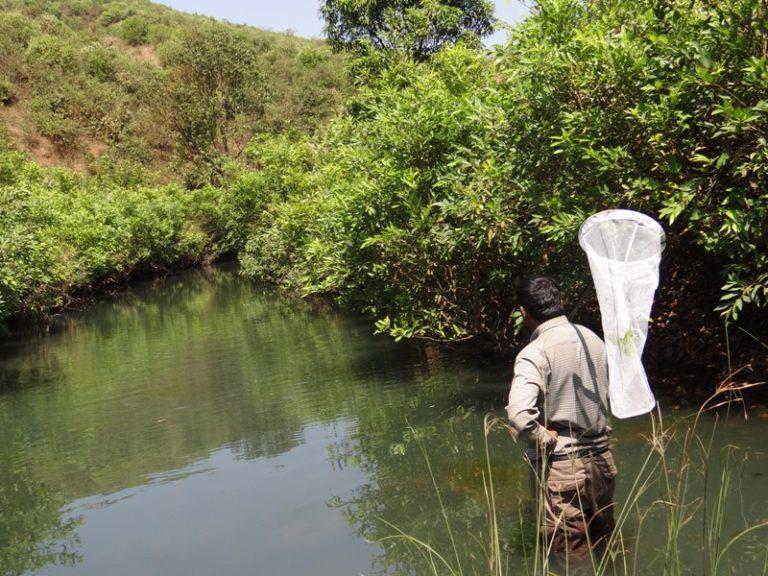
Two-Year Survey Records 143 Odonata Species Across Western Ghats
(MENAFN- ForPressRelease)
Pune, 22 April 2026: A landmark two-year survey across the Western Ghats has revealed a worrying gap in the region's biodiversity: researchers were able to document only about 65% of the dragonfly and damselfly species historically recorded in the region, pointing to a
potential shortfall of nearly l 35% of these ecologically critical insects.
Conducted between February 2021 and March 2023, the study mapped“Odonata” populations, an order of insects comprising dragonflies and damselflies, across 144 sites spanning five states. The scale and spread of the survey make it one of the most extensive
recent efforts to assess freshwater biodiversity in the Western Ghats, a 1,600-kilometre mountain chain along India's west coast and a globally recognised biodiversity hotspot.
The research team, Dr. Pankaj Koparde (Assistant Professor, MIT-WPU Pune), Arajush Payra (PhD Scholar, MIT-WPU Pune), Amey Deshpande (MSc Student, MIT-WPU Pune), and Reji Chandran (Society for Odonate Studies, Kerala), undertook rigorous fieldwork
across a wide range of freshwater habitats, including rivers, streams, waterfalls, ponds, lakes, and dams. Many of these locations were remote and difficult to access, with logistical challenges compounded by terrain and the need for official permissions.
Over the course of the study, the team recorded 143 distinct odonate species, including 40 species endemic to the Western Ghats. However, the overall count represents only around 65% of the species historically known from the region, an alarming gap that raises concerns about species decline and habitat degradation.
Odonates are highly sensitive to environmental changes because they depend entirely on freshwater ecosystems for reproduction. As a result, they are widely regarded as“indicator taxa,” meaning their presence, or absence, directly reflects the ecological health of water
bodies. The missing species, researchers suggest, may be early indicators of deeper
ecological stress.
The study points to multiple, intensifying threats across the Western Ghats. These include linear infrastructure development, hydropower projects, severe pollution, and large-scale land-use changes. Additional pressures such as unregulated tourism, recurring forest fires, and the growing impact of climate change are further fragmenting and degrading these ecosystems.
The conservation status of the species that were recorded also adds to the concern. While Three species, Elattoneura souteri, Protosticta sanguinostigma and Cyclogomphus ypsilon, are currently classified as“Vulnerable,” while most of the observed species fall under the“Data Deficient” and“Not Evaluated” category on the IUCN Red-List of Threatened Species,
indicating significant gaps in scientific understanding.
potential shortfall of nearly l 35% of these ecologically critical insects.
Conducted between February 2021 and March 2023, the study mapped“Odonata” populations, an order of insects comprising dragonflies and damselflies, across 144 sites spanning five states. The scale and spread of the survey make it one of the most extensive
recent efforts to assess freshwater biodiversity in the Western Ghats, a 1,600-kilometre mountain chain along India's west coast and a globally recognised biodiversity hotspot.
The research team, Dr. Pankaj Koparde (Assistant Professor, MIT-WPU Pune), Arajush Payra (PhD Scholar, MIT-WPU Pune), Amey Deshpande (MSc Student, MIT-WPU Pune), and Reji Chandran (Society for Odonate Studies, Kerala), undertook rigorous fieldwork
across a wide range of freshwater habitats, including rivers, streams, waterfalls, ponds, lakes, and dams. Many of these locations were remote and difficult to access, with logistical challenges compounded by terrain and the need for official permissions.
Over the course of the study, the team recorded 143 distinct odonate species, including 40 species endemic to the Western Ghats. However, the overall count represents only around 65% of the species historically known from the region, an alarming gap that raises concerns about species decline and habitat degradation.
Odonates are highly sensitive to environmental changes because they depend entirely on freshwater ecosystems for reproduction. As a result, they are widely regarded as“indicator taxa,” meaning their presence, or absence, directly reflects the ecological health of water
bodies. The missing species, researchers suggest, may be early indicators of deeper
ecological stress.
The study points to multiple, intensifying threats across the Western Ghats. These include linear infrastructure development, hydropower projects, severe pollution, and large-scale land-use changes. Additional pressures such as unregulated tourism, recurring forest fires, and the growing impact of climate change are further fragmenting and degrading these ecosystems.
The conservation status of the species that were recorded also adds to the concern. While Three species, Elattoneura souteri, Protosticta sanguinostigma and Cyclogomphus ypsilon, are currently classified as“Vulnerable,” while most of the observed species fall under the“Data Deficient” and“Not Evaluated” category on the IUCN Red-List of Threatened Species,
indicating significant gaps in scientific understanding.

Legal Disclaimer:
MENAFN provides the
information “as is” without warranty of any kind. We do not accept
any responsibility or liability for the accuracy, content, images,
videos, licenses, completeness, legality, or reliability of the information
contained in this article. If you have any complaints or copyright
issues related to this article, kindly contact the provider above.
Most popular stories
Market Research

More Story







Comments
No comment