




403
Sorry!!
Error! We're sorry, but the page you were looking for doesn't exist.
Kazakhstan Showcases Constitutional Reforms In Talks With S&P, Moody's, And Fitch
(MENAFN- Trend News Agency)
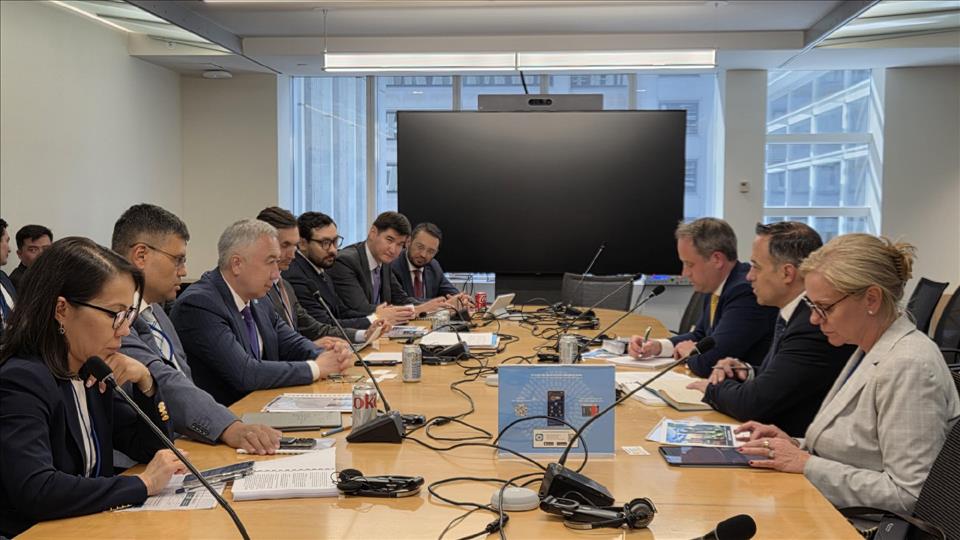
ASTANA, Kazakhstan, April 17. Deputy Prime
Minister and Minister of National Economy of Kazakhstan Serik
Zhumangarin and representatives of S&P, Moody's, and Fitch
discussed the country's constitutional reforms during meetings in
Washington, D.C, Trend reports via the press service of the Kazakh
government.
Zhumangarin emphasized that sustainable economic development in today's environment depends not only on natural resources but primarily on strong institutions, predictability, and public trust. These principles, he noted, are firmly embedded in the country's updated Constitution.
''Among the government's key priorities are the advancement of education, science, innovation, and human capital, identified as strategic pillars for long-term growth,'' he added.
Furthermore, Zhumangarin highlighted Kazakhstan's solid economic performance. Real GDP growth remained robust, reaching 6.5% in 2025. For the current year, growth is projected at 5-5.5%, while the economy expanded by 3% in the first quarter, excluding temporary factors related to oil production.
The Deputy Prime Minister underscored the continuation of structural transformation within the economy. The share of the oil sector in GDP declined significantly-from 16.5% in 2010 to 8.1% in 2024.
Agriculture and fertilizer supply were also discussed as part of the broader economic agenda. Zhumangarin noted that Kazakhstan currently has 27 fertilizer producers, including major companies such as KazAzot and Kazphosphate. Domestic production covers approximately 56% of national demand, while the majority of imports come from Russia, a partner within the Eurasian Economic Union.

Legal Disclaimer:
MENAFN provides the
information “as is” without warranty of any kind. We do not accept
any responsibility or liability for the accuracy, content, images,
videos, licenses, completeness, legality, or reliability of the information
contained in this article. If you have any complaints or copyright
issues related to this article, kindly contact the provider above.
Most popular stories
Market Research

More Story







Comments
No comment