




403
Sorry!!
Error! We're sorry, but the page you were looking for doesn't exist.
NBFC Bank Loan Share Seen Rising To 4445% In FY27 From 43% In H2 FY26: Crisil Ratings
(MENAFN- KNN India)
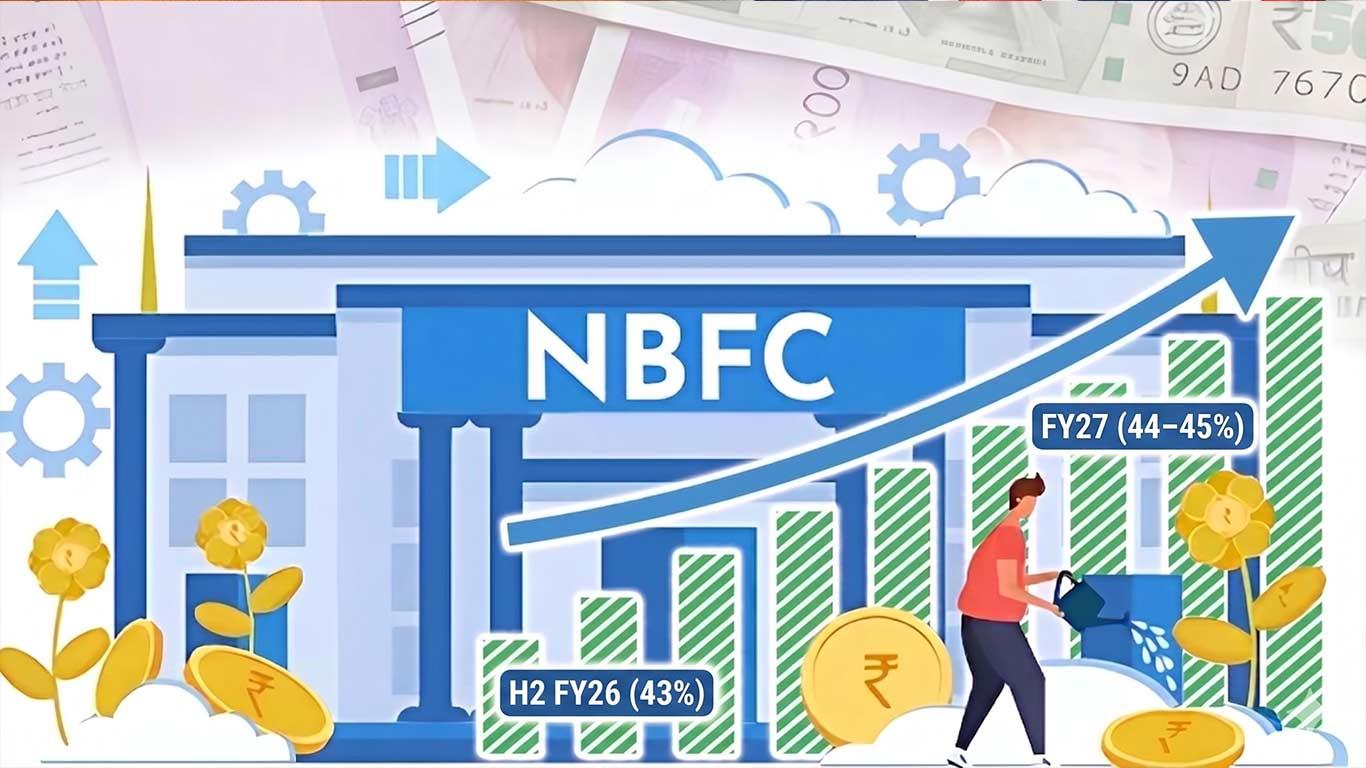
New Delhi, Apr 16 (KNN) The share of bank loans in the overall borrowings of non-banking financial companies (NBFCs) is expected to rise to 44–45 per cent in the current fiscal, up from around 43 per cent in the second half of FY26, according to a report by Crisil Ratings.
The shift is driven by relatively lower bank lending rates compared to other funding sources such as corporate bonds and external borrowings.
Cost Dynamics Favour Bank Credit
Bank lending rates declined steadily through the last fiscal, while bond yields, after softening in the first half, moved higher in the second half and remain elevated.
Malvika Bhotika, Director, Crisil Ratings, said,“With government security (G-sec) and corporate bond yields expected to remain elevated in the near term due to an uncertain macroeconomic environment, corporate bond interest rates are likely to continue to be higher than bank lending rates in the initial part of this fiscal at least. As a result, NBFCs' preference for bank credit will continue. In the base case, we expect the share of bank funding in overall borrowings of NBFCs to increase 100-200 bps this fiscal.”
Diverging Trends in FY26
The report noted that funding patterns shifted notably during FY26. Between January and July 2025, bond yields fell sharply, outpacing the decline in banks' weighted average lending rates (WALR). However, in the latter half, bond yields reversed course and rose above January 2025 levels, while bank lending rates continued to soften.
As a result, bond issuances dropped from Rs 2.1 lakh crore in the first half to Rs 1.4 lakh crore in the second half of FY26.
In contrast, bank lending to NBFCs saw a sharp increase of about Rs 2.5 lakh crore in the second half, compared to a slight contraction in the first half.
Securitisation Gains Traction
Securitisation emerged as a key alternative funding source, with volumes rising 30 per cent to around Rs 1.3 lakh crore in the second half of FY26. Stable collection efficiencies supported this growth, particularly benefiting mid- and small-sized NBFCs.
The report expects securitisation to remain an important tool for resource mobilisation in the near term.
ECB Borrowings to Stay Subdued
External commercial borrowings (ECBs), which saw increased traction in the first half of FY26, are likely to remain muted in the near term due to geopolitical uncertainties and exchange rate volatility.
Rounak Agarwal, Associate Director, Crisil Ratings, said,“Given the increased traction for ECBs last fiscal, their share in the resource mix of NBFCs is estimated to have risen ~100 bps. In the near term, a sharp rupee depreciation amid ongoing geopolitical uncertainties could make this route less attractive.”
“However, the recent amendment in ECB regulations, covering aspects such as maturity period, end use, borrowing limit and hedging requirements, is expected to provide greater flexibility for NBFCs to consider the ECB route over the medium to long term once exchange rate volatility stabilizes,” Agarwal added.
Need for Diversified Funding Mix
The report emphasised that maintaining a diversified funding mix will be critical for NBFCs to ensure adequate liquidity and manage borrowing costs efficiently.
Such flexibility becomes especially important during periods of macroeconomic or regulatory shifts, as it enables lenders to navigate uncertainties and sustain growth.
(KNN Bureau)

Legal Disclaimer:
MENAFN provides the
information “as is” without warranty of any kind. We do not accept
any responsibility or liability for the accuracy, content, images,
videos, licenses, completeness, legality, or reliability of the information
contained in this article. If you have any complaints or copyright
issues related to this article, kindly contact the provider above.
Most popular stories
Market Research

More Story








Comments
No comment