



403
Sorry!!
Error! We're sorry, but the page you were looking for doesn't exist.
Inside The Struggle Of Tirah's Displaced Families Waiting For Relief And Return
(MENAFN- Tribal News Network) By Muhammad Rehan
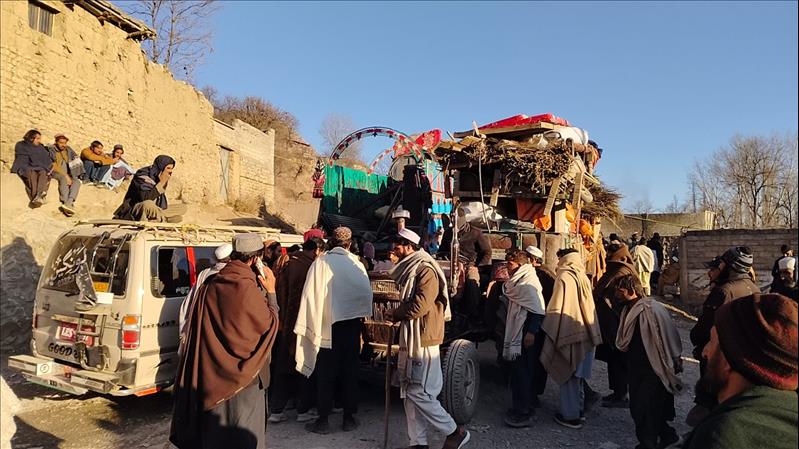
Abdul Baqi and eight members of his family are currently living in caves along a seasonal stream in the Hisara area near Bara.
Due to a possible military operation in Tirah Valley, they, like many other families, were forced to leave their homes for the second time in early January. Although the deadline for the return of displaced persons under an agreement has passed, the repatriation process has yet to begin.
Abdul Baqi and other affected families are facing severe hardships and are eager to return to their homes.
He says they had proper houses in Tirah Valley where basic facilities were available, and they were living a better life through income generated from their agricultural lands.
Under the current circumstances, they are not only deprived of basic necessities but are also facing uncertainty. According to him, the place where they are currently residing belongs to someone else, and they could be evicted at any time.
Also Read: North Waziristan: How did Zarb-e-Azb disrupt education for thousands of children?
Regarding the displacement from Tirah Valley, a 37-point agreement was reached in late December last year between a 24-member committee representing local elders, the district administration, and security officials.
Under this agreement, evacuation was to be completed by January 25, and the return process was scheduled to begin on April 10. However, despite the passage of the deadline, obstacles in registration, verification, and financial assistance have not yet been resolved.
The Displaced Persons Movement has been staging a protest camp for the past two months outside Bara Press Club, demanding solutions to the issues faced by the affected families.
According to the movement's spokesperson, Sohbat Khan Afridi, the 24-member committee is not presenting the facts accurately regarding the return process. He said that roads remained blocked for five days due to snowfall, which delayed the evacuation. On this basis, the return date was revised from April 10 to April 15.
He further stated that promises made to the affected people have not yet been fulfilled, leaving them in severe distress.
According to him, the movement's primary demand is the immediate return of displaced persons to their homes, as their houses, markets, forests, and agricultural lands are being destroyed.
In response to a question, he said that upon the invitation of the Chief Minister of Khyber Pakhtunkhwa's brother, they presented their demands at the Chief Minister House, where they were assured of an upcoming meeting with the Chief Minister.
According to district authorities, the displacement process began on November 10 last year due to insecurity in the valley, while the registration and financial assistance process for displaced families started on January 5.
Although the agreement set April 10 as the return date, committee members say consultations with relevant authorities are ongoing to resolve issues related to registration and financial aid and to finalize a plan for return.
Maulana Izzatullah, an active committee member and a leader of Jamiat Ulema-e-Islam (F), said that the final return date would be determined soon. He added that he would raise the issue, along with other concerns, in a meeting with the Chief Secretary.
He acknowledged that the grievances of the affected people are valid and require immediate attention, as they are currently facing serious difficulties. He assured that the government is implementing the agreement, although some steps have been delayed. If further obstacles arise, alternative plans are also in place.
According to Muhammad Fawad, Deputy Director Operations at the Provincial Disaster Management Authority (PDMA), a total of 33,833 families displaced from Tirah have been registered so far. He said that around 15,000 families have been provided Rs240,000 each, amounting to over Rs3.5 billion in total.
He clarified that reports of a Rs10,000 deduction are incorrect and that the amount is part of a pre-defined procedure. Additionally, affected families will receive Rs35,000 per month for two months, along with Rs25,000 at the time of return.
Sohbat Khan Afridi also stated that recent heavy rains have partially or completely damaged more than two houses in Tirah Valley. He alleged that contractors involved in development projects are damaging the homes and properties of poor residents, and incidents of theft of construction materials are also being reported.
He added that due to the effective strategy of the Displaced Persons Movement, deforestation has decreased, but reports of damage to commercial centers are concerning.
Despite two months having passed, no affected family has yet received the monthly stipend, while many families are complaining about not receiving the Rs240,000 assistance.
According to PDMA, the responsibility for issuing registration tokens, transportation expenses, and food provision lies with the district administration. In August last year, the registration procedure for displaced families was revised, assigning NADRA the responsibility for immediate verification. The data is then sent to district authorities through PDMA, and after final verification, a list of eligible beneficiaries is prepared.
Regarding the registration of the Akakhel tribe in Tirah, authorities said the process had been initiated but was later temporarily halted. Its resumption depends on instructions from the district administration and security forces.
Before any potential military operation in other areas, villages are identified and their data is entered into the NADRA system. However, individuals with dual residences are not registered.
This has been a major issue in Tirah, where a large number of people from settled areas also came for registration, with ID cards showing addresses in Landi Kotal, Bara, Peshawar, or other regions.
According to officials, despite Tirah being granted the status of a sub-division, the NADRA system and administrative structure remain outdated. Polio data and assistance from the 24-member committee are also being used in the verification process, but issues persist.
Repeated attempts were made to obtain the stance of district authorities regarding the problems faced by displaced families and the start of the return process, but no official response was received.

Legal Disclaimer:
MENAFN provides the
information “as is” without warranty of any kind. We do not accept
any responsibility or liability for the accuracy, content, images,
videos, licenses, completeness, legality, or reliability of the information
contained in this article. If you have any complaints or copyright
issues related to this article, kindly contact the provider above.
Most popular stories
Market Research

More Story



Comments
No comment