




403
Sorry!!
Error! We're sorry, but the page you were looking for doesn't exist.
Ghost Of Suez Haunts Trump's Iran War
(MENAFN- Asia Times)
There is a particular kind of strategic catastrophe that announces itself dressed in the garb of bold necessity. History's statesmen rarely declare that they are about to blunder into an unwinnable quagmire; they speak instead of existential threats forestalled, of windows of opportunity closing, of regimes too dangerous to be allowed to survive.
It is a language we have heard before. We are hearing it again. On February 28, 2026, the United States and Israel launched a series of strikes against Iran, aimed, their governments said, at inducing regime change and eliminating Tehran's nuclear and ballistic missile programs.
The strikes came at a peculiarly telling moment: just before hostilities began, Oman's foreign minister had announced a significant breakthrough in indirect US-Iran nuclear negotiations, with Iran agreeing to never stockpile enriched uranium and to full IAEA verification.
Peace, we were told, was“within reach.” It was destroyed from the air before the ink of any agreement could dry. To a student of Middle Eastern history, the parallels with October 1956 are not merely suggestive - they are, in their essential structure, almost embarrassingly precise.
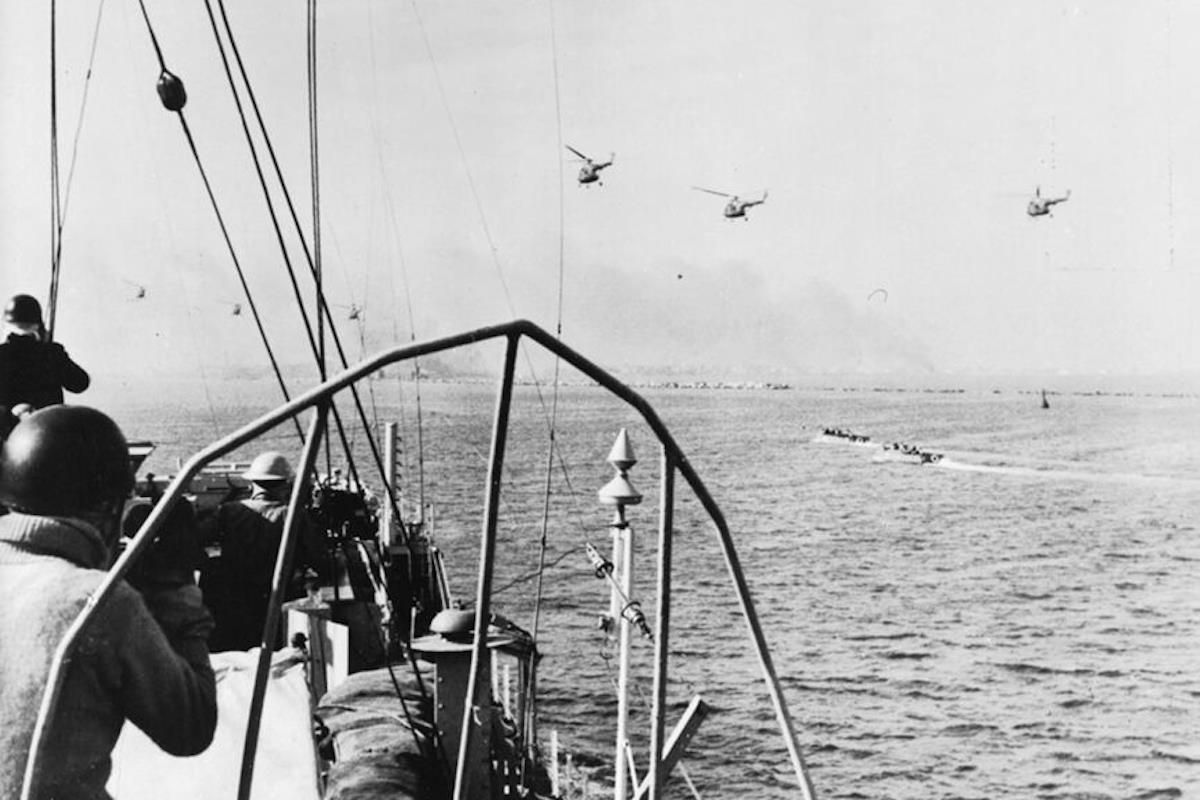
Recall the anatomy of the Suez adventure. Britain and France, chafing at the nationalist pretensions of Gamal Abdel Nasser and the loss of the canal, entered into a secret arrangement with Israel.
The plan was elegantly cynical: Israel would attack Egypt across the Sinai; London and Paris would then“intervene” as ostensible peacemakers, demanding both sides stand down from the canal zone - which they knew Egypt would refuse - thereby furnishing a pretext to seize the waterway themselves.
The justifications offered to the public shifted kaleidoscopically: it was about freedom of navigation; it was about containing Soviet influence; it was about preventing a dangerous authoritarian from acquiring too much power.
Latest stories Transactional diplomacy and strategic ambiguity on Taiwan China targets US trade barriers amid Section 301 probes A major disaster for Russia in shipyard attackWhat it was actually about, stripped of its rhetorical dressing, was the reassertion of waning imperial authority and the settling of regional scores under the cover of high principle.
Now examine what we have been told about the Iran war's origins. Trump administration officials have offered conflicting explanations for starting the war: to pre-empt Iranian retaliation against US assets, to ward off an imminent Iranian threat, to destroy Iran's missile and military capabilities, to prevent Iran from obtaining a nuclear weapon, to secure Iran's natural resources, and to achieve regime change.
Six rationales, each subtly different, each available for deployment depending on the audience. This is not the language of strategic clarity. This is the language of a policy in search of a justification it does not yet possess.
And the collusion? According to the Washington Post, Crown Prince Mohammed bin Salman had multiple phone calls with Trump, urging him to attack Iran, and Trump's decision came after the Saudi Arabian and Israeli governments lobbied him repeatedly.
In 1956, it was the Protocol of Sèvres - a secret meeting in a French villa where the conspirators carved up their roles. In 2026, it was phone calls from Riyadh and Jerusalem to a president who, by all accounts, needed persuading, until suddenly he didn't.
The deepest parallel, however, is the one that should give Americans most pause. In 1956, the United States played the role of the sober, restrained power.
Dwight Eisenhower - a man who had actually seen war - was furious at the Anglo-French-Israeli adventure, not because he loved Nasser, but because he understood that launching wars of dubious legality against sovereign nations while nuclear negotiations were underway was precisely the kind of reckless gambit that unraveled international order.
He forced Britain and France to back down. He absorbed the political discomfort of opposing his closest allies because he grasped the long-term strategic stakes. In 2026, there is no Eisenhower. America is the adventurer. America is Eden, not Ike.
The consequences have followed a pattern familiar to anyone who bothered to study the history they were about to repeat. Iran has launched strikes across nine countries in the region, hitting US military bases in Bahrain, Jordan, Kuwait, Qatar and Saudi Arabia, as well as energy infrastructure across the Gulf.
Trump's approval rating has fallen to 36%, its lowest point of his second term, driven by the rising cost of living and growing public disapproval of the war. Global energy and food prices continue to rise, and the conflict shows no signs of ending.
In 1956, the Suez adventure collapsed within days under American and Soviet pressure. Britain's humiliation was so total that it accelerated the final dissolution of the British Empire and triggered a financial crisis that forced a prime ministerial resignation.
The lesson drawn - eventually, reluctantly - was that wars launched on shifting pretexts, against the grain of international diplomacy, tend to produce outcomes their architects never envisioned.
The strategic architecture of the current war follows the same internal logic of escalation that has undone similar ventures throughout the modern era. You bomb a country's leadership, kill its Supreme Leader, and expect - what exactly?
Sign up for one of our free newsletters-
The Daily Report
Start your day right with Asia Times' top stories
AT Weekly Report
A weekly roundup of Asia Times' most-read stories
That a traumatized population will rise up in gratitude and install a pro-Western government? That a state with decades of experience surviving sanctions and military pressure will simply fold? The Islamic Republic may be weakened. It is not, as its ongoing missile salvos make abundantly clear, finished.
The advocates of this war will tell you that the situations are not comparable; that Iran's nuclear program represented a genuine and imminent threat that Egypt's canal nationalization did not; that the Middle East of 2026 is not the Middle East of 1956.
They are right that the details differ. They are catastrophically wrong that the structural dynamic does - the dynamic of a coalition of states launching a war of choice against a regional power, while diplomatic alternatives were actively on the table, under the cover of pretexts that kept multiplying because none of them was quite sufficient on its own.
The British prime minister said he did not believe in regime change from the skies. It is a sentence Anthony Eden might have found useful in the autumn of 1956, had anyone thought to offer it to him.
The question now is not whether the historical analogy is imperfect - all analogies are. The question is whether Washington possesses the institutional wisdom to recognize, before the damage compounds further, that it has walked into a trap of its own construction.
In 1956, America provided that corrective. Today, it must find the corrective within itself. History, as always, is watching.
This article was originally published on Leon Hadar's Global Zeitgeist and is republished with kind permission. Become a subscriber here.
Thank you for registering!
-
Share on X (Opens in new window)
Share on LinkedIn (Opens in new window)
LinkedI
Share on Facebook (Opens in new window)
Faceboo
Share on WhatsApp (Opens in new window)
WhatsAp
Share on Reddit (Opens in new window)
Reddi
Email a link to a friend (Opens in new window)
Emai
Print (Opens in new window)
Prin

Legal Disclaimer:
MENAFN provides the
information “as is” without warranty of any kind. We do not accept
any responsibility or liability for the accuracy, content, images,
videos, licenses, completeness, legality, or reliability of the information
contained in this article. If you have any complaints or copyright
issues related to this article, kindly contact the provider above.
Most popular stories
Market Research

More Story







Comments
No comment