




403
Sorry!!
Error! We're sorry, but the page you were looking for doesn't exist.
What To Expect From Federal Reserve In 2026?
(MENAFN- The Peninsula)
The Peninsula
Doha, Qatar: At the beginning of 2026, QNB's baseline macroeconomic view for the United States remained broadly constructive.
According to QNB Economic Commentry, latest powerful wave of artificial intelligence (AI) related capital expenditures, improving productivity dynamics, and the gradual normalisation of shelter inflation were expected to create a“Goldilocks” environment for the US economy.
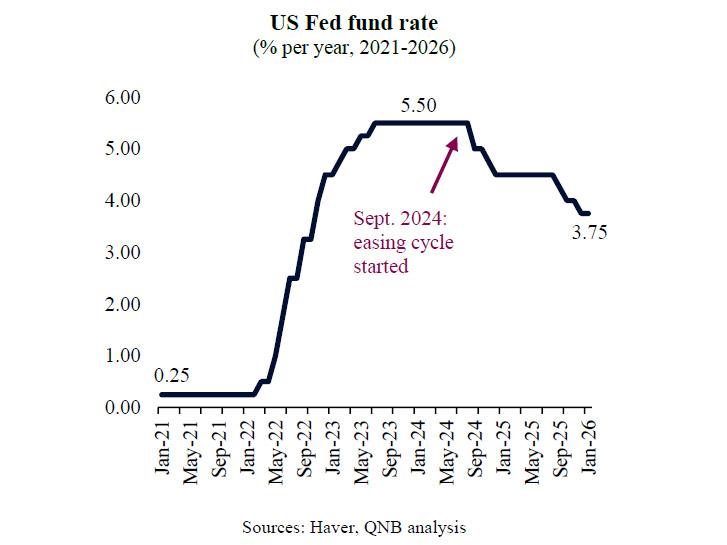
In such a scenario, economic growth would remain robust while inflation continued to moderate. This combination would be further supported by the Federal Reserve (Fed) to proceeding with the monetary easing cycle that began in September 2024, gradually bringing policy down to more accommodative levels.
However, the optimistic narrative has been challenged early in the year. A series of adverse developments has raised question marks about the macroeconomic outlook.
These include renewed trade policy tensions, increased volatility in US foreign policy, and major disruptions in global commodity markets following the geopolitical shock. o enact rate hikes this year.
Analysts continue to expect the Fed to deliver two additional rate cuts in 2026, extending the easing cycle that started in September 2024 and bringing the policy rate to around 3.25% by year end.
Three factors sustain our view. First, supply side shocks and inflationary pressures driven by geopolitical developments tend to be temporary and are largely immune to interest rate changes. Monetary policy operates primarily by influencing financial conditions and aggregate demand. It is therefore poorly suited to address disruptions that originate from the supply side of the economy, including energy shortages, trade restrictions, or logistical bottlenecks.
Historical experience shows that central banks typically“look through” such episodes when they are expected to be temporary. Attempting to offset supply driven inflation through tighter monetary policy would risk amplifying the negative effects on economic activity while doing little to reduce price pressures. As long as geopolitical disruptions appear to be temporary as of today, the Fed is likely to treat them as transitory developments rather than as a reason to halt its easing cycle.
Second, although higher hydrocarbon prices contribute to inflation, their overall impact on the US consumer price index (CPI) is limited.
Energy and transportation together account for only about 12.8% of the US consumption basket. Even significant increases in fuel or oil prices therefore translate into relatively moderate effects on headline inflation.
As a result, the overall inflation trajectory should remain consistent with a gradual return toward the Fed's target. Breakdown of US CPI basket (% of total by major component).
Third, the balance of risks for the Fed has increasingly shifted from inflation toward employment. Labour market conditions have softened noticeably in recent quarters. Job openings have declined significantly from their post pandemic peaks, layoffs have accelerated in several sectors, and private payroll indicators point to further moderation in hiring conditions.
At the same time, the rapid adoption of AI technologies is encouraging companies to improve efficiency and rationalise labour costs. This combination of cyclical cooling and structural productivity improvements suggests that the US labour market is transitioning from a period of excess demand to one characterised by gradually increasing slack.
For a central bank operating under a dual mandate of price stability and maximum employment, signs of labour market deterioration will strengthen the case for additional policy easing.
All in all, while geopolitical tensions and commodity price volatility have complicated the macroeconomic outlook for 2026, they are unlikely to derail the broader disinflationary trend in the US economy. In our view, as of today, supply impact on inflation should remain contained, and labour market conditions are gradually softening. Taken together, these factors support our expectation that the Fed will continue its gradual normalisation of monetary policy, delivering two additional rate cuts this year and bringing the policy rate to 3.25%.

Legal Disclaimer:
MENAFN provides the
information “as is” without warranty of any kind. We do not accept
any responsibility or liability for the accuracy, content, images,
videos, licenses, completeness, legality, or reliability of the information
contained in this article. If you have any complaints or copyright
issues related to this article, kindly contact the provider above.
Most popular stories
Market Research

More Story







Comments
No comment