




403
Sorry!!
Error! We're sorry, but the page you were looking for doesn't exist.
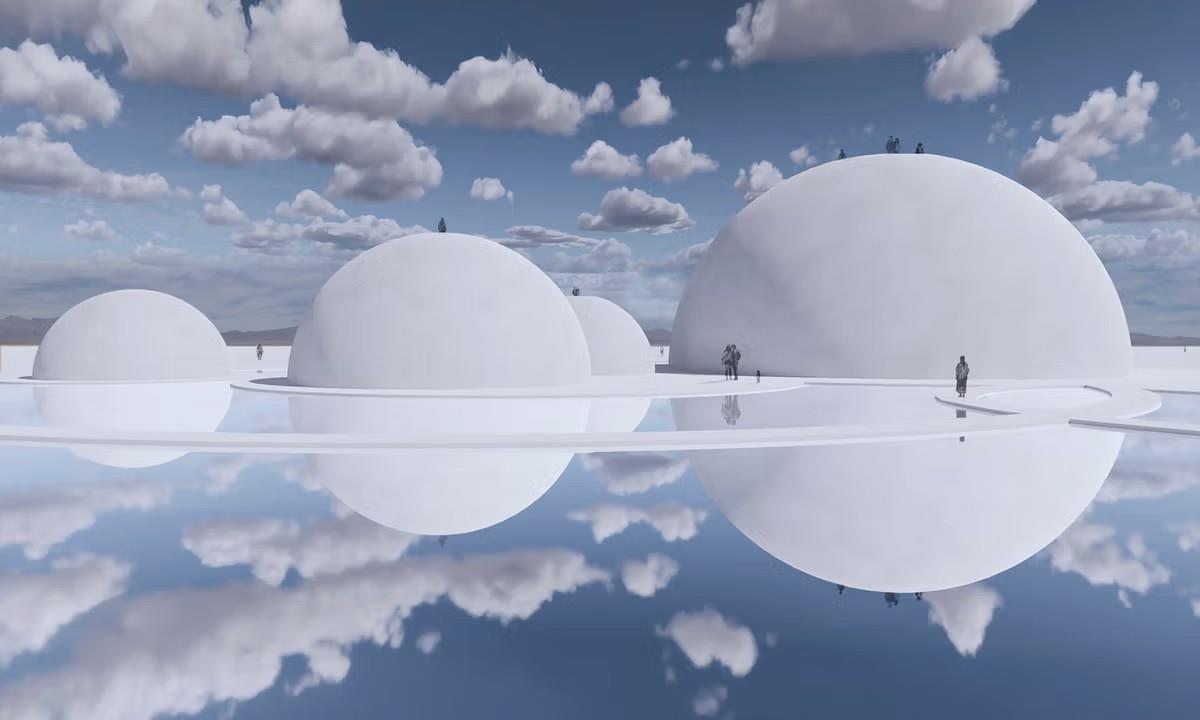
Tomás Saraceno And Indigenous Communities Build Art Complex In Argentine Salt Flats The Art Newspaper International Art News And Events
(MENAFN- USA Art News)
Tomás Saraceno Builds a Salt“Sanctuary of Water” in Argentina's Lithium-Rich Salinas Grandes
At 11,300 feet above sea level, the salt flats of Salinas Grandes can turn, after rain, into a vast natural mirror - a white expanse that briefly holds the sky on its surface. This high-desert landscape spanning the provinces of Jujuy and Salta is also part of one of the world's largest lithium reserves, where the water costs of extraction have become a defining environmental and political fault line.
Now, construction is underway on El Santuario del Agua (The Sanctuary of Water), a monumental land-art project by Argentine artist Tomás Saraceno (b. 1973), developed in collaboration with Red Atacama, a coalition of Indigenous communities. The site is scheduled to open in October.
The work comprises five semicircular structures built principally of salt, in varying sizes from roughly seven feet to 99 feet in diameter and reaching up to 50 feet high. Saraceno has described the forms as incomplete until the landscape itself finishes them: when water returns, the structures will appear whole in reflection,“when the water returns its hidden half.” Visitors will be able to climb stairs carved into the back of each structure to reach elevated viewing platforms.
The five elements draw on the tradition of apachetas - stone mounds placed as offerings to Pachamama, the Andean earth deity - and take their names from Andean cosmology: Inti, Killa, Ch'aska, Hawcha, and Tiqsimuyu.
The project's setting is inseparable from its message. Salinas Grandes is an arid region that receives about 300 millimeters of rain per year. In lithium production, water is central: to produce a single ton of lithium carbonate used in smartphone batteries, more than two million liters of fresh groundwater are evaporated.
In a joint message, Saraceno and representatives of Red Atacama framed water not as a resource but as a living presence.“Water - puri - is not an element but a living being, an essential part of life,” they wrote. Indigenous leaders working alongside Saraceno on the project include Miguel Casimiro, Iván Arjona Acoria, Romualdo Fabián, Justo Casimiro, Celeste Valero, Andrei Fernández, Álvaro Simón Padrós.
Saraceno, who is based in Berlin and is known for a practice that moves between art and science, has exhibited at the Venice Biennale and the Metropolitan Museum of Art in New York, and has collaborated with institutions including Nasa and MIT. With El Santuario del Agua, the ambition extends beyond a site-specific installation: it is conceived as a model for territorial and economic sovereignty.
“We are building a sanctuary, a work of art that seeks to reinforce the activism Atacameño communities have long led in defence of water and territory,” Saraceno said.“It is about safeguarding ancestral knowledge and resisting development models imposed without consultation.”
Organizers say the project is designed to establish a community-led model of sustainable tourism that can generate funds and long-term employment while responding to extractive economies. All income will remain with the communities, which will own and administer the site. The organizers expect between 100 and 350 visitors per day in an area that already receives more than 1,500 tourists daily. Admission will be $20.
El Santuario del Agua has been shaped over more than a decade of collaboration with Indigenous communities and the environmental justice movement Aerocene, which has sought to rethink how art can operate within climate justice, territorial sovereignty, and community economies. Ahead of the October opening, the project will be previewed in an exhibition of Saraceno's work opening in July at Haus der Kunst in Munich, curated by Sarah Theurer and Andrea Lissoni.
In a landscape where water is both sacred and contested, Saraceno's salt-built forms propose a different kind of infrastructure: one that asks visitors to look, climb, and reflect - and to consider what the energy transition extracts, and from whom.

Legal Disclaimer:
MENAFN provides the
information “as is” without warranty of any kind. We do not accept
any responsibility or liability for the accuracy, content, images,
videos, licenses, completeness, legality, or reliability of the information
contained in this article. If you have any complaints or copyright
issues related to this article, kindly contact the provider above.
Most popular stories
Market Research

More Story






Comments
No comment