


Twenty Years After Its Creation, The Human Rights Council Is Under Pressure


Based in Geneva, I cover the work of the United Nations and other international organisations there. My focus is on humanitarian aid, human rights, and peace diplomacy. I studied business and economics at the University of Lausanne before training as a journalist and joining SWI swissinfo in 2021.
-
More from this aut
French Departm
-
Deutsch
de
Zwanzig Jahre Menschenrechtsrat: Das wichtigste UNO-Gremium steht unter Druck
Read more: Zwanzig Jahre Menschenrechtsrat: Das wichtigste UNO-Gremium steht unter
Français
fr
Vingt ans après sa création, le Conseil des droits de l'homme est mis sous pression
Original
Read more: Vingt ans après sa création, le Conseil des droits de l'homme est mis sous pre
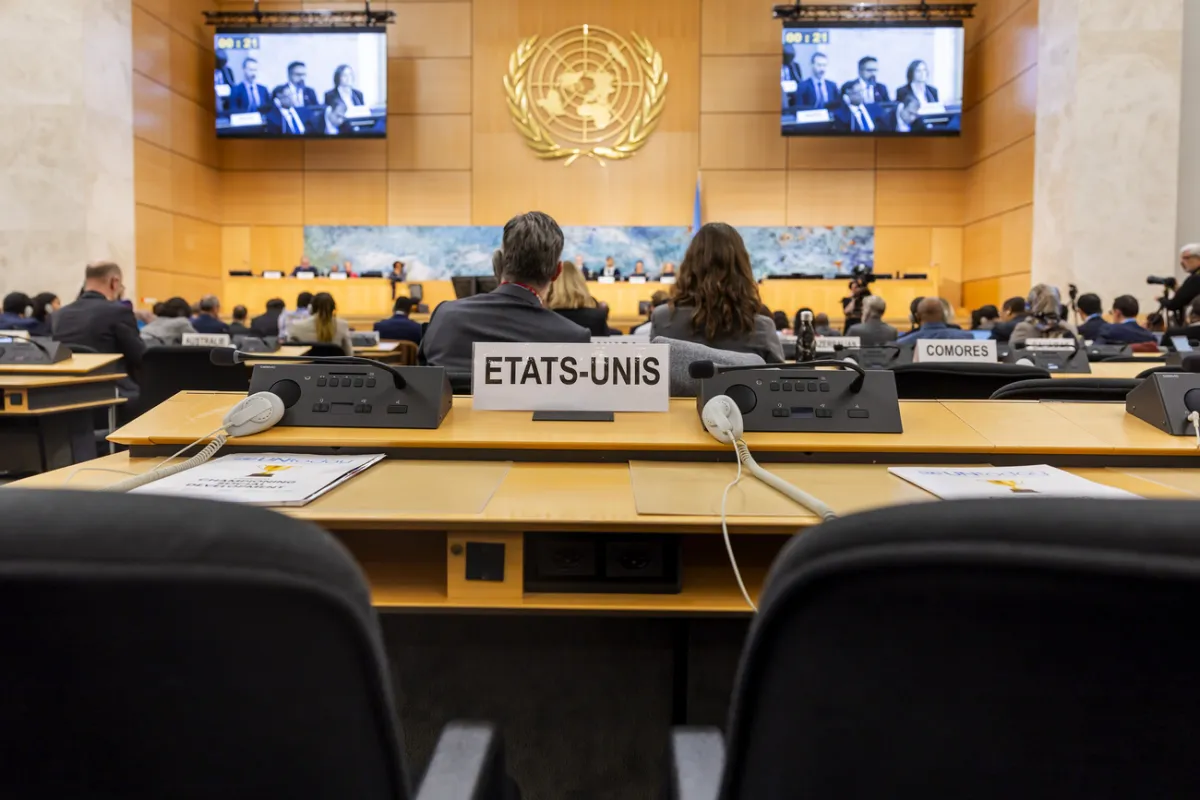
The Human Rights Council – the main UN body responsible for protecting fundamental rights in the world – meets on Monday in Geneva for its first session of the year.
From February 23 to March 31, its 47 members will have the opportunity to address a wide range of issues – from new technologies to children's rights and climate change – and many countries that require their attention. Among them are some of the worst humanitarian crises, including Sudan, Ukraine, Iran and the Occupied Palestinian Territories.
Like last year, the debates will take place in a difficult climate, marked by geopolitical tensions – wars in Ukraine and Gaza in particular, US tariffs – as well as the liquidity and financial crisis that the UN is going through.
Cash strappedAt the end of January, UN Secretary-General Antonio Guterres warned of a risk of“imminent financial collapse” of the organisation if member states continue to pay their budgetary contributions late or partially.
To date, only 69 of the 193 member countries have paid their bills for 2026. Neither the United States nor China, the two largest donors, are among them.
The lack of liquidity and budget cuts by some countries have forced the UN to draw up a plan of reforms and savings, which does not spare the Office of the High Commissioner for Human Rights. Its expected budget in 2026 has been reduced by 16% to $624.3 million. Faced with this situation, the Human Rights Council had to shorten its session from six to five and a half weeks.
“This session will test the ability of the Human Rights Council to work under duress while remaining faithful to its mandate,” the president of the Council, Indonesian Ambassador Sidharto Reza Suryodipuro, told the press.
In recent years, the proliferation of resolutions calling for follow-up in the Council has resulted in the expansion of its programme and thus the lengthening of its sessions. This is a sign of the growing importance that member states attach to this body, which is celebrating its 20th anniversary, while the Security Council remains paralysed.
Services reducedSpeaking times will be reduced and some services – particularly interpretation – could be disrupted. These cost-saving measures are worrying NGOs.
“Shortening a session of the Council is tantamount to reducing the ability of civil society to engage in one of the few UN bodies that accepts and encourages its participation,” said Raphaël Viana David, programme manager at the International Service for Human Rights (ISHR), an NGO based in Geneva and New York.
NGOs regret in particular the disappearance of the hybrid modalities, temporarily introduced during the Covid-19 pandemic, which allowed remote access to the Council for organisations that do not have the means to travel to Geneva. A system that the member states consider too costly.
Fact-finding missions threatened?Even more worryingly, last year, the lack of cash prevented the implementation of some decisions of the Human Rights Council.
A commission of inquiry to document abuses in eastern Democratic Republic of Congo (DRC) – requested by the country's authorities and voted by the Council in February 2025 – has still not been able to begin its work due to a lack of cash. A situation that the Afghanistan investigative mechanism is also experiencing.
More More International Geneva UN Human Rights Council demands investigation into Iran's 'brutal' repressionThis content was published on Jan 26, 2026 The Geneva-based UN Human Rights Council has condemned Iran for rights abuses and mandated an investigation into a recent crackdown on anti-government protests that killed thousands of people.
Read more: UN Human Rights Council demands investigation into Iran's 'brutal' repre
Legal Disclaimer:
MENAFN provides the
information “as is” without warranty of any kind. We do not accept
any responsibility or liability for the accuracy, content, images,
videos, licenses, completeness, legality, or reliability of the information
contained in this article. If you have any complaints or copyright
issues related to this article, kindly contact the provider above.


Comments
No comment