


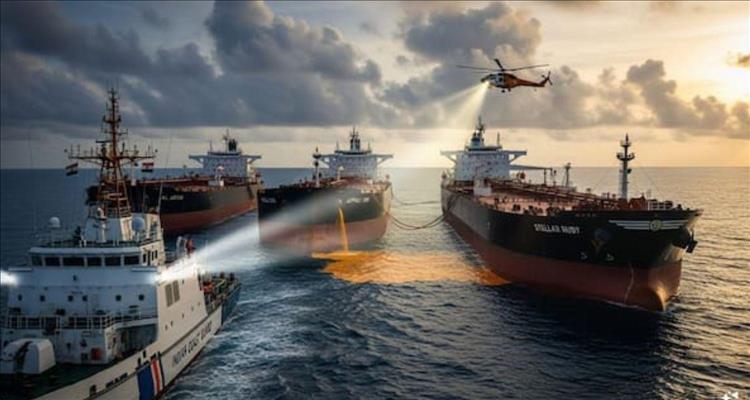
India Intercepts US-Sanctioned Tankers Linked To Iran


Indian authorities have seized three oil tankers that were under United States sanctions and linked to Iranian oil networks, intensifying surveillance of the country's maritime zones to stem illicit trade and enforce sanctions compliance, officials familiar with the matter said. The vessels, operating under multiple identities to evade detection, were intercepted about 100 nautical miles west of Mumbai in the Arabian Sea and have been escorted to port for detailed inspection and investigation.
The three tankers, identified as Stellar Ruby, Asphalt Star and Al Jafzia, were reported to have frequently changed flags and names, a tactic commonly used to conceal ownership and shipment origins. Analysts say such practices complicate enforcement of international sanctions and maritime law, making vessel tracking and monitoring a major challenge for coastal states.
Sources with direct knowledge of the interdictions told reporters that the ships were seized after Indian maritime authorities detected suspicious ship-to-ship transfer activity within India's Exclusive Economic Zone. This practice, they said, can be used to mask the origin of oil cargoes and undermine sanctions regimes aimed at limiting the flow of crude derived from sources subject to punitive measures.
The seizures coincide with a broader push by New Delhi to tighten enforcement in its waters, deploying about 55 Coast Guard ships and up to a dozen aircraft to support around-the-clock monitoring. Officials described the expanded maritime surveillance as a necessary step to deter networks that use the Indian Ocean and adjacent seas for complex, opaque oil trading operations.
The United States Treasury's Office of Foreign Assets Control had previously designated three vessels last year - Global Peace, Chil 1 and Glory Star 1 - with International Maritime Organization numbers that match those of the tankers now in Indian custody. Maritime data shows that two of the seized vessels have links to Iranian shipping activity: Al Jafzia is reported to have carried Iranian fuel oil to Djibouti in 2025, and Stellar Ruby has been flagged in Iranian registries. Asphalt Star's voyages have been mainly around East Asia, including China, according to ship-tracking records.
See also Mubadala Capital launches expanded co-investment fund for private marketsTehran's state-run media, however, has rejected any connection between the seized vessels and the National Iranian Oil Company, stating that neither the cargoes nor the tankers are linked to the state oil enterprise. The Iranian response underscores the diplomatic sensitivities surrounding enforcement actions tied to sanctions and maritime security.
Experts in shipping compliance and sanctions enforcement observe that the prevalence of“shadow fleets” - networks of ageing or reflagged tankers with opaque ownership and documentation - has grown as a means of circumventing international restrictions. These oil transport networks are estimated to be worth billions of dollars in trade and often rely on false paperwork and mid-sea transfers to obscure sources of crude.
The Indian Coast Guard's stepped-up operations reflect concern among regional powers about the use of their waters for such activities, which can have economic and legal implications. Coastal enforcement agencies increasingly employ satellite tracking, automatic identification system data and aerial reconnaissance to identify anomalous behaviour at sea.
Maritime analysts note that India's move may also be viewed within the context of evolving geopolitical ties, including closer cooperation with the United States on sanctions enforcement and broader security goals. Washington recently adjusted import tariffs on certain goods from India following bilateral agreements on energy and trade, signalling a warming of economic relations that could dovetail with coordinated action against sanctions evasion.
Commercial shipping insurers and risk advisory firms have been warning about the environmental and regulatory hazards posed by older tankers operating outside conventional oversight. Without proper maintenance and oversight, such vessels can pose threats ranging from oil spills to navigation hazards, adding a safety dimension to enforcement priorities.
See also Middle East Asia bond flows gather paceAlso published on Medium.
Notice an issue? Arabian Post strives to deliver the most accurate and reliable information to its readers. If you believe you have identified an error or inconsistency in this article, please don't hesitate to contact our editorial team at editor[at]thearabianpost[dot]com. We are committed to promptly addressing any concerns and ensuring the highest level of journalistic integrity.

Legal Disclaimer:
MENAFN provides the
information “as is” without warranty of any kind. We do not accept
any responsibility or liability for the accuracy, content, images,
videos, licenses, completeness, legality, or reliability of the information
contained in this article. If you have any complaints or copyright
issues related to this article, kindly contact the provider above.


Comments
No comment