




403
Sorry!!
Error! We're sorry, but the page you were looking for doesn't exist.
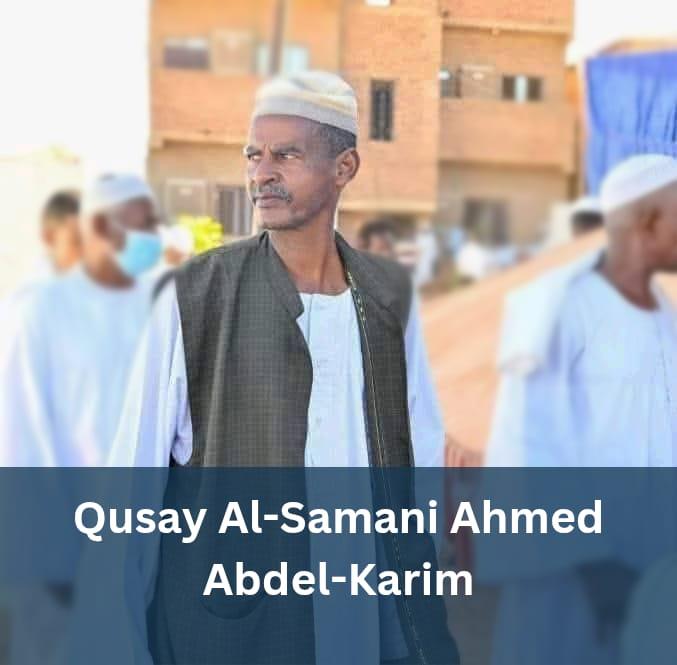
Tales From Inside The Battlefield When A Bag Of Medicine Becomes An Accusation... A Militia Kills A Citizen
(MENAFN- Sudanow Magazine)
By: Eng. Nada Abdelsalam
Khartoum (Sudanow) -
Violations committed by the rebel militia continue unabated: killings, abuse of civilians, forcing people out of their homes in villages and cities, and turning them into the displaced and the refugee. Among the tragedies of this war is a story narrated to Sudanow by Fathiya Mohamed Youssef, a lawyer and certified contracts registrar, who was present at the moment of the killing and served as an eyewitness to this painful incident. This time, she speaks not as a lawyer, but as a human being stripped of any protection.
She saw fear walking on two legs in streets she had known since childhood. Homes lost their sanctity, and faces no longer resembled their owners. There was no sound louder than silence, and no law present to say,“Stop.” She says that on the eleventh of Ramadan, March 2024, killing did not need a reason.
We write this story not to reopen wounds, but to prevent forgetting.
A bag of medicine was enough to accuse the young man Qusay Al-Samani Ahmed Abdel-Karim, and to shoot him five times inside his home, on his bed, in front of his wife, in a neighborhood where he had grown up among his family and neighbors-Al-Sadaga neighborhood in the city of Al-Hasahisa, Gezira State.
After the army liberated the area, and after she performed Umrah dedicating its reward to the soul of Qusay and to the soul of her mother-his maternal aunt-who passed away less than a month after his killing out of grief, Fathiya spoke. She said:
“Qusay was my cousin and our neighbor since childhood. Our houses were adjacent, our memories one: neighborhood games, school, and growing up in the same place. Qusay was a kind, gallant man, loved by everyone. He had no connection to the army-an unarmed civilian. He worked on a passenger bus on a public transport line, earning his living from the sweat of his brow. People of the neighborhood knew him as a simple, quiet man.
That day, he felt unwell and went to see a doctor. He left carrying a bag of medicine-nothing more.
There, a group of militia members who controlled the area noticed him. They followed him with suspicious eyes and assumed the bag contained money, and that he had sold his bus. A delusion that turned into a death sentence.
They let him return home.
But they came back after midnight.
They woke him and confronted him in front of his wife, Rasha, demanding money he did not have. He tried to explain, to tell the truth: no money, he sold nothing, what he carried was medicine. They did not listen.
They shot him five times. He fell dead inside his home, in the place that should have been the safest of all.
I saw Qusay's body lying near his bed, his blood flowing in the courtyard of his house, while his wife screamed, 'The militia killed Qusay.' I went into shock. The silence that followed the gunshots was heavier than the sound itself-a silence of fear and the absence of law. There was no clash, no resistance, no chance of survival. It was a direct killing, born of an illusion.”
The loss did not stop with Qusay.
Only three weeks later, my mother-Qusay's aunt-died of heartbreak and grief over her sister's son. A heart that could not bear the shock.
As for Rasha, his wife, she did not die, but she shattered. She suffered a breakdown and could no longer remain in her husband's village. She had been loved by his family, part of the household, but the place became too heavy to endure. Her family came from the village of Abu Frou' to attend Qusay's burial and took Rasha with them.
Even farewell was denied its humanity.
At that time, the militia banned gatherings and forbade loud crying. Qusay was buried in enforced silence.
Qusay's mother and the rest of the family were displaced after the bus was sold. They moved to Kassala, then to Egypt, fleeing loss, grief, and fear. They did not return until the army liberated Gezira State. His mother returned to complete her mourning, but Al-Sadaga neighborhood was no longer the same, and life was no longer as it had been.
Qusay was not just a number on a list of victims of the rebel militia.
He was the childhood neighbor, the son of the neighborhood, a husband whose life was cut short because of a bag of medicine.
We write his name here because war begins when a civilian is killed for no reason,
and it continues when he is forgotten.
To be continued... We did not lose Qusay alone.
We lost my mother, who left this world broken by grief, and his wife, who lost the love of her life. They lived a love story crowned by marriage that lasted fourteen years. She now refuses contact, rejecting even carrying a phone that connects her to this unjust world.
And our neighborhood lost one of its most loyal sons.
In conclusion, Qusay's story is not an exception, but a model of what the Sudanese citizen faced alone against a militia of mercenaries, amid international silence-when humanity is assassinated.
When a civilian is killed without cause, memory becomes the last line of defense.

Legal Disclaimer:
MENAFN provides the
information “as is” without warranty of any kind. We do not accept
any responsibility or liability for the accuracy, content, images,
videos, licenses, completeness, legality, or reliability of the information
contained in this article. If you have any complaints or copyright
issues related to this article, kindly contact the provider above.
Most popular stories
Market Research

More Story



Comments
No comment