







403
Sorry!!
Error! We're sorry, but the page you were looking for doesn't exist.
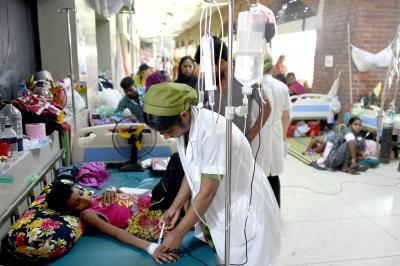
Climate Change, Industrial Pollution Worsening Healthcare Crisis In Bangladesh
(MENAFN- IANS) New Delhi, Feb 5 (IANS) Climate change and industrial pollution are worsening the healthcare crisis in Bangladesh, according to a media report.
The Irish Times reported that despite emitting only about 0.3 per cent of global CO2 emissions from combustible fuels, the air quality in Bangladesh's capital city, Dhaka, regularly ranks among the worst in the world.
This is surging diseases such as asthma, lung cancer, bronchitis, pneumonia, and chronic obstructive pulmonary disease in the capital city.
According to climate scientists, Bangladesh -- with its low and flat land --is one of the world's most vulnerable countries to climate change.
It currently has a population of about 174 million people, and by 2050, it could become the most populous city, as per a recent UN report.
If environmental pollution continues to worsen, it could cause Bangladesh's health system to“completely break down”, said Dr Mustafijur Rahman, from the National Institute of Diseases of the Chest and Hospital in Dhaka.
He added that many live in slums, often beside industrial areas, where“the sewage system is not sufficient for standard living,” and there is a“contamination of infections from one to another”.
“Brickfields around Dhaka pose a health hazard, as do garment factories and tanneries, with fumes sent out into the air and hazardous materials thrown into the rivers, polluting the water,” the report noted.
The report also mentioned the high healthcare costs, which often push people into debt. And to repay the debt, people are forced to travel abroad, often illegally crossing the Mediterranean to Europe.
“The political unrest in our country is making this more difficult,” said Dr. Md. Safiun Islam (50), an assistant professor of respiratory medicine who also works at the hospital.
He said the number of patients has“exponentially increased” in five years: they sometimes have a queue of 20-30 people waiting to be admitted to the ICU.
Controlling“pollution-producing sectors” is“an emergency,” he said.
With elections on February 12th -- the first since long-time prime minister Sheikh Hasina was ousted in August 2024 -- Rahman called for efforts to separate industrial areas from residential ones, and to educate Dhaka's residents about personal hygiene, sanitation, and decreasing risks.
He urged the new government to do“proper planning” and make sure to put the“right person in the right place”.

Legal Disclaimer:
MENAFN provides the
information “as is” without warranty of any kind. We do not accept
any responsibility or liability for the accuracy, content, images,
videos, licenses, completeness, legality, or reliability of the information
contained in this article. If you have any complaints or copyright
issues related to this article, kindly contact the provider above.
Most popular stories
Market Research

More Story






Comments
No comment