




403
Sorry!!
Error! We're sorry, but the page you were looking for doesn't exist.
K2 Gold Strengthens Si2 Model - New Studies Define High-Priority Targets
(MENAFN- Newsfile Corp)
Vancouver, British Columbia--(Newsfile Corp. - December 8, 2025) - K2 Gold Corporation (TSXV: KTO) (OTCQB: KTGDF) (FSE: 23K) ("K2" or the "Company") today announced the results of comprehensive geological studies that further reinforce the Company's Si2 Project as a compelling analogue to other significant low-sulphidation epithermal gold deposits, including AngloGold Ashanti's Expanded Silicon Project (16.3 Moz Au)i. Both K2 Gold's Si2 Project and AngloGold Ashanti's Silicon Project were originally identified by the same project generator using its proprietary geological targeting methodology, securing first-mover access to this previously overlooked epithermal target styleii.
"At Si2, we have taken a disciplined, science-first approach to validating our geological model. The results from both the fluid inclusion and alteration studies unequivocally demonstrate that our drilling to date has only tested the upper level of a potentially much larger epithermal system," stated Anthony Margarit, K2's President and CEO. "The data strongly indicate that by targeting deeper levels along key fault structures, we may enter the productive boiling zone, similar to what is observed at other world class deposits in the Walker Lane."
Highlights
- Fluid inclusion study on quartz veining from 2023 drillholes confirms increasing temperature with depth in the Si2 epithermal system (Fig. 1).
Results indicate that 2023 drilling terminated above the modelled "boiling zone", which typically begins at fluid temperatures of >220°C. Alteration study confirms Si2 is a classically zoned low-sulphidation epithermal system exhibiting evidence for higher temperature fluid in the vicinity of the 2023 drilling.
Combined results indicate that the productive level of the epithermal system may lie immediately beneath the extent of 2023 drilling.
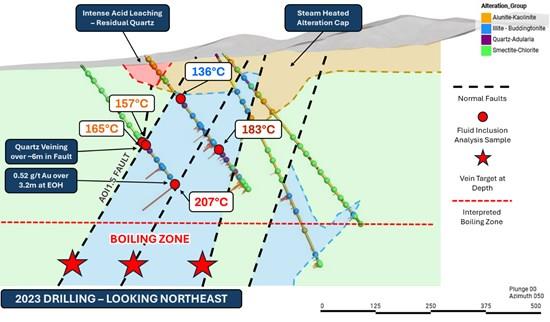
Figure 1: K2's drill holes with fluid inclusion sample locations. Both temperature and gold grade increase with depth, with the projected "boiling zone" occurring beneath the sampled interval.
To view an enhanced version of this graphic, please visit:
Technical Summary
Why Are Epithermal Deposits Important
Epithermal systems are a major deposit class globally and in the western United States-including in the Walker Lane of Nevada and eastern California-and have historically been important sources of gold and silver due to their near-surface, structurally controlled mineralization. When preserved and not deeply eroded these systems can host blind-to-surface, vertically zoned mineralization which may have been historically overlooked. Defining and understanding this zonation (including locating the "boiling zone" where precious metals precipitate) can reveal high-priority exploration targets.
Gold Deposition in Epithermal Systems
Precious metal deposition in epithermal systems typically occurs in what is known as the "boiling zone", a depth at which hot, metal-rich fluids rising towards the surface begin to boil due to dropping pressure. Fluid boiling results in the precipitation of the metals previously held in solution forming high-grade veins and breccias. Boiling in typical low sulphidation epithermal gold systems occurs at temperatures of >220°C, and most commonly between 230 and 240°C.
Fluid Inclusion Analysis and Microscopic Study
Through study of trapped inclusions or bubbles of hydrothermal fluid within quartz veins, the temperature of the fluid can be determined, and depth of formation of the vein inferred. Vein formation temperatures can aid in exploration targeting by revealing the level of the epithermal system encountered by drilling.
Fluid inclusions examined from six core samples reveal low-salinity (0.5-6 wt.% NaCl equiv.) aqueous fluids trapped at temperatures of ~130-200°C, warming downwards through the core of the drilled interval. These characteristics, along with microscopically observed vein textures, confirm the shallow-level nature of the drilled interval and support the interpretation of a blind, deeper gold-bearing zone. No evidence of significant boiling was observed in the inclusions, suggesting that the productive zone lies below the depth tested.
Alteration Mineralogy & Structural Controls:
The alteration study, based on 108 spectral analyses from 95 drill core samples, delineates a classic vertically zoned epithermal system, with a systematic transition from steam-heated alunite and kaolinite/dickite at surface into progressively higher-temperature assemblages (smectite → illite-smectite → illite → illite-chlorite). Variations in illite abundance and locations of quartz-illite ± adularia alteration suggest proximity to primary fluid pathways and fault-controlled mineralization.
The AOI1.5 fault in particular hosts an approximately 6 m thick quartz-veined interval at 200 m depth with adjacent anomalous gold, indicating a strong target for follow-up drilling down-dip and along strike.
Exploration Implications and Next Steps
The combined datasets establish a clear, multi-layered vectoring model for follow-up drilling. Priority targets include:
- At depth and along strike of the AOI1.5 fault, where increasing gold values and deeper alteration assemblages suggest proximity to the productive / boiling zone.
Beneath consistent gold mineralization encountered in hole SD-23-002, where quartz-illite +/- adularia alteration vectors towards strong fluid pathways projecting to depth. Deeper structural targets at AOI3, AOI4, AOI5, and AOI6-each of which exhibits extensive advanced argillic alteration and anomalous mercury in rocks at surface.
Ongoing exploration work at Si2 includes a property scale geological mapping campaign and a planned expanded IP survey, with results to support future drill targeting.
Qualified Person ("QP") and QA/QC
The technical information in this news release has been prepared in accordance with Canadian regulatory requirements set out in NI 43-101 and reviewed and approved by Eric Buitenhuis, M.Sc., P.Geo., K2's QP and Vice President of Exploration.
Petrographic sections used in the fluid inclusion study were prepared by Precision Petrographics of Langley, British Columbia, and submitted to Colorado State University for analysis.
About K2 Gold Corporation
K2 Gold is a member of Discovery Group and is focused on advancing gold exploration projects in mining-friendly jurisdictions across the Western U.S. and Canada. The Company's flagship Mojave Project covers 5,830 hectares and includes multiple previously drilled oxide gold targets. Since acquiring the project, K2 has advanced exploration through geochemical, geophysical, and remote sensing surveys, as well as RC drilling.
Notable past drill highlights at Mojave include:
- 4.0 g/t Au over 86.9m from surface at the Dragonfly Zone
1.69 g/t Au over 41.15m at the Newmont Zone
K2 also holds:
- The Si2 Gold Project in Nevada, a large steam-heated alteration system with confirmed gold mineralization and compelling similarities to AngloGold Ashanti's Expanded Silicon project (3.40 Moz Au at 0.87 g/t Au Indicated Resource, 12.91 Moz Au at 1.03 g/t Au Inferred Resource1.
The Wels Project in Yukon, Canada, where recent drilling intersected gold in all holes and outlined a new mineralized corridor at the Saddle South target.
K2 Gold is committed to responsible exploration, Indigenous and community engagement, and advancing high-quality projects through a collaborative and technically disciplined approach.

Legal Disclaimer:
MENAFN provides the
information “as is” without warranty of any kind. We do not accept
any responsibility or liability for the accuracy, content, images,
videos, licenses, completeness, legality, or reliability of the information
contained in this article. If you have any complaints or copyright
issues related to this article, kindly contact the provider above.
Most popular stories
Market Research

More Story








Comments
No comment