





403
Sorry!!
Error! We're sorry, but the page you were looking for doesn't exist.
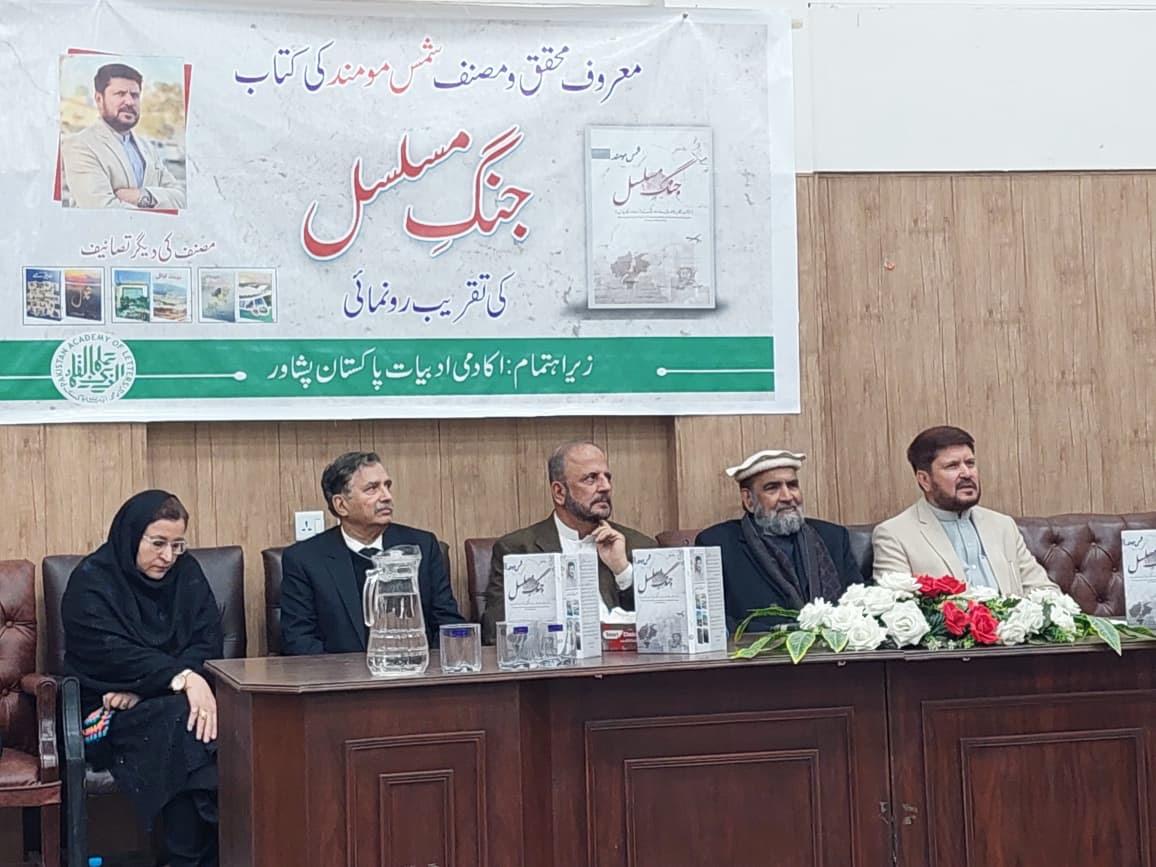
“Jang Musalsal”: A Monumental Chronicle Of A Land That Has Known Nothing But War
(MENAFN- Tribal News Network) -->
For more than four decades, the soil of Khyber Pakhtunkhwa and the former tribal districts has absorbed a level of violence, instability and trauma that few regions in the world have endured for so long, so relentlessly. This land has witnessed the full cycle of conflict: explosions, bodies, shifting alliances, broken agreements, military operations, withdrawals, renewed chaos, and then another round of war. It has been a cycle without a pause, without relief, and often without hope.
Reporting from such a volatile environment is inherently challenging, but remaining truthful under constant threat is an even greater test. Shams Momand met that test consistently, upholding professional integrity when the space for honest journalism was rapidly shrinking.
A Journalist Who Chose the Hardest Possible Path
Among the very few individuals who walked straight into this storm, and stayed there, is Khyber Pakhtunkhwa's distinguished journalist, researcher, and author of seven books, Shams Momand.
Despite being the only brother among six sisters, burdened with significant family responsibilities and limited resources, he chose a profession where risk was constant and security nonexistent. Yet he not only continued reporting; he insisted on writing the truth, even when the truth was dangerous.
Reporting at the Height of Terrorism, A Daily Duel with Death
There was a period when every city in KP trembled with daily blasts, when movement was monitored, when journalists were targets, and when every assignment carried the shadow of a possible final day.
Shams Momand worked precisely during this period, not from a safe distance but from the frontline.
Reaching Baitullah Mehsud, the then-chief of the TTP in Waziristan, interviewing Taliban commanders when military operations were at their peak, these were not reporting tasks. These were acts of courage that remain rare even today.
“Jang Musalsal”: A Coherent, Non-Partisan, 45-Year Chronicle of War
In“Jang Musalsal”, Momand presents the 45-year trajectory of conflict in Pakistan, especially KP, with extraordinary coherence and objectivity.
The book covers the entire arc:
- The rise of the Afghan jihad The emergence of the Taliban in Pakistan The expansion of militancy The shifts in state strategy and political decision-making Major military operations Peace talks, collapses, renewed escalations
All of it is narrated without sensationalism, without ideological bias, and without the self-censorship that often distorts such histories. It is a resource not only for general readers but for students of politics, security and modern South Asian history.
Truth Without Decoration, Without Fear
One of the book's most compelling qualities is its honesty. There is no embellishment, no rhetorical flourish, no evasive politeness.
Every line feels lived, witnessed, absorbed.
Momand does not present war as a single-angle tragedy; he documents it as a complex social rupture. This includes:
- colossal human losses economic devastation mass displacement psychological trauma fear as a lived, daily reality and the long-term erosion of societal structures
An Unexpected Side-Story: How War Triggered a Media Boom
Momand highlights a less-discussed but fascinating development: after 9/11, as war intensified, Pakistan saw the rapid rise of private news media.
Geo News, Dawn News, ARY, SAMAA, Khyber News and several other channels emerged.
This expansion was not accidental. The public's hunger for information, the global focus on the region and the economics of breaking news all contributed to a media boom.
Ironically, while war destroyed numerous livelihoods, it created a parallel wave of economic and professional growth within the media industry.
The Displacement of Tribal Communities - War's Social Recalibration
Another major insight in the book is the transformation of tribal society.
For decades, residents of the tribal belt lived without basic facilities - no structured health system, minimal education, limited infrastructure and restricted state access.
But the war, harsh, prolonged and suffocating, pushed many to relocate to settled districts.
For the first time, these communities accessed:
- regular schooling hospitals and clinics employment options administrative structures and urban civic life
Nearly 40 percent of the tribal population has now permanently settled in these regions.
Momand presents this shift with analytical clarity - acknowledging both the trauma that forced migration and the improved opportunities it ultimately offered.
The Most Heart-Wrenching Chapter: His Father's Funeral
The emotional core of the book lies in the chapter where Momand recalls his father's funeral.
From Kabul, he sent a message:
“If anyone buries my father before I arrive, it will not be acceptable.”
This isn't just grief.
It is the story of a journalist whose professional commitments, and the dangerous circumstances surrounding them, made even personal loss a hostage of time and conflict. The reader pauses here, not because the lines are poetic, but because they are painfully real.
A Reader's Journey - Information, Emotion and Reflection
Reading“Jang Musalsal” is not passive consumption. It's a journey.
Some passages inform, others stun, some force re-reading, and many leave the heart heavy.
And to be honest: it is not a book that confines itself to a desk.
You can read it on a bed, in the courtyard with a cup of tea - even in a restroom, if the story grips you enough to refuse boundaries.
At times you pause to light a cigarette; the smoke rises while Momand's words sink deeper.
It feels as if the smoke leaves your body while 45 years of history enters your mind.
A Message to the Young Generation
For younger readers seeking real history - not the diluted, political, polarised versions that dominate today - this book is essential.
If you want to understand:
- why this region could not stabilize, who made which mistakes, what the people endured, where the state faltered, how society fractured, and why extremism embedded itself so deeply,
then“Jang Musalsal” is unmatched.
Even if you don't have time for multiple books, reading just this one will give you the sweep of 45 years - like a film unfolding before your eyes.
Because Momand did not simply write this book.
He lived it.
He bore it.
And he survived it.

Legal Disclaimer:
MENAFN provides the
information “as is” without warranty of any kind. We do not accept
any responsibility or liability for the accuracy, content, images,
videos, licenses, completeness, legality, or reliability of the information
contained in this article. If you have any complaints or copyright
issues related to this article, kindly contact the provider above.
Most popular stories
Market Research

More Story



Comments
No comment