


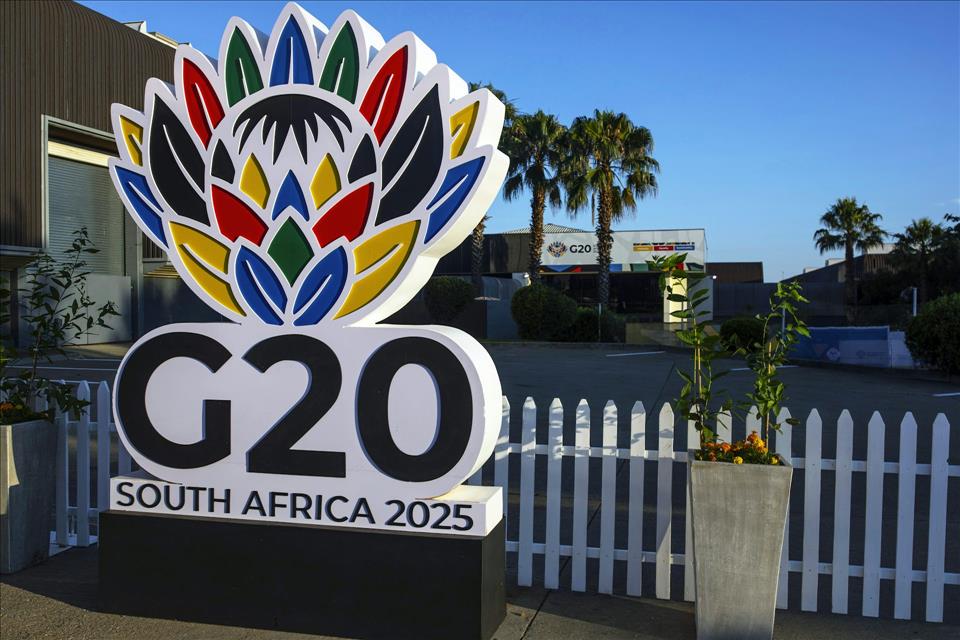
South Africa's G20 Presidency Is Over What Did It Achieve For Climate And Clean Energy In Africa?


A G20 presidency is more than a summit of political leaders. It is a series of dialogues between countries that represent 78.9% of the world's population. The South Africa G20 presidency hosted 177 official meetings and was guided by 15 thematic working groups and groups representing youth, business, women's rights, science and think tanks.
Read more: Global inequality is as urgent as climate change: the world needs a panel of experts to steer solutions
The G20 is a small group of major countries that work to support wider international agreements, but it has no legal power to force action. Even so, it brings together 19 countries plus the African and European Unions in conversation. This means that strong G20 statements provide the foundation for governments to improve their laws and policies on climate change.
The G20 countries contribute to 73% of greenhouse gas emissions from fossil fuels. I'm an energy and climate policy researcher, observer of the G20 process and member of the G20's Think 20 energy transition working group. I argue that the G20 presidency was a mixed diplomatic success in a challenging geopolitical situation. It highlighted the need for climate action and just energy transitions. But the final declaration was vaguely worded.
To examine how the South African G20 presidency lived up to the solidarity, equality and sustainability themes, I looked at the progress of each in the areas of climate change and sustainable energy.
The G20 and solidarityThe theme of solidarity is deeply enshrined in African philosophy and culture. The spirit of ubuntu, meaning a person is only human through others, binds African societies despite their differences, also in the climate crises.
Read more: South Africa's G20 presidency: diplomatic victory, but a weak final declaration
Africa is the most vulnerable to the impacts of climate change, despite its limited contribution to greenhouse gas emissions.
The final G20 declaration backed the Paris Agreement – the global deal where countries commit to limiting climate change in the United Nations. And it welcomed the outcomes from the recent COP30 global climate change conference in Belém, Brazil.
Read more: Climate disasters are escalating: 6 ways South Africa's G20 presidency can lead urgent action
The declaration also recognised that Africa faces unique challenges. Because of this, countries with higher greenhouse gas emissions need to show solidarity with African countries by accepting their responsibility to provide funding, technology, and support.
This responsibility is known as the principle of “common but differentiated responsibilities” that was adopted in 1992 at the United Nations Earth Summit, where 179 countries discussed how economic activities were affecting the environment and what needed to be done about this.
The G20 and equalityEquality was meant to ensure that the G20 focused on fair treatment and opportunities for all, regardless of economic status, gender, race or location.
Access to energy is unequal in Africa. Access to clean cooking fuel is a major challenge for sustainable development, with 80% of households lacking access. The reliance on fuelwood for cooking causes 3.2 million premature deaths a year, mostly women and children, and damages the forests.
The G20 South African presidency came up with a voluntary plan to make clean cooking fuels a global priority. Countries can opt out.
Read more: G20 countries could produce enough renewable energy for the whole world – what needs to happen
It failed to address energy poverty specifically, building on the principles to promote sustainable energy inclusively that were agreed during the G20 Brazilian presidency in 2024.
These principles were developed in line with the United Nations' programme to support countries on how they can manage just transitions to clean energy.
The 2025 G20 declaration makes no explicit reference to developing these principles further. It remains vague about how countries should implement and fund just energy transitions.
The G20 and sustainabilityOn sustainability, South Africa pushed for the G20 to tackle Africa's debt crisis. Debt is tied to a deeper problem: the continent lacks affordable finance for clean energy, to adapt to climate change and recover from extreme weather disasters. Most funding for this still comes as loans rather than grants, increasing the debt burden.
Clean energy projects in Africa still mostly depend on public rather than private investment. Adaptation finance – funds for preventing future damage – is even more difficult to secure. Climate finance mostly comes as loans. Debt for climate swaps come with risks.
Read more: Africa has a debt crisis: momentum from G20 in South Africa can help find solutions
Transitioning to clean energy means phasing out fossil fuels, increasing renewable energy technology in national systems and regional energy pools.
This is where stronger language would have helped. The G20 said back in 2009 that it would phase out fossil fuel subsidies by 2020. In 2025, the phase out was not mentioned at all.
What's next for Africa in the G20?The G20 was a success in that its Climate and Environment Working Group finalised ministerial declarations on air quality and environmental crime (this is illicit trafficking in flora and fauna, metals and minerals, poaching, transport and disposal of waste and hazardous substances).
Environmental crime is a new addition to the G20 agenda and is especially important for African countries to protect their people, biodiversity, minerals and wildlife.
Read more: Why are so few environmental criminals on Interpol's 'most wanted' list?
South Africa can be proud of these achievements, but it is unclear how the 2026 US G20 presidency will take them further. After US president Donald Trump boycotted the summit, South Africa handed over the G20 documents to a junior official of the US embassy instead. The US assumed the presidency on 1 December. It has already uninvited South Africa from the 2026 G20 engagements.
It is now up to the remaining 19 countries that are members of the G20 to stand up for Africa – for solidarity, equality and sustainability – in 2026 and the years to come.


Legal Disclaimer:
MENAFN provides the
information “as is” without warranty of any kind. We do not accept
any responsibility or liability for the accuracy, content, images,
videos, licenses, completeness, legality, or reliability of the information
contained in this article. If you have any complaints or copyright
issues related to this article, kindly contact the provider above.


Comments
No comment