




403
Sorry!!
Error! We're sorry, but the page you were looking for doesn't exist.
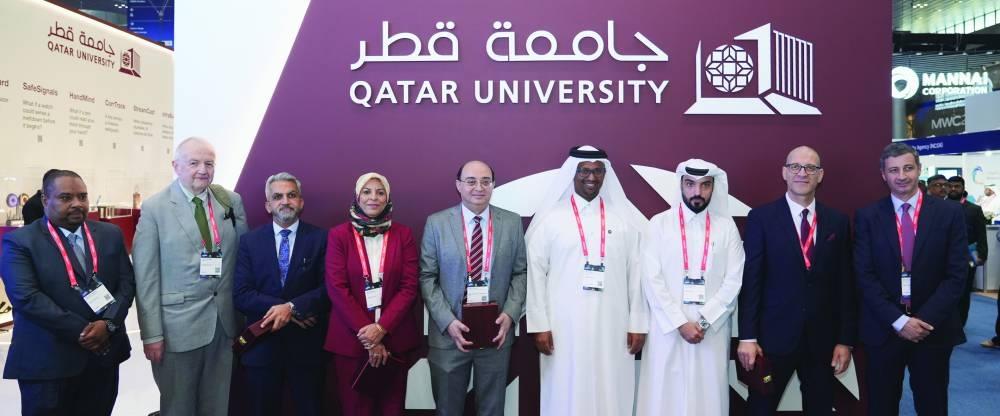
QU Signs IP Licensing Agreements At MWC25 Doha
(MENAFN- Gulf Times) As the exclusive educational partner of the recent Mobile World Congress (MWC25) in Doha, Qatar University (QU) announced the signing of several intellectual property (IP) licensing agreements with four emerging and international technology companies.
The agreements were formalised during the“From Innovation to Impact: IP Commercialisation and Industry Collaboration Signing Ceremony”, held on the sidelines of the global event.
These agreements align with the QU's strategy to strengthen the national innovation ecosystem and accelerate the transition of research outputs from laboratories to industry and the marketplace, a statement said Tuesday.
The QU signed a licensing agreement with ClearExhaust, the second startup to emerge from the university's innovation ecosystem.
ClearExhaust was founded and led by Prof Samer Ahmed from the Department of Mechanical Engineering, supported by a team of graduate students and research assistants at the QU.
The company specialises in developing innovative systems to reduce emissions from combustion engines.
Its first product, the“Smokeless Exhaust Pipe”, is based on a registered US patent and offers a breakthrough solution that removes 100% of visible diesel emissions while reducing carbon dioxide (*CO2) emissions by 20-30%.
The system was developed at the QU's Thermal Engines Laboratory and tested on TATA buses in collaboration with Al-Hamad Automobiles, as well as municipal service trucks at the Ministry of Municipality.
The company is also developing a second innovation, the Portable Carbon Capture System, which demonstrated 100% carbon capture efficiency during laboratory testing on diesel engines.
The technology will be registered soon as a US patent.
These solutions address Qatar's needs for emission reduction in line with the Qatar National Vision 2030 and the National Climate Change Action Plan (NCCAP 2021).
The QU also signed an exclusive licensing agreement with iDiagnostix Ltd, a UK-based medical diagnostics company, to commercialise a novel blood test for the early detection of Autism Spectrum Disorder (ASD).
The test is the first of its kind globally to achieve accuracy levels exceeding 80% sensitivity and specificity in both discovery and clinical validation studies, meeting the diagnostic standards set by the American Psychiatric Association.
The technology analyses low-level protein modifications associated with metabolic changes in the brain, supported by advanced artificial intelligence (AI) algorithms to ensure predictive accuracy.
The company was founded in 2024 by former QU researcher Prof Naila Rabbani and Prof Paul Thornalley, formerly from Hamad Bin Khalifa University.
The technology was developed and clinically validated in a large-scale study funded by the QU, which also owns the associated patents.
The licensing agreement marks a major milestone in enabling early ASD diagnosis, improving referral accuracy, and accelerating access to timely support and treatment for children.
The QU also signed an exclusive licensing agreement with QLife Pharma, a Qatar-based pharmaceutical company specialised in manufacturing high-value pharmaceutical products and advancing national self-sufficiency, to produce and commercialise Q-Silvano, a topical antimicrobial gel based on stable silver nanoparticles.
The product was developed in the QU Health Sector – College of Pharmacy laboratory under the leadership of Prof Alaaeldin Elkilany.
Q-Silvano is the first nano-based medical product to be officially registered with the Ministry of Public Health in Qatar.
Technology transfer is currently underway to enable local manufacturing and product launch in early 2026, with plans for regional expansion into GCC and Mena (Middle East and North Africa) markets.
The licensing agreement covers the transfer of formulation knowledge, enabling large-scale production, and facilitating commercial marketing processes.
This collaboration focuses on technology transfer, regulatory compliance, quality systems development, and sustainable production scaling, supporting local market needs and paving the way for regional expansion.
The achievement highlights the impact of QU-industry partnerships in transforming local research innovation into therapeutics manufactured in Qatar, in line with Qatar National Vision 2030 and the country's knowledge-based health sector goals.
The QU also launched a new collaboration agreement with Genesis Technologies, a startup emerging from the national research and innovation ecosystem, to introduce the Imdaat platform during its first commercial phase.
The agreement transforms research outcomes developed by the Qatar Research, Development and Innovation Council and the QU into a tangible digital product.
The platform is preparing for its first implementation with a ministry in Qatar in the coming months, offering a reliable and secure decentralised system for issuing and verifying digital documents, enhancing government service efficiency, and supporting the nation's digital transformation agenda.
Commenting on the occasion, QU Vice-President (Research and Graduate Studies) Prof Aiman Erbad said:“The QU's signing of a series of IP licensing agreements during MWC25 reflects the significant progress we have made in building an integrated innovation ecosystem grounded in applied research and researcher empowerment and in linking scientific output directly to industry and societal needs.”
“These agreements mark an important step toward accelerating the transfer of national knowledge and technologies to global markets, while strengthening the ability of our startups to offer innovative solutions in vital fields such as digital health, sustainability, and clean energy,” he said.“We believe strategic partnerships with local and international institutions create unique opportunities for our researchers and students to expand their impact and achieve tangible economic and societal value.”
These agreements, it was pointed out, reflect the advanced stage reached by the QU in building an integrated innovation and IP ecosystem founded on applied research support, researcher empowerment, the establishment of knowledge-based startups, and strengthened collaboration with industry locally and globally.
At the end of the ceremony, the QU emphasised that enhancing the commercialisation of national innovations will remain a central focus of its research strategy in the coming years, supporting the knowledge-based economy and advancing national priorities in health, environment, and digital transformation, the statement added.
MWC25 Qatar University intellectual property licensing agreements
Legal Disclaimer:
MENAFN provides the
information “as is” without warranty of any kind. We do not accept
any responsibility or liability for the accuracy, content, images,
videos, licenses, completeness, legality, or reliability of the information
contained in this article. If you have any complaints or copyright
issues related to this article, kindly contact the provider above.
Most popular stories
Market Research

More Story








Comments
No comment