







403
Sorry!!
Error! We're sorry, but the page you were looking for doesn't exist.
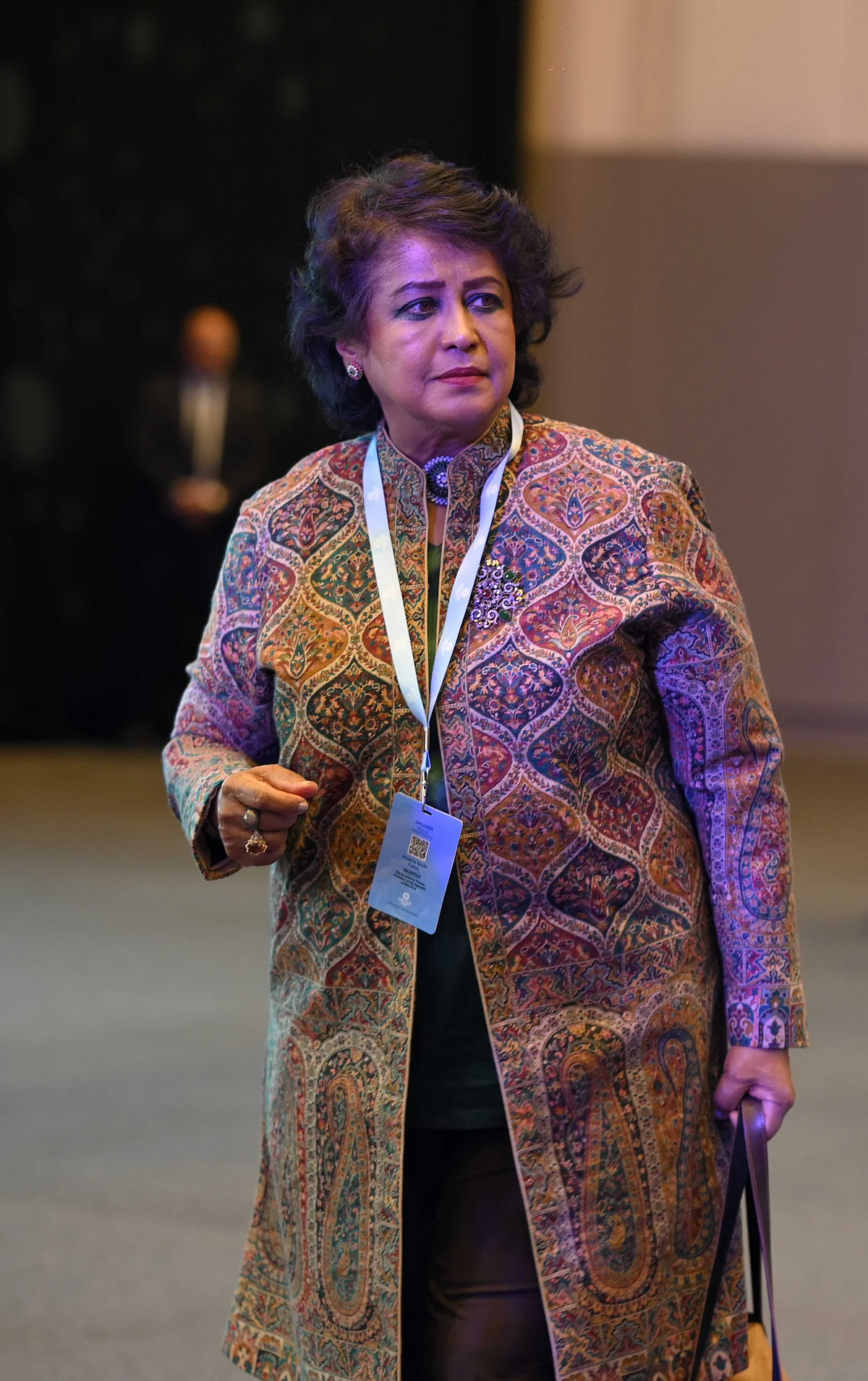
From Lab Coats To Presidency: Meet The First Female President Of Mauritius
(MENAFN- Khaleej Times)
It's not often that one meets a global leader who can speak about molecular structures and macroeconomics, sustainability and leadership values in the same breath. Gracefully toggling between biodiversity and diplomacy, climate change and constitutional reform, Dr. Ameenah Gurib-Fakim, the first female President of Mauritius, is a renowned biodiversity scientist who walks an extraordinary path that connects science, sustainability, and social change.
Recommended For YouIf there was one thing that came to the fore during the talk she gave in Dubai at the Global Justice, Love and Peace Summit recently it was her quiet conviction of having consistently chosen purpose over prestige.
“I was very privileged to have been able to take the risk,” she says, reflecting on her unlikely leap into politics.“I don't have any political background, and we don't come from a political family. But when the offer came, I didn't hesitate.”
Before becoming president, Dr. Gurib-Fakim was Professor of Organic Chemistry at the University of Mauritius, where she also served as Dean of the Faculty of Science and Pro Vice Chancellor. With a PhD from the University of Exeter, the founder of the Centre for Phytotherapy Research has led and coordinated numerous international research initiatives on medicinal and aromatic plants and worked closely with organisations like the World Bank, UN, and the EU all through her career.
That leap of faith to politics wasn't made blindly. Encouragement from her father -“my cheerleader” - paved the way for her to step into a male-dominated arena and make history. And she did so not by abandoning her roots as a scientist, but by carrying them with her to the highest office in her land.
“My scientific background really helped,” explains the soft-spoken, and down-to-earth world leader, on the sidelines of the Global Justice, Love and Peace Summit that was held at the Dubai Expo earlier this year.“I defined my presidency through the lens of sustainability, and of course, climate change.”
The timing was serendipitous: during her term (2015-18), two landmark events unfolded - the ratification of the UN Sustainable Development Goals and the Paris Climate Agreement. Dr. Gurib-Fakim didn't just witness them; she shaped conversations around them.“I took it to that level where I could help bring attention to these issues,” she says, her eyes lighting up with the memory.“Then the UN Secretary-General appointed me to co-chair the SDG 6 on water. That was very special.”
Dr. Gurib-Fakim makes it also clear that having a strong mentor helped her transition from laboratory to leadership.“I had a mentor in [former Indian President] APJ Abdul Kalam. He was a scientist as well, and he did a wonderful job. People used to refer to him as the Rocket Man.“So I suppose I could be called the 'Science Woman',” she says with a laugh.
“But you know, we need that kind of rational thinking. We need more scientists at the helm,” she says.
“We need more technocrats with a science background. We need that input of science to understand the quality of education, to understand how we can improve food sovereignty and food security through the lens of science. So we need more technically wise leadership.”
If that's the case, the 'Science Woman' has also become something of a global conscience. Her advocacy for STEM education, especially for girls, resonates deeply in a world still struggling with gender equity.
Is there a piece of advice she can offer women?
“Take risks. Believe in yourself. And never give up,” she says.
Any tips for leaders?
“Leaders have to learn to listen,” she says, a lesson earned through real-time governance.“Unfortunately, many don't. And that's why they don't stay in office very long.”
She is convinced that what makes a leader great in times of upheaval is ensuring they are“in the midst of competent people”.“You don't need to know everything. But you need to listen to those who do, and make decisions based on facts“, she says without hesitation.
Facts. Data. Evidence. These are more than scientific tools for Dr. Gurib-Fakim; they are a philosophy. And yet, she is far from robotic. Her love for her island nation is deeply emotional.“Mauritius is in one of the world's biodiversity hotspots,“ she says.“Just one square kilometre of our land holds more diversity than the entire European continent. And it provides ecosystemic support to all of us, especially the most vulnerable.”
A prolific author and advocate for sustainable development, Dr. Gurib-Fakim has published 28 books and numerous scientific papers including co-authoring the first African Herbal Pharmacopoeia. She has been honoured globally for her scientific contributions, receiving the L'Oréal-UNESCO Prize for Women in Science and the African Union Award for Women in Science
But her reverence for nature isn't just about conservation; it's about justice.“People don't realise that biodiversity underpins life on Earth. That's why we must drive the global conversation on its preservation.”
And she believes small island nations like Mauritius can lead that conversation.“We've learned to leverage our strategic positioning. We can be the bridge between Asia and Africa. There's so much we can do together.”
A strong advocate for sustainable development, climate change action, and the advancement of education and innovation across Africa, her vision for Mauritius as a connector not just geographically, but ideologically is compelling. It's a place where science meets culture, and where tradition embraces innovation. It's a place where girls can grow up dreaming not just of breaking glass ceilings, but of redesigning the whole structure.
But this dream won't realise itself.“Investment, investment, investment,” she says when I ask what it will take to unlock Africa's scientific potential.“In infrastructure, in people, in professionalism. Education should never be treated as an expense; it's an investment.”
For a woman who has achieved so much, Dr. Gurib-Fakim remains remarkably grounded. Asked how she maintains her balance, she smiles and says simply:“Do good, think good, and do plenty of exercise.”
Her sources of inspiration are rooted in the Global South - a term she wears with pride.“Some people tend to use it derogatorily, but I'm proud to say I'm from the Global South. Think of the wisdom we have with its incredible thinkers and writers.”
Her voice grows more passionate:“We have to pull from the knowledge and the wisdom of these great people and push forward. Sustainability must drive the world of the future.”
Passionately working to advance awareness of global warming and to promote new investments in science and technology in Mauritius and greater Africa, Dr. Gurib-Fakim believes science isn't just about the pursuit of knowledge. It's about the application of knowledge to build a just, sustainable, and inclusive world.“Anything that touches on education or
that kind of support should not be treated as an expense, but as an investment,” she says.

Legal Disclaimer:
MENAFN provides the
information “as is” without warranty of any kind. We do not accept
any responsibility or liability for the accuracy, content, images,
videos, licenses, completeness, legality, or reliability of the information
contained in this article. If you have any complaints or copyright
issues related to this article, kindly contact the provider above.
Most popular stories
Market Research

More Story






Comments
No comment