




403
Sorry!!
Error! We're sorry, but the page you were looking for doesn't exist.
What is Tangential Flow Filtration and Why It Is in High Demand?
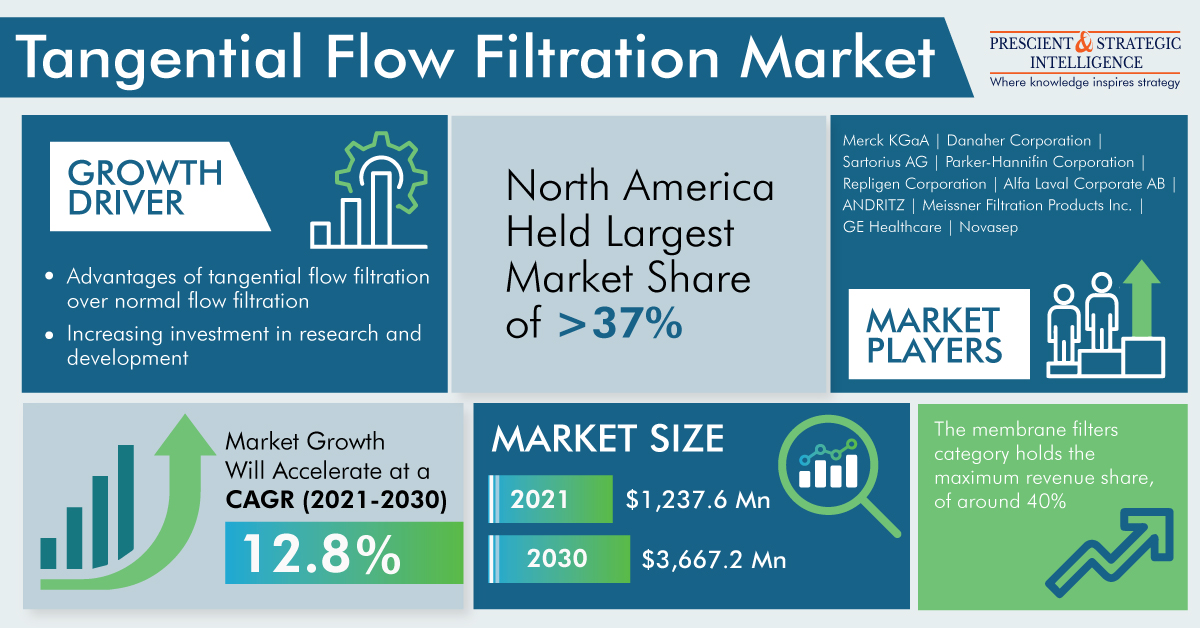
(MENAFN- P&S Intelligence) In 2021, the global tangential flow filtration market accounted for $1,237.6 million, which is on the path to hit $3,667.2 million revenue by 2030, growing at a 12.8% CAGR from 2021 to 2030. The market is being driven by the expansion of the biopharmaceutical sector, especially the growth of biosimilars and biologics production; increasing investment in research & development by industry players; and the benefits of tangential flow filtration above normal flow filtration.
Furthermore, tangential flow filtration may be the ideal solution when impurity removal must be efficient and cost-effective while also involving a significant volume of sample. tangential flow filtration separates or isolates certain particle sizes using a filter. In contrast to classical filtration, the fluid is cycled over the filter rather than being driven through it, creating a pressure difference. The system is completely operational after the setup is complete and the sample is in the reservoir. Moreover, tangential flow filtration separates and purifies biomolecules quickly and continuously.
Types of Tangential Flow Filtration
• Microfiltration (MF)
MF is used in the initial stages of extraction processes to "recover" or isolate bio-products from bioreactor effluent and micro-particulates. Microfiltration is a technique for suspending particles and separating microorganisms with sizes ranging from .1 to 10 μm.
• Ultrafiltration (UF)
UF can be used in the downstream process as an intermediate step, either before or after purification chromatography. Before the polishing chromatography phase, UF is an efficient approach for buffer exchange and protein concentration. Ultrafiltration separates macromolecules with diameters ranging from 0.001 to 0.1 μm.
• Nanofiltration (NF)
One approach for end-process sterilization is NF. In preparation for formulating and filling, NF is used to sterilize the UF retentate by killing bacteria and viruses and removing insoluble proteins. Nanofiltration is a technique for separating molecules with sizes ranging from 1 to 10 μm.
Furthermore, the two main methods used in tangential flow filtration are ultrafiltration and microfiltration. The ultrafiltration category holds over 65% share of the market, because it helps in decreasing the biopharmaceutical products’s manufacturing costs. General Biol, a Chinese pharmaceutical company, recently collaborated with Cytiva to produce oligonucleotides using the company's integrated FlexFactory single-use technology. The platform consists of the KTA Process explosion-proof purification system, the OligoProcess nucleic acid synthesis system, and the Uniflux explosion-proof tangential flow ultrafiltration system.
Hence, at each stage of the bioproduction train, tangential flow filtration systems provide a flexible and effective option for almost any type of filtering, purification, and/or clarifying. The demand for tangential flow filtration will grow further owing to the growing investment in research and development.
Furthermore, tangential flow filtration may be the ideal solution when impurity removal must be efficient and cost-effective while also involving a significant volume of sample. tangential flow filtration separates or isolates certain particle sizes using a filter. In contrast to classical filtration, the fluid is cycled over the filter rather than being driven through it, creating a pressure difference. The system is completely operational after the setup is complete and the sample is in the reservoir. Moreover, tangential flow filtration separates and purifies biomolecules quickly and continuously.
Types of Tangential Flow Filtration
• Microfiltration (MF)
MF is used in the initial stages of extraction processes to "recover" or isolate bio-products from bioreactor effluent and micro-particulates. Microfiltration is a technique for suspending particles and separating microorganisms with sizes ranging from .1 to 10 μm.
• Ultrafiltration (UF)
UF can be used in the downstream process as an intermediate step, either before or after purification chromatography. Before the polishing chromatography phase, UF is an efficient approach for buffer exchange and protein concentration. Ultrafiltration separates macromolecules with diameters ranging from 0.001 to 0.1 μm.
• Nanofiltration (NF)
One approach for end-process sterilization is NF. In preparation for formulating and filling, NF is used to sterilize the UF retentate by killing bacteria and viruses and removing insoluble proteins. Nanofiltration is a technique for separating molecules with sizes ranging from 1 to 10 μm.
Furthermore, the two main methods used in tangential flow filtration are ultrafiltration and microfiltration. The ultrafiltration category holds over 65% share of the market, because it helps in decreasing the biopharmaceutical products’s manufacturing costs. General Biol, a Chinese pharmaceutical company, recently collaborated with Cytiva to produce oligonucleotides using the company's integrated FlexFactory single-use technology. The platform consists of the KTA Process explosion-proof purification system, the OligoProcess nucleic acid synthesis system, and the Uniflux explosion-proof tangential flow ultrafiltration system.
Hence, at each stage of the bioproduction train, tangential flow filtration systems provide a flexible and effective option for almost any type of filtering, purification, and/or clarifying. The demand for tangential flow filtration will grow further owing to the growing investment in research and development.

Legal Disclaimer:
MENAFN provides the
information “as is” without warranty of any kind. We do not accept
any responsibility or liability for the accuracy, content, images,
videos, licenses, completeness, legality, or reliability of the information
contained in this article. If you have any complaints or copyright
issues related to this article, kindly contact the provider above.
Most popular stories
Market Research

More Story








Comments
No comment