

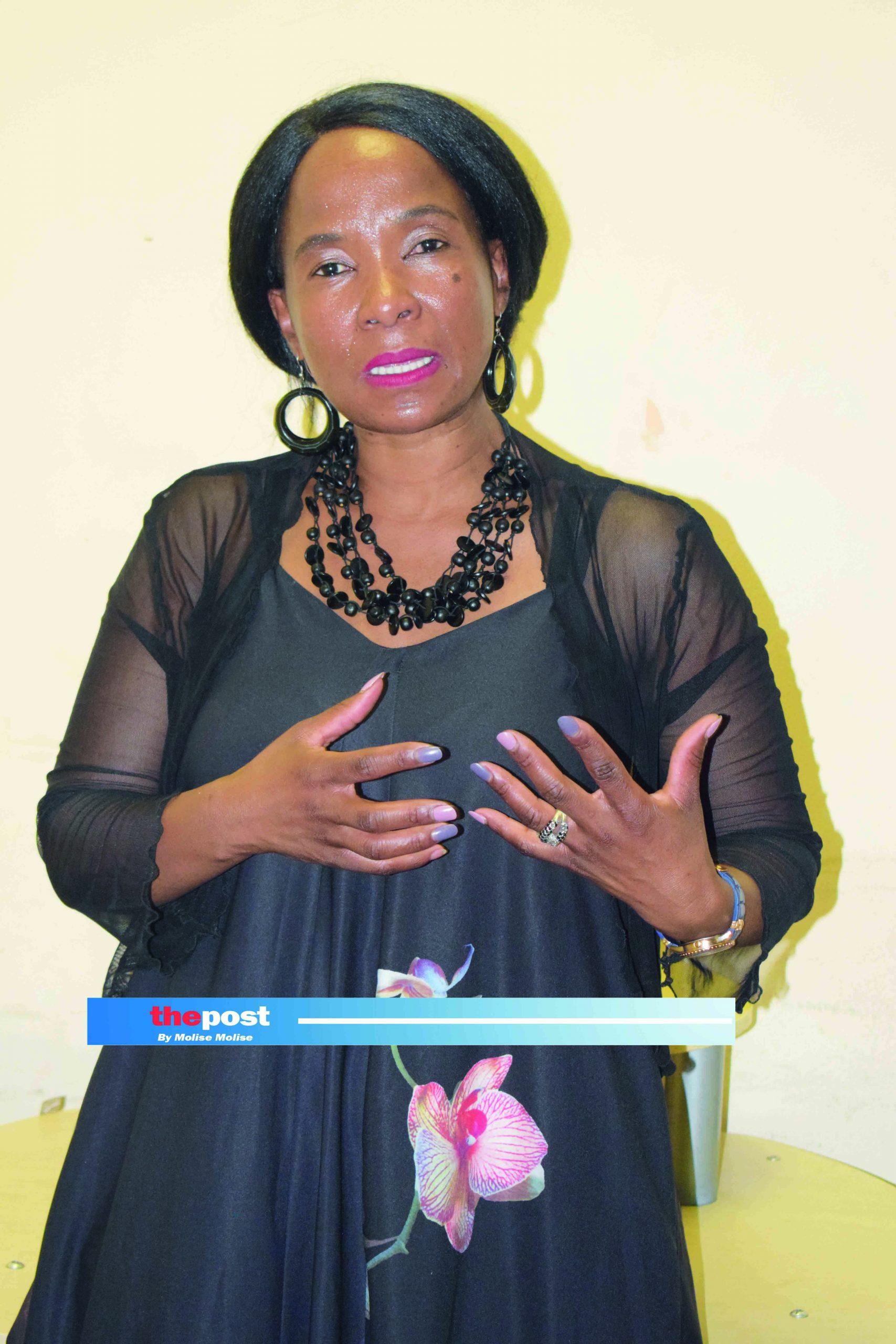
Shaking Lesotho's politics


(MENAFN- The Post) MASERU -IT would be tempting to dismiss Tšepang Tšita-Mosena, 43, as just another political novice.
Admittedly, Tšita-Mosena is indeed a political greenhorn having only been elected into Parliament just three years ago.
Cool, collected and dressed to the nines, Tšita-Mosena does not look like your typical politician.
She speaks softly during the interview, making it difficult to imagine how she fares during heated debates in a male-dominated parliament where high testosterone levels are often on show.
But beyond that soft underbelly is a wily, combative character who has been aggressively pushing one of the most controversial and radical indigenisation laws ever promulgated in Lesotho.
The new law, which has since been passed by Parliament, seeks to reserve certain sectors of Lesotho's economy to indigenous Basotho while blocking foreign and naturalised Basotho.
The law, Tšita-Mosena argues, will rectify decades of marginalisation of indigenous Basotho by foreign nationals and naturalised Basotho.
For years Basotho have watched with dismay how indigenous Basotho were being slowly pushed to the periphery of Lesotho's economy.
Where they used to own small yet thriving grocery shops in the villages, such shops have been overrun by powerful naturalised Basotho businessmen and other foreign nationals.
Tšita-Mosena, who is the deputy leader of the Movement for Economic Change (MEC) party, says now is the time ('Ke Nako') to protect indigenous Basotho and right these wrongs.
Under the new law, it would be illegal for foreign nationals to operate businesses such as grocery shops, hair salons and vehicle repair businesses.
Such businesses will be reserved for indigenous Basotho.
It is this push for this indigenisation law that has brought Tšita-Mosena into the international spotlight, and the line of fire.
She is seen as one of the key architects of the controversial law.
Despite blistering criticism that the law will scare away foreign investors, Tšita-Mosena has stuck to her guns.
In fact, she insists the law was long overdue.
There is nothing xenophobic with MPs crafting this new law, she argues.
'The Constitution allows for certain acts that may appear discriminatory in the interests of progress for Lesotho,' she says.
She cites the affirmative policies in South Africa that were crafted into law after 1994 to support the black community which had suffered for decades under apartheid.
'We are therefore deliberately creating special zones for Basotho to grow. Naturalised Basotho can tap into other businesses while foreigners are free to tap in other areas, and not compete unfairly in the specified sectors.'
'Of course, we want foreign direct investment but not in these reserved economic spaces. We welcome foreign investment to help us grow the economy but they should not come here and compete with Basotho to sell fat-cakes!'
Tšita-Mosena says Lesotho's investment laws made it extremely easy for foreigners to come in without putting in any meaningful investment. They exploited the gap and made it very difficult for indigenous Basotho to thrive in business, she says.
'Our people are asking us, why are we there as MPs if we can't protect them?'
She however admits there are still a few areas of the law that still need to be refined to ensure the legislation works perfectly.
Critics of the controversial new law have been quick to point out at the failed 'indigenisation experiments' elsewhere in Africa.
Instead of empowering locals the elites have abused such laws for personal financial gain.
Tšita-Mosena however rejects the charge that such empowerment programmes are vehicles for wealth accumulation by the elites.
'What we are doing is simply creating the space for Basotho as MPs but the challenge is that Basotho are not running fast enough to occupy these spaces. We need to help them use the opportunity as intended.'
She says she has benefited a lot from her interaction with her peers in the SADC Parliamentary Forum where they share ideas on a regular basis.
It is through such interaction that they are able to learn and adopt new policies that empower their people.
'We share ideas as MPs and that exposure has taught me that Lesotho can do much more to help our people if we stop wasting time and prioritise important issues,' she says.
'You learn by observing how other parliaments are getting business done.'
Tšita-Mosena says all her work in parliament is anchored on the MEC's three core pillars – service delivery, growing the economy and putting Lesotho and Basotho first.
'That's my mandate in Parliament, that's what drives me,' she says.
At 43, Tšita-Mosena is relatively young in politics.
She is almost half the age of the oldest politician in Lesotho's parliament, Vincent Malebo, who at 89 has been a constant feature in Parliament since 1965. Tšita-Mosena says the generation of tired, geriatric politicians needs to be 'diluted' if Lesotho is to be allowed to advance.
She says Lesotho has too many politicians whose mindset is focused on 'old and tired ideologies' that are not in sync with the current realities.
'Old people cannot easily address today's challenges with today's thinking and creativity because their approach is stuck in the past,' she says.
'Of course, we need the wisdom of the elderly but we must close that generational gap,' she says.
That can only happen when we have younger MPs in parliament, she says.
Former Prime Minister Thomas Thabane, 81, is still serving as MP for Ha-Abia while his predecessor Pakalitha Mosisili, 75, is also still an MP for Tsoelike constituency in Qacha's Nek.
There is also a generous sprinkling of MPs in their 60s and early 70s.
Tšita-Mosena says she wants to see the thinking and influence of old MPs heavily diluted in parliament.
She wants to see a new breed of MPs 'with a new positive and progressive mindset' to tackle the immense socio-economic challenges facing Lesotho.
'We need to reduce the acceptable age in parliament; but that can only happen when we have young MPs joining politics and running for office. The pace of change has been too slow.'
She is equally scathing of new trends that see politicians who are in their 60's and way past their retirement age slowly finding a new home in Parliament.
She says parliament should never be seen as an old-people's retirement home if it is to be effective.
'Old people should not retire to parliament because the results will be retired policies that will not be progressive for Lesotho.'
Tšita-Mosena appears to take pleasure in firing salvos at the old generation that she says has been at the root of Lesotho's perennial political and economic challenges since independence from the British in 1966.
But does she see herself one day leading Lesotho as its first woman Prime Minister?
She laughs, long and hard!
'It would be nice to have a young woman politician at the helm, but not now, please' brushing off the question.
Again, the question is answered through the prism of a patriarchal society.
In her opinion, Tšita-Mosena thinks we are not yet at the level where society appreciates women as equals in the political space.
To even suggest that a woman could aspire for the highest political office in Lesotho is almost seen as sacrilegous.
'We have been conditioned to see the man as the head of the wife and that no woman should be seen to be too ambitious to take independent decisions,' she says.
'Our role is seen as that of the neck supporting the head.'
The analogy would seem to suggest for Tšita-Mosena that women are only good enough to play a supportive role and not being the main actor.
This is a deeply patriarchal society, she says.
'We still have a long way to get to freedom.'
To highlight that point, Tšita-Mosena says only about 25 percent of all the 120 MPs in Parliament are women.
None of these women lead a political party. Even in her own MEC's national executive committee, only five are women in a committee made up of 15 members.
'I am currently the only woman deputy leader of a political party in Lesotho,' she says highlighting the tough terrain women still need to navigate in politics.
Not many women are able to balance the demands of a political career with that of being a wife and motherhood.
It's a costly venture, she says.
'The political space is perceived as a dirty space; it is associated with a lot of negativity and most women want to steer clear of politics.'
Tšita-Mosena credits her party leader, Selibe Mochoboroane, for her rise in the political arena.
It is no surprise that she fiercely defends Mochoboroane who is now facing a serious treason charge for the events of August 30, 2014 when the army attacked the State House sending the then Prime Minister Thomas Thabane scurrying into exile in South Africa.
She wants to see the treason charges quashed in the interests of peace and stability in Lesotho.
She would also want to see Prime Minister Moeketsi Majoro rally Basotho towards a common goal.
She yearns to see an inspirational leader who can mobilise all Basotho towards a common vision.
'Majoro must give us his dream,' she says. 'He must tell us what he envisions for Lesotho in 2030, and in 2063.'
She wants the government to work towards a vision that every Mosotho would be proud of, that brings more peace, stability and opportunities for Basotho.
'We want our children to be able to dream and see a future free of violence, with an economy transformed, with a country that embodies development.'
Tšita-Mosena, who holds a Bachelor of Science in Computer Science and Physics degree from the National University of Lesotho and a Master of Science Degree in Development Management from the Open University of London, says her decision to enter politics came gradually.
It was while she was working as a Systems Development Specialist for UNESCO in Paris, France, that she realised she needed to dive into her country's development full-time if she was to drive the sort of change that she wanted to see.
She realised that being a spectator on the terraces was never going to work. That is why she decided she had to come back home where she ultimately decided to enter the political arena and play.
'I realised I needed to come back home and eventually do something for my country, particularly on the abject poverty in the rural areas,' she says.
'The seed of servitude was planted in that moment.'
And as she interacted particularly with rural communities and the business fraternity she was soon to realise the scope of challenges facing her own people.
Up until today, she says she is most comfortable when she works on whatever she feels will impact the grassroots at the village level.
She wants to see rural communities, particularly women and youths, uplifted.
Tšita-Mosena and her siblings established a successful media company – BAM Media, under BAM Group of Companies.
While working at BAM she realised there were politicians who were making certain policy decisions on her behalf and particularly for the private sector that she was not happy with and always complaining.
'MEC gave me the opportunity to drive the change I had always talked about.'
When she was elected into parliament in June 2017, her singular desire was 'to be the voice of women, youth and the marginalised in parliament'.
'My goal was to redirect the thinking about the economy in Lesotho. That is why I am in politics.'
Tšita-Mosena, a mother of three, was born on January 6, 1977 in Morija. Her father, Bambatha Tšita, was a successful businessman and sports administrator.
All in all, there were 13 children in the house. Her father had two wives. Yet despite the polygamous nature of their parents' marriage, Tšita-Mosena says this was a beautiful family with so much love.
'There were no divisions; we did everything together and all were treated equally. Our sense of family unity emanates from there.'
Her father, a tough traditionalist and disciplinarian, pushed them hard to excel in school and excel they did.
She says he always told them that he wanted all his daughters to be independent and not rely on 'anyone' for sustenance.
'He was a very strong man, very opinionated and decisive on what he wanted done. I guess I picked this independent streak from him,' she says.
He would not take no for an answer, it was either his way or the highway, she says.
Bambatha Tšita was the first president of the Lesotho Football Association (LEFA). The Bambatha Tšita Sports Arena in Maseru was named in his honour.
'He had a strong leadership mentality; I perhaps adopted that from my father,' she says. 'He was a very forceful character; he had the drive to make things happen.'
Abel Chapatarongo

Legal Disclaimer:
MENAFN provides the
information “as is” without warranty of any kind. We do not accept any
responsibility or liability for the accuracy, content, images, videos,
licenses, completeness, legality, or reliability of the information
contained in this article. If you have any complaints or copyright issues
related to this article, kindly contact the provider above.
Comments
No comment