








403
Sorry!!
Error! We're sorry, but the page you were looking for doesn't exist.
Ballard Reports Record Q4 and Full Year 2017 Results
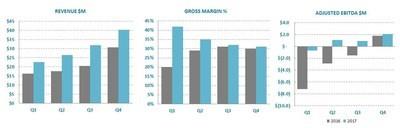
(MENAFNEditorial) Full year 2017 revenue of $121.3M and $3.3M Adjusted EBITDA Q4 revenue of $40.3M and $2.1M Adjusted EBITDA $60.3M cash reserves at year-end VANCOUVER, Feb. 28, 2018 /PRNewswire/ - (NASDAQ: ; TSX: BLDP) today announced consolidated financial results for the fourth quarter and full year ended December 31, 2017. All amounts are in U.S. dollars unless otherwise noted and have been prepared in accordance with International Financial Reporting Standards (IFRS). Ballard Power Systems Q4 2017 key metrics (CNW Group/Ballard Power Systems Inc.) Ballard Power Systems 2017 full year key metrics (CNW Group/Ballard Power Systems Inc.) Randy MacEwen, President and CEO said, "2017 was a milestone year for Ballard on our path to profitability. We generated record revenue of $40.3 million in the final quarter, contributing to record full year 2017 revenue of $121.3 million, an increase of 42% year-on-year. We delivered a 6-point improvement in gross margin for the full year to 34%. The Company's strong top-line growth and gross margin expansion contributed to Adjusted EBITDA of $2.1 million in Q4 and $3.3 million for the full year 2017. We have now achieved positive Adjusted EBITDA in four of the last five quarters." Mr. MacEwen continued, "In addition to improved financial performance, we made measured progress in 2017 on our strategic positioning. We continued to advance our next generation technology and products. We made important progress on the localization of Ballard-designed stacks and modules in China, including commissioning of both our Synergy-Ballard stack joint venture operation and Broad-Ocean's engine assembly line in Shanghai. We strengthened our engagement with key customers and continued to expand the range of fuel cell electric vehicle, or FCEV, applications. As a result, our fuel cell value proposition is gaining traction across a broadening array of FCEVs, including buses, commercial trucks and rail, and in the key geographic markets of China, Europe and the United States. We also continued to advance our Technology Solutions business, which offers significant embedded optionality on longer-term fuel cell motive markets, including drones, marine and passenger cars." Total revenue was $40.3 million, a 31% improvement. Power Products revenue was $30.1 million, up 58% year-over-year and reflecting strong growth in Heavy Duty Motive. Technology Solutions revenue was $10.2 million, a 13% decrease due primarily to program scope and timing of underlying service contracts. Gross margin was 31%, up 1-point to $12.6 million, due to the increased proportion of revenue from high-margin Heavy Duty Motive. Cash operating costs2 were $11.2 million, a 38% increase due primarily to higher technology and product development activities, increased investment to support commercial efforts in China as well as the impact of a higher Canadian dollar, relative to the U.S. dollar, on the Canadian operating cost base. Adjusted EBITDA2 improved 18% to $2.1 million, due to the increase in revenue and gross margin. Net loss was ($2.9) million or ($0.02) per share, changes of -158% and 0%, respectively. The quarterly net loss was driven primarily by impairment charges related to the divestiture of the Solid Oxide Fuel Cell business at the Company's Protonex subsidiary. Adjusted net loss2 was ($0.9) million or ($0.01) per share, changes of -5% and -3%, respectively. Cash used by operating activities was ($0.7) million, a -109% change, reflecting cash operating income of $1.7 million, combined with net working capital outflows of ($2.4) million, driven by higher accounts receivable of ($5.7) million and lower deferred revenue of ($1.5) million. Full Year 2017 Financial Highlights
(all comparisons are to full year 2016 unless otherwise noted) Total revenue was $121.3 million, a 42% improvement. Power Products revenue was $77.6 million, an increase of 39% reflecting strong growth in Heavy Duty Motive and Technology Solutions. Technology Solutions revenue was $43.7 million, an increase of 47% due to program scope and timing of programs, including the Synergy JVCo technology transfer agreement. Gross margin was 34%, up 6-points to $41.6 million primarily due to a shift in revenue mix toward higher margin Heavy Duty Motive and Technology Solutions. Cash operating costs2 were $39.1 million, an increase of 14% due primarily to higher technology and product development activities, increased investment to support commercial efforts in China as well as the impact of a higher Canadian dollar, relative to the U.S. dollar, on the Canadian operating cost base. Adjusted EBITDA2 improved 134% to $3.3 million, due to higher revenue and gross margin. Net loss narrowed to ($8.0) million or ($0.05) per share, improvements of 62% and 66%, respectively. The reduction in net loss was driven by the improvement in Adjusted EBITDA and by higher finance and other income due primarily to higher foreign exchange gains. Adjusted net loss2 was ($5.2) million or ($0.03) per share, improvements of 73% and 76%, respectively. Cash used by operating activities was ($9.8) million, a change of -150% reflecting cash operating income of $2.5 million and net working capital outflows of ($12.3) million, reflecting in part the completion of certain work that had significant prepayments. Cash reserves were $60.3 million at December 31, $12.3 million lower than the end of 2016. 2018 Outlook Given the early stage of the hydrogen fuel cell market development and adoption rate, and consistent with the Company's approach in 2017, Ballard is not providing specific financial performance guidance for 2018.
Mr. MacEwen added, "We believe we are poised with highly-disruptive and field-proven technology at the convergence of three global megatrends – decarbonization, air quality and electrification of propulsion – presenting a compelling future for Ballard. We believe that FCEVs will become a meaningful portion of the heavy, medium and light duty transport markets where long range, rapid refueling and route flexibility are customer requirements. This is consistent with our '30 by 30' industry challenge, by which 30% of all new commercial vehicles in key markets are FCEVs by 2030."
Mr. MacEwen concluded, "As we look out to 2020, we expect strong growth in FCEV demonstration programs and commercial scaling in certain heavy and medium duty applications in China, Europe and the United States. With continued investment in technology, products, customer engagement and our brand, we see Ballard having a leading position in these large and growing addressable markets. In 2018 we will continue focusing on our strategic positioning, delivery against our customer promises, exceptional talent and disciplined investments. We have a solid foundation for 2018, including total committed orders of $91.4 million expected for delivery in 2018 and a robust sales pipeline. In addition to the $91.4 million, we received and announced a Letter of Intent today from Van Hool, a Ballard bus partner in Europe, for 40 fuel cell engines. This planned deployment of fuel cell buses in Germany will be the largest order ever for fuel cell buses in Europe. We expect to receive purchase orders and begin shipping later this year." Q4 2017 Financial Highlights
(all comparisons are to Q4 2016 unless otherwise noted)
(all comparisons are to full year 2016 unless otherwise noted)
Global trends toward decarbonization, improving air quality and the electrification of propulsion systems have underpinned a growing interest in fuel cell electric vehicles, or FCEVs, for heavy and medium duty applications in bus, commercial truck, rail and marine markets. Industry activity levels are increasing in China, Europe and the United States.
Looking to 2020, the Company expects strong growth in FCEV demonstration programs and commercial scaling in certain heavy and medium duty applications in China, Europe and the United States. With continued investment in talent, technology, products, customer engagement and brand, Ballard expects to have a leading market position.In 2018, Ballard will continue to pursue a corporate strategy and business model that mitigates risk by diversifying its business across a portfolio of market opportunities that are enabled by substantially the same core competencies, technology, products and intellectual property.
In China, Ballard has been pursuing a strategy that includes the development of a local fuel cell supply chain and related ecosystem to address the zero-emission bus and commercial vehicle markets. The Company accomplished important progress in 2017 with the localization of stack and module assembly operations in China, which generated associated one-time revenue from technology transfer activities. Further, the Company generated significant revenue from the supply to Broad Ocean of 600 modules and components to support initial FCEV demonstration programs in key Chinese markets.In 2018, with completion of the Company's localization activities, we expect the China revenue mix to shift from the sale of modules towards MEA component sales and royalties from the sale of locally-assembled modules.With this transition in business model, combined with the absence of one-time revenue related to the technology transfer activities and module sales in 2017, Ballard expects year-on-year revenue from China to be lower in 2018.However, beyond 2018, Ballard expects to generate increasing revenue from MEA sales, royalties and future Technology Solutions opportunities as a result of increasing demand for FCEV engines in a range applications.In Europe, the Company expects increased market activity in 2018 for fuel cell electric buses, which can be expected to result in growth of purchase orders for modules.
Within the United States, Ballard expects increased 2018 market activity in California for fuel cell electric buses, which can also be expected to result in growth of purchase orders for modules. Ballard also expects growth in revenue from its Protonex subsidiary in 2018, as a result of obtaining "Milestone C" status in the U.S. Army Program of Record in 2017. At the same time, a continued decline in sales of fuel cell stacks to Plug Power in the material handling market segment is expected in 2018, as this customer continues to internalize production.Technology Solutions revenue is expected to be relatively flat year-on-year in 2018, given the significant contribution made in 2017 by one-time technology transfer projects in China. This revenue decline is expected to be largely offset by increases in engineering services activity with existing and new customers in the automotive, rail, material handling and drone sectors, including the Company's HyMotion program with Volkswagen Group.
In summary, given the relatively early stage of development in some markets, the uncertainty of timing in contract awards and program deliveries in 2018, together with significant one-time contributions from key projects in 2017, Ballard expects revenue to be relatively flat in 2018, coincident with a strengthening of the underlying business mix for long-term growth prospects. The 2018 revenue outlook is supported by a solid foundation to start the year, with a 12-month Order Book of $73.4 million at 2017 year end. Since year-end the Company has secured additional orders of $18.0 million, such that Ballard now has total committed orders of $91.4 million expected for delivery in 2018, together with a robust pipeline of qualified commercial sales opportunities.Q4 & Full Year 2017 Financial Summary

Legal Disclaimer:
MENAFN provides the
information “as is” without warranty of any kind. We do not accept
any responsibility or liability for the accuracy, content, images,
videos, licenses, completeness, legality, or reliability of the information
contained in this article. If you have any complaints or copyright
issues related to this article, kindly contact the provider above.
Most popular stories
Market Research

More Story







Comments
No comment