




403
Sorry!!
Error! We're sorry, but the page you were looking for doesn't exist.
Why 'Singapore Washing' Will Never Be The Same
(MENAFN- Asia Times)
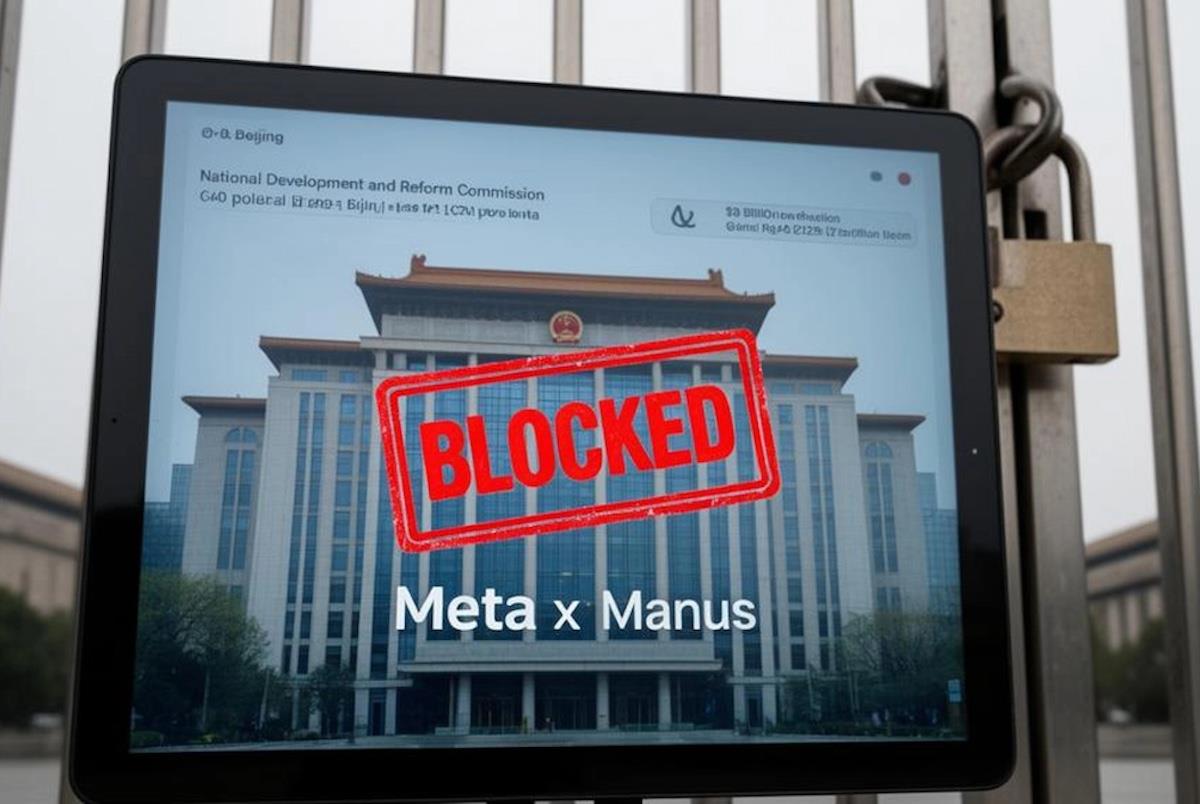
In April, China's National Development and Reform Commission moved to unwind Meta's planned US$2 billion acquisition of Manus, the AI-agent startup founded in Beijing that had relocated its headquarters to Singapore in mid-2025.
Meta had agreed to buy the company in December. But by late March, co-founders Xiao Hong and Ji Yichao had been barred from leaving China while regulators reviewed the transaction. By the end of April, the deal was blocked.
The case has been widely reported, including in this publication, largely as a US-China story: a test of how far Washington and Beijing will allow AI talent and capital to flow between them.
That reading is correct as far as it goes. But it misses the part of the Manus story that matters most to anyone who actually allocates capital in the region.
Manus is the most visible example of a pattern financial media has dubbed “Singapore washing”, whereby Chinese-founded firms relocate part of their corporate structure to Singapore to access Western capital and present a neutral face, while operations, intellectual property and the substance of the business remain in China.
Analysts have applied the term to Shein, which relocated its headquarters to Singapore in 2021 while keeping its roughly 10,000-supplier base in Guangdong, China. Manus took the strategy to its logical end in 2025, closing its China offices and moving its core team to Singapore in the months leading up to the Meta deal.
The Manus block is China's first major regulatory enforcement against the playbook. The geopolitical reading treats this as a story about two superpowers.
The more useful reading treats it as a stress test of something smaller and, for this region, more important: how well cross-border capital structures actually hold up when someone finally looks inside them, and what it costs Singapore when the answer is“not very well.”
What the structure was hidingThe logic of“Singapore washing” is simple. A Singapore address signals neutrality. It opens access to Western investors who cannot or will not fund a Chinese-domiciled company, and to customers and capital markets that price Chinese regulatory risk heavily.
The relocation from China to Singapore is real on paper. However, the transplanted business's substance – the engineers, the code, the data, the supply chain – often is not relocated at all.
Latest stories The fading mirage of US-guaranteed Gulf security Belgrade bets on Beijing as Budapest pivots to Brussels In Myanmar's info war, foreign pens mouth junta's linesFor a while, the gap between the paper and the substance did not matter, because no one with the power to act chose to look. Beijing's unraveling of the Manus-Meta deal was the moment someone looked and balked.
Beijing's intervention established that a Chinese-founded company cannot simply re-domicile its way out of Chinese jurisdiction when its core technology and talent are still based at home.
The message, as one reading of the case put it, is that Singapore can be a launch pad but not an exit ramp. That is a problem for Chinese founders. And it is a larger problem for Singapore.
When the integrity of a Singapore corporate structure becomes contingent on whether Beijing decides to assert a claim over what is inside it, the Singapore flag stops being a clean signal.
It becomes a question and the cost of that question does not fall only on the firms that misused the playbook. It falls on every legitimately Singaporean company that now has to prove it is not one of them.
This matters more now because regional capital is already under strain. Southeast Asian venture funding is contracting sharply.
PitchBook's data points to a 33.9% year-on-year decline in regional venture capital deal value in 2025, to US$6.3 billion across 805 transactions, a fall the firm attributes partly to reduced cross-border participation and tighter diligence standards.
In a tightening market, investors become far less willing to underwrite structures they cannot fully verify. Ambiguity that was tolerated in a capital-abundant cycle gets repriced to zero in a capital-scarce one.
The accounting fraud at eFishery, once one of the region's most celebrated startups, had already reset diligence standards across Southeast Asia. The Manus block adds a second lesson on top of the first.
The eFishery scandal taught investors that reported numbers might not be real. The Manus-Meta deal block has shown that the corporate structure itself might not be what it appears to be, and that a jurisdiction's protection is only as durable as the substance beneath it.
Together, these cases are doing something that no amount of policy messaging could: they are teaching capital to look harder at Asia's cross-border structures. Singapore, as the region's preferred neutral domicile, has the most to gain if that scrutiny finds substance, and the most to lose if it does not.
The Manus case played out at the $2 billion level, which is why it made headlines. But the same structure shows up far below the headlines, in the deals investors actually see every week.
Earlier this year, a founder pitched me on his semiconductor company. The pitch was for a Singapore-incorporated business for which the deck was clean, the market was real and the technology was genuinely differentiated.
Then I asked the business founder three questions. Where does your intellectual property legally sit? Who owns the entity that owns it? And if I wire money into your Singapore company tomorrow, what exactly am I buying?
He could not answer any of them cleanly. The intellectual property (IP) sat in China. The product was built in China. The team was in China. The Singapore entity he was raising owned almost nothing of substance.
It was, in miniature and entirely sincerely, the same structure Beijing had just enforced against at the $2 billion level. The founder was not running a scheme. He had simply done what the ecosystem had taught him to do: put a Singapore wrapper on a Chinese business and assume the wrapper was enough.
But it is no longer enough, and the Manus case is the clearest possible evidence of why. A Singapore address does not change where the substance of a business lives, who can assert jurisdiction over it or what an investor is actually able to own.
At the seed stage, these questions are cheaper to answer and easier to fix. They are also almost never asked, because the wrapper does its job of making the question feel unnecessary.
What investors must askThe asset at risk is bigger than any single company. It is the meaning of“Singapore-based.” Singapore has spent decades building a reputation as a jurisdiction where a corporate domicile signals real substance, sound governance and enforceable ownership.
Sign up for one of our free newsletters-
The Daily Report
Start your day right with Asia Times' top stories
AT Weekly Report
A weekly roundup of Asia Times' most-read stories
That reputation is the foundation of its position as Asia's neutral capital hub.“Singapore washing”, left unchecked, erodes exactly that by making the Singapore flag a thing investors must verify rather than trust.
Defending it is partly a policy question, and the substance tests that determine whether a Singapore entity is real, where its IP and operations sit, and whether its ownership is clean, deserve more weight in how the jurisdiction presents itself. But it is also a question for investors, who hold more of the answer than they often use.
The Manus case suggests a short, unglamorous checklist for any cross-border deal in this region. Where does the IP legally sit, and who owns it? Is the Singapore entity substantive, or a shell over operations elsewhere? Can the revenue be independently verified in the jurisdiction where it is booked?
What regulatory exposure, including export controls and outbound-investment rules, exists in the country where the business actually operates? And what happens to ownership if that country chooses to assert a claim?
None of these questions is exotic. All of them would have surfaced the Manus problem long before Meta's $2 billion was on the table, and all of them would have surfaced the semiconductor founder's problem before a term sheet was drafted.
The Manus-Meta deal veto will be remembered as a moment in the US-China AI contest. But its more lasting lesson is for the region itself.
Asia's capital corridor is only as strong as the structures that run through it. And Singapore's value as the corridor's most trusted node depends on those structures being real with every check written to and by a company that claims to be“Singaporean.”
Chris Chen is the founder of Future 500, an accelerator working with founders across Asia to scale beyond their home markets.
Sign up here to comment on Asia Times stories OrThank you for registering!
-
Share on X (Opens in new window)
Share on LinkedIn (Opens in new window)
LinkedI
Share on Facebook (Opens in new window)
Faceboo
Share on WhatsApp (Opens in new window)
WhatsAp
Share on Reddit (Opens in new window)
Reddi
Email a link to a friend (Opens in new window)
Emai
Print (Opens in new window)
Prin

Legal Disclaimer:
MENAFN provides the
information “as is” without warranty of any kind. We do not accept
any responsibility or liability for the accuracy, content, images,
videos, licenses, completeness, legality, or reliability of the information
contained in this article. If you have any complaints or copyright
issues related to this article, kindly contact the provider above.
Most popular stories
Market Research

More Story







Comments
No comment