




403
Sorry!!
Error! We're sorry, but the page you were looking for doesn't exist.
Lab Grown Diamond Market Size, Share, Growth, Report, 2034
| Company | Recent Activity | Timeline | Details |
|---|---|---|---|
| Limelight Diamonds | Expansion & Fundraise | December 2025 | Limelight Diamonds announced USD 29.8 Million (INR 250 crore) fundraising to support in-house lab grown diamond manufacturing expansion and planned retail store growth across India. |
| ONYA | Pre-Seed Funding | November 2025 | ONYA secured USD 0.66 million (INR 5.5 Crore) in pre-seed funding led by Zeropearl VC to expand its lab grown diamond jewelry retail operations across India. |
| Lucira | Funding Round | September 2025 | Lucira secured USD 5.5 million in its maiden funding round led by Blume Ventures and Spring Marketing Capital to expand lab grown diamond jewelry operations and strengthen retail presence. |
| Market Metric | Details & Data (2025-2034) |
|---|---|
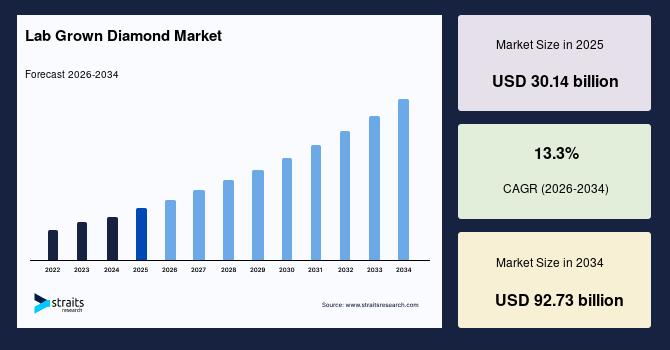
| 2025 Market Valuation | USD 30.14 billion |
| Estimated 2026 Value | 34.15 billion |
| Projected 2034 Value | USD 92.73 billion |
| CAGR (2026-2034) | 13.3% |
| Study Period | 2022-2034 |
| Dominant Region | North America |
| Fastest Growing Region | Asia Pacific |
| Key Market Players | Diamond Foundry Inc.(US), De Beers Group(UK), WD Lab Grown Diamonds(US), Lusix(Israel), Swarovski Created Diamonds (Austria) |
Download Free Sample Report to Get Detailed Insights.
Lab Grown Diamond Market Dynamics Market DriversIncreasing Preference for Sustainable Luxury Jewelry and Expanding Use of Lab Grown Diamonds in Semiconductor Applications Drives Market
The lab grown diamond market growth is being supported by increasing adoption among Millennials and Gen Z consumers seeking sustainable and affordable luxury jewelry products. Younger consumers are increasingly shifting toward lab grown diamond engagement rings and fashion jewelry due to lower pricing and ethical sourcing preferences. According to a 2025 study highlighted by Fortune, more than 50% of couples selected engagement rings featuring lab grown diamonds in 2025, reflecting rapid adoption among younger consumers. In addition, Pandora Group stated that all Pandora lab grown diamonds have been produced using 100% renewable electricity since 2022, supporting sustainability-focused purchasing trends among younger demographics, significantly driving lab grown diamond market growth.
The lab grown diamond market growth is also supported by increasing use of synthetic diamonds in semiconductor cooling systems, thermal management applications, and industrial cutting technologies due to their superior thermal conductivity and hardness properties. Diamond materials can achieve thermal conductivity levels of up to 2,200 W/(m·K), making them highly suitable for advanced electronic heat dissipation applications.
Market RestraintsLack of Rarity Perception and Limited Acceptance in Luxury Jewelry Segments Restrain Market Growth
The lab grown diamond market faces restraint due to limited rarity perception associated with mass-scale synthetic diamond manufacturing and lower acceptance across ultra-luxury jewelry segments. Unlike natural diamonds, lab grown diamonds can be produced in controlled laboratory environments at commercial scale, reducing exclusivity perceptions among premium jewelry consumers.
The market is also affected by lower penetration of lab grown diamonds in heritage luxury jewelry categories, where consumers continue to associate natural diamonds with long-term rarity, prestige, and investment value. According to a 2025 report published by The Washington Post, prices of lab grown diamonds declined by more than 70% over the last few years due to increasing production volumes and expanding manufacturing capacity. Continuous price reductions and large-scale availability are limiting exclusivity positioning for lab grown diamonds within premium luxury jewelry markets.
Market OpportunitiesExpansion of Quantum Sensing Technologies and Radiation-resistant Electronic Applications Creates Growth Opportunities for Market Players
The lab grown diamond market is creating opportunities through increasing research and commercialization of nitrogen-vacancy (NV) center diamonds for quantum sensing and quantum computing technologies. NV centers in synthetic diamonds are being used for ultra-sensitive magnetic field detection, semiconductor testing, biomedical sensing, and precision metrology applications. According to the Press Information Bureau (Government of India), India's National Quantum Mission includes dedicated research programs focused on NV-center diamond technologies for quantum sensing applications. The government-backed Qmet hub currently includes 16 research institutes and around 40 researchers working on quantum sensing and metrology technologies using diamond-based systems. The program is developing quantum diamond microscopes capable of non-destructive semiconductor chip testing and nanoscale magnetic sensing applications, creating new commercial opportunities for lab grown diamond manufacturers.
The lab grown diamond market is witnessing emerging opportunities from increasing use of synthetic diamonds in radiation detection systems, aerospace electronics, and high-radiation industrial environments. Lab grown diamonds possess high radiation hardness, thermal stability, and electrical insulation properties, making them suitable for advanced sensing and electronic applications. According to the European Organization for Nuclear Research (CERN), synthetic diamond detectors are being evaluated for high-energy particle physics experiments due to their radiation resistance and fast signal response characteristics. CERN reported that diamond detectors can tolerate radiation doses exceeding 1016 protons/cm2, supporting long-term operation in extreme radiation environments.
Market ChallengesLimited Resale Infrastructure and Commoditization Challenges Act as Barriers in the Lab Grown Diamond Market
The lab grown diamond market faces challenges due to limited secondary market infrastructure for resale, exchange, and auction trading of synthetic diamond jewelry products. Unlike natural diamonds, lab grown diamonds currently have lower participation in established auction ecosystems and investment-grade jewelry trading channels, affecting long-term resale confidence among consumers. According to the Gemological Institute of America (GIA), laboratory-grown diamonds possess the same physical and chemical properties as natural diamonds but differ in origin and market positioning.
The market also faces challenges in establishing premium brand perception due to rapid commoditization and increasing large-scale production of synthetic diamonds. Continuous manufacturing expansion and declining retail prices are limiting exclusivity positioning for lab grown diamond products within luxury jewelry segments. According to the Federal Trade Commission (FTC) Jewelry Guides, marketers are required to clearly disclose laboratory-created diamonds to avoid consumer confusion regarding product origin and value perception. Rapid expansion of standardized CVD and HPHT manufacturing technologies is increasing product availability across retail markets, creating pricing pressure and reducing differentiation opportunities for premium lab grown diamond brands.
Lab Grown Diamond Regional Outlook Asia Pacific: Market Dominance Led by Expanding Lab Grown Diamond Manufacturing Infrastructure and Jewelry Retail AdoptionThe Asia Pacific lab grown diamond market accounted for a share of 34.86% in 2025 due to increasing production capacity, expanding jewelry retail networks, and rising consumer acceptance of synthetic diamond jewelry products across regional markets. The region benefits from strong diamond cutting and polishing infrastructure, lower manufacturing costs, and growing investment in chemical vapor deposition technologies. According to the Gem & Jewelry Export Promotion Council (GJEPC), India continues to maintain a major position in global lab grown diamond exports and processing activities, supporting regional market expansion.
India Lab Grown Diamond MarketThe lab grown diamond market in India was estimated to be USD 4.74 billion in 2025, supported by the country's large-scale diamond manufacturing ecosystem, export infrastructure, and increasing government-backed research initiatives for synthetic diamond technologies. According to ICRA Indian lab grown diamond exports increased from USD 225 million in FY2019 to USD 1.207 million in FY2025, reflecting rapid expansion of domestic production and export capabilities. India also benefits from a strong diamond cutting and polishing ecosystem, expanding chemical vapor deposition manufacturing infrastructure, and growing export-oriented jewelry production activities centered around Surat-based manufacturing clusters.
China Lab Grown Diamond MarketThe lab grown diamond market in China was estimated to be USD 4.86 billion in 2025, driven by increasing synthetic diamond manufacturing activity, expanding industrial diamond applications, and growing domestic jewelry consumption. According to the General Administration of Customs of the People's Republic of China, China continues to maintain significant trade activity across synthetic diamond and industrial diamond product categories, supported by expanding domestic manufacturing capabilities and export-oriented production infrastructure. The country benefits from strong high-pressure high-temperature (HPHT) manufacturing capacity, increasing adoption of synthetic diamonds in industrial tooling applications, and growing commercialization of lab grown diamond jewelry across domestic retail markets.
Japan Lab Grown Diamond MarketThe Japan lab grown diamond market was estimated to be valued at USD 1.42 billion, supported by increasing demand for premium jewelry products, rising adoption of sustainable luxury goods, and expanding use of advanced synthetic materials across high-technology industries. According to the Ministry of Economy, Trade and Industry (METI), Japan, Japan continues to maintain significant manufacturing activity across precision materials, electronics, and advanced industrial technologies, supporting demand for high-performance synthetic diamond materials across industrial and semiconductor-related applications.
North America: Fastest Growth Driven by Expanding Online Jewelry Retail and Increasing Adoption of Lab Grown Diamond Engagement RingsThe North America lab grown diamond market is expected to grow at a CAGR of 14.1% during the forecast period due to rising consumer acceptance of sustainable diamond jewelry, increasing online jewelry purchases, and growing penetration of lab grown engagement rings across the region. According to the U.S. Census Bureau Quarterly Retail E-Commerce Sales Report, U.S. retail e-commerce sales reached USD 365.2 billion in the fourth quarter of 2025, accounting for 18.3% of total retail sales. Expanding digital retail infrastructure and rising online luxury purchases are supporting growth of lab grown diamond jewelry sales across North America.
US Lab Grown Diamond MarketIn 2025, the US lab grown diamond market was estimated to be USD 6.82 billion, fueled by increasing adoption of synthetic diamond engagement rings, growing preference for larger carat jewelry products, and expanding online jewelry retail platforms. According to the US Census Bureau via Federal Reserve Economic Data (FRED), US jewelry store retail sales remained above USD 3 billion monthly during 2025, reflecting continued consumer spending across diamond jewelry categories. Rising online retail penetration and increasing consumer preference for certified and traceable diamond products are supporting growth of lab grown diamond jewelry across the country.
Canada Lab Grown Diamond MarketThe lab grown diamond market in Canada was estimated to be USD 0.96 billion in 2025, supported by increasing demand for ethically sourced jewelry products, rising sustainability awareness, and expanding jewelry retail activity across urban consumer markets. According to the Government of Canada – Retail Commodity Survey, jewelry and accessory retail activity continues to expand across Canada supported by rising online retail participation and premium product spending trends. Increasing consumer preference for traceable and environmentally responsible luxury products is supporting adoption of lab grown diamond jewelry across Canada.
Lab Grown Diamond Market Segmentation Analysis By Manufacturing MethodBy manufacturing method, chemical vapor deposition is expected to grow at a CAGR of 14.4% during the forecast period due to increasing adoption of CVD technology for manufacturing high-clarity and large-size lab grown diamonds. The technology enables better control over diamond purity, crystal quality, and scalable production processes for jewelry and industrial applications. Rising use of CVD-grown diamonds in premium engagement rings and semiconductor applications is also supporting segment growth.
High pressure high temperature is projected to grow at a CAGR of 11.8% during the forecast period due to continued use of HPHT technology for cost-efficient production of industrial-grade and gemstone-quality synthetic diamonds. The process remains widely adopted for manufacturing smaller diamonds and colored lab grown diamonds across commercial jewelry markets. Increasing utilization of HPHT diamonds in cutting tools, abrasives, and polishing applications is sustaining demand for this segment globally.
By NatureBy nature, the polished lab grown diamonds segment is projected to grow at a CAGR of 14.6% during the forecast period due to increasing consumer preference for certified and jewelry-ready synthetic diamonds across engagement rings and fashion jewelry categories. Rising adoption of polished diamonds through online retail platforms and branded jewelry collections is supporting segment expansion globally. Growing demand for high-clarity and premium-cut lab grown diamonds is also contributing to market growth.
The rough lab grown diamonds segment is expected to grow at a CAGR of 11.2% during the forecast period due to increasing use of uncut synthetic diamonds in polishing, processing, and industrial manufacturing applications. The segment continues to benefit from expanding diamond cutting and processing activities across India and China. Rising demand for cost-efficient raw materials for jewelry manufacturing and industrial tooling applications is sustaining growth for rough lab grown diamonds.
By SizeBelow 2 carat dominated the lab grown diamond market, by size, accounting for a share of 52.4% in 2025. Increasing consumer preference for affordable engagement rings, fashion jewelry, and daily wear accessories is supporting demand for smaller carat lab grown diamonds. Their lower pricing and wider availability compared to large-size diamonds continue to strengthen adoption across mainstream jewelry markets.
The above 4 carat segment is projected to grow at a CAGR of 15.3% during the forecast period due to rising demand for premium and luxury lab grown diamond jewelry products. Improvements in chemical vapor deposition manufacturing technologies are enabling production of larger and high-clarity synthetic diamonds for high-end jewelry applications. Growing consumer interest in oversized engagement rings and customized luxury jewelry is supporting segment growth globally.
By ApplicationBy application, bridal jewelry accounted for a the largest share of 49.6% in 2025 and is projected to grow at the fastest rate, registering a CAGR of 14.2% during the forecast period. Increasing consumer preference for affordable engagement rings and wedding jewelry is supporting demand for lab grown diamonds across bridal applications. Growing adoption among Millennials and Gen Z consumers seeking certified and ethically sourced diamonds is further contributing to segment expansion globally.
Fashion jewelry accounted for second largest share of 36.7% in 2025. Rising demand for lightweight, trendy, and affordable diamond accessories for daily wear is supporting adoption across fashion jewelry categories. Increasing product launches across earrings, pendants, bracelets, and customized jewelry collections are also strengthening segment growth.
By Distribution ChannelBy distribution channel, specialty jewelry stores accounted for a market share of 39.5% in 2025 due to strong consumer preference for in-store diamond verification, customized consultations, and certified jewelry purchases. These stores provide personalized engagement ring selection, premium product showcasing, and grading transparency for buyers. Growing availability of branded lab grown diamond collections across jewelry retail chains is also supporting segment dominance.
The online retail segment is expected to grow at a CAGR of 15.6% during the forecast period due to increasing consumer preference for digital jewelry purchasing platforms and customized ring configuration services. Online platforms offer competitive pricing, wider product availability, and virtual diamond comparison tools for consumers. Rising adoption of direct-to-consumer sales models and digital engagement ring customization is further supporting segment growth globally.
By End UserBy end user, residential accounted for a market share of 71.4% in 2025 and is projected to grow at a CAGR of 14.0% during the forecast period. Rising consumer preference for affordable engagement rings, fashion jewelry, and ethically sourced diamond products is supporting strong adoption across residential applications. Increasing online jewelry purchases and growing acceptance of lab grown diamonds among Millennials and Gen Z consumers are further contributing to segment growth globally.
Commercial accounted for the second largest share of 17.8% in 2025 due to increasing procurement of lab grown diamonds by jewelry retailers, branded stores, and commercial jewelry manufacturers. Growing expansion of customized jewelry collections and retail showroom offerings is supporting demand across commercial applications. Increasing partnerships between lab grown diamond producers and jewelry brands are also strengthening segment growth.
Competitive LandscapeThe lab grown diamond market landscape is moderately fragmented, with competition among global synthetic diamond manufacturers, jewelry retailers, vertically integrated producers, and technology-focused diamond growing companies. Major players compete through chemical vapor deposition manufacturing capabilities, diamond grading quality, pricing strategies, sustainability positioning, and direct-to-consumer retail expansion. Established companies focus on scaling production capacity, strengthening branded jewelry portfolios, and expanding certified lab grown diamond offerings across bridal and fashion jewelry categories.
Emerging market participants are increasingly focusing on customized jewelry solutions, online retail platforms, premium large-carat diamonds, and renewable energy-powered manufacturing operations to strengthen market positioning. the lab grown diamond market competition is also influenced by advancements in HPHT and CVD reactor technologies, product certification standards, digital jewelry customization, and expansion into semiconductor and industrial synthetic diamond applications.
List of Key and Emerging Players in Lab Grown Diamond Market-
Diamond Foundry Inc.(US)
De Beers Group(UK)
WD Lab Grown Diamonds(US)
Lusix(Israel)
Swarovski Created Diamonds (Austria)
Pure Grown Diamonds (US)
Greenlab Diamonds (India)
New Diamond Technology LLC(Russia)
Fenix Diamonds(UAE)
Ada Diamonds Inc.(US)
Aether Diamonds(US)
VRAI(US)
Applied Diamond Inc. (US)
IIa Technologies Pte. Ltd.(Singapore)
October 2025: Charles & Colvard announced a strategic partnership with Ethara Capital to expand its lab grown diamond jewelry offerings and strengthen supply chain integration for Caydia® lab grown diamond collections. The partnership supports expansion across wholesale and direct-to-consumer jewelry channels.
Report Scope| Report Metric | Details |
|---|---|
| Market Size in 2025 | USD 30.14 billion |
| Market Size in 2026 | 34.15 billion |
| Market Size in 2034 | USD 92.73 billion |
| CAGR | 13.3% (2026-2034) |
| Base Year for Estimation | 2025 |
| Historical Data | 2022-2024 |
| Forecast Period | 2026-2034 |
| Report Coverage | Revenue Forecast, Competitive Landscape, Growth Factors, Environment & Regulatory Landscape and Trends |
| Segments Covered | By Manufacturing Method, By Nature, By Size, By Application, By Distribution Channel, By End User |
| Geographies Covered | North America, Europe, APAC, Middle East and Africa, LATAM |
| Countries Covered | US, Canada, UK, Germany, France, Spain, Italy, Russia, Nordic, Benelux, China, Korea, Japan, India, Australia, Taiwan, South East Asia, UAE, Turkey, Saudi Arabia, South Africa, Egypt, Nigeria, Brazil, Mexico, Argentina, Chile, Colombia |
Download Free Sample Report to Get Detailed Insights.
Lab Grown Diamond Market Segments By Manufacturing Method-
High Pressure High Temperature
Chemical Vapor Deposition
-
Rough Lab Grown Diamonds
Polished Lab Grown Diamonds
-
Below 2 Carat
2 Carat to 4 Carat
Above 4 Carat
-
Fashion Jewelry
Bridal Jewelry
Industrial Applications
-
Online Retail
Specialty Jewelry Stores
Department Stores
Direct Sales
-
Residential
Commercial
Industrial
-
North America
Europe
APAC
Middle East and Africa
LATAM

Legal Disclaimer:
MENAFN provides the
information “as is” without warranty of any kind. We do not accept
any responsibility or liability for the accuracy, content, images,
videos, licenses, completeness, legality, or reliability of the information
contained in this article. If you have any complaints or copyright
issues related to this article, kindly contact the provider above.
Most popular stories
Market Research

More Story







Comments
No comment