




403
Sorry!!
Error! We're sorry, but the page you were looking for doesn't exist.
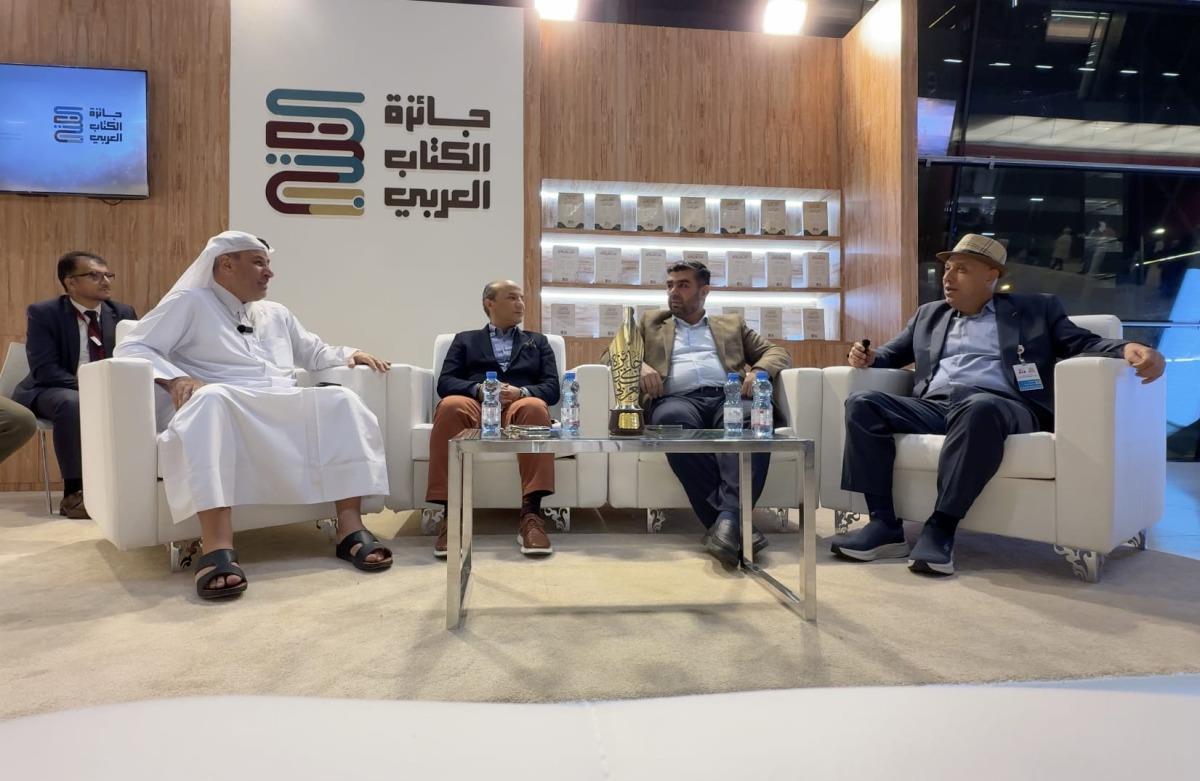
Arab Book Award Panel Highlights Role Of Cultural Awards In Supporting Arab Research And Creativity
(MENAFN- The Peninsula)
The Peninsula
Doha: A panel discussion hosted by the Arab Book Award has highlighted the important role cultural awards play in supporting research, creativity, and high-quality intellectual production across the Arab world.
The event was organized as part of the award's participation in the 35th edition of the Doha International Book Fair, held from May 14 to 23, as part of ongoing efforts to strengthen engagement with writers and researchers and to promote the award's mission of serving Arab culture and encouraging serious scholarly work.
The session was attended by Dr. Naji Al-Sharif, Executive Director of the award, and featured contributions from Dr. Mahmoud Al-Ashiri, winner of the award's second edition, as well as Dr. Ahmad Sanobar and Muhannad Halwah, founder and director of Kunooz Al-Ma'rifa Publishing House, both winners in the third edition. The discussion was moderated by Dr. Mohammed Khaled Al-Rahawi.
Speakers emphasized the importance of books as the product of integrated intellectual and academic effort, while underscoring the role cultural awards play in showcasing serious scholarly achievements and encouraging researchers and publishers to produce distinguished works that enrich the Arab library.
Discussing his book The Audible Linguistic Corpus, Dr. Mahmoud Al-Ashiri explained that the project was built on teamwork and collaboration among researchers from diverse academic backgrounds, which contributed to a comprehensive and rigorous study worthy of recognition. He said the award had provided strong motivation to continue his academic and scientific work, stressing that winning marked the beginning of a broader intellectual journey rather than a final destination.
For his part, Dr. Ahmad Sanobar spoke about his book 'Authority and Its Impact on the Narration and Criticism of Hadith', noting that the work relied on a precise scientific methodology based on statistical analysis and historical research, offering new insights in the field.
He added that following previous award-winning works had inspired him to further develop his research project, emphasizing that cultural awards provide valuable moral recognition that encourages scholars to continue contributing to academic knowledge.
Addressing the publishing industry, Muhannad Halwah outlined the philosophy of Kunooz Al-Ma'rifa Publishing House in selecting books for publication. He explained that the publishing house prioritizes content quality, originality of ideas, linguistic accuracy, and the intellectual value of each work, in addition to ensuring alignment with the institution's cultural and intellectual vision.
He also highlighted the importance of academic and linguistic review processes, respect for intellectual property rights, and evaluating a book's potential for distribution and participation in exhibitions and cultural awards.
Participants agreed that the Doha International Book Fair has become a leading cultural platform bringing together writers, publishers, and researchers from various countries, helping to facilitate the exchange of expertise and strengthen Arab cultural activity.
They also stressed that the Arab Book Award has become a distinguished initiative in supporting Arab thought and authentic intellectual production.
The award continues to receive submissions for its fourth edition until May 28. This year's categories include linguistic and critical studies, with a focus on grammar and morphology as well as critical studies in narrative and theater. In social and philosophical studies, the current edition is dedicated to Arab-Islamic philosophy and psychology.
Historical studies are limited to research on the history of the Arab and Islamic world from the 12th Hijri century to the present day. The Sharia studies category focuses on Quranic sciences and the principles of interpretation, alongside dictionaries, encyclopedias, and critical editions of texts. This edition also includes the editing and study of works on Islamic creed, theology, Islamic philosophy, and the principles of Islamic jurisprudence.

Legal Disclaimer:
MENAFN provides the
information “as is” without warranty of any kind. We do not accept
any responsibility or liability for the accuracy, content, images,
videos, licenses, completeness, legality, or reliability of the information
contained in this article. If you have any complaints or copyright
issues related to this article, kindly contact the provider above.
Most popular stories
Market Research

More Story





Comments
No comment