




403
Sorry!!
Error! We're sorry, but the page you were looking for doesn't exist.
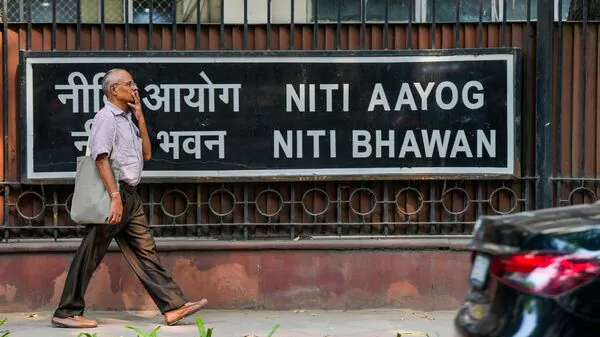
Digital Public Infrastructure Could Account For 4% Of GDP By 2030: NITI Aayog
(MENAFN- Live Mint) NEW DELHI: Digital public infrastructure (DPI), which currently contributes about 1% to India's GDP, could rise to around 4% by 2030, government think tank NITI Aayog said on Monday, arguing it should be leveraged as a key growth engine.
Releasing a report that lays out a strategy for DPI 2.0, NITI Aayog said the next phase would build on the momentum needed to achieve the goal of a“Viksit Bharat,” or developed India.
The think tank said India's existing digital public infrastructure, referred to as DPI 1.0, has already enabled a surge in services, financial inclusion and economic activity that was previously not possible at scale. This has created a growth trajectory that is non-linear, it said, accelerating as more individuals and businesses are brought onto digital systems.
Also Read | NITI Aayog eyes overhaul of India's chaotic last-mile transitNITI Aayog said the scope of DPI should now be expanded in its next phase to address structural constraints that limit growth among lower- and middle-income groups.
It added that artificial intelligence (AI) represents a major productivity lever, with the potential to address complex systemic challenges that hinder inclusive growth. Integrating AI into the DPI framework, it said, could make advanced tools accessible to entrepreneurs and citizens, creating exponential gains.
The report traced India's digital transformation to foundational platforms such as Aadhaar, Jan Dhan bank accounts and widespread mobile usage, which enabled the Direct Benefit Transfer system, now the world's largest government-to-person payment infrastructure, helping reduce leakages in welfare delivery.
It said the most significant acceleration came with the Unified Payments Interface (UPI), launched in 2016. Subsequent reforms, including the Goods and Services Tax (GST) and FASTa system in 2017, helped create a more unified national market, improved logistics and reduced transit delays, while also drawing small businesses into the formal economy.
Also Read | Need higher value-addition in electronics export, says Niti AayogOn India's long-term growth path, NITI Aayog said achieving the 2047 development goal would not follow a linear trajectory.
“It requires an engine of exponential, non-linear growth. The DPI approach, with its specific architecture and principles, is that engine. It is uniquely positioned to drive this transformation by fundamentally changing how our economy functions,” the report said.
“Over the past decade, digital public infrastructure has demonstrated the transformative potential of shared digital foundations in expanding access, enhancing service delivery, deepening inclusion, and catalysing innovation at population scale. The next phase of this journey must move decisively beyond foundational inclusion towards enabling livelihoods, strengthening human capabilities, and unlocking new engines of growth across sectors and regions,” NITI Aayog chairperson Suman Bery said in the report.
Also Read | Niti Aayog defers Global Electric Mobility Summit amid West Asia war
Legal Disclaimer:
MENAFN provides the
information “as is” without warranty of any kind. We do not accept
any responsibility or liability for the accuracy, content, images,
videos, licenses, completeness, legality, or reliability of the information
contained in this article. If you have any complaints or copyright
issues related to this article, kindly contact the provider above.
Most popular stories
Market Research








Comments
No comment