

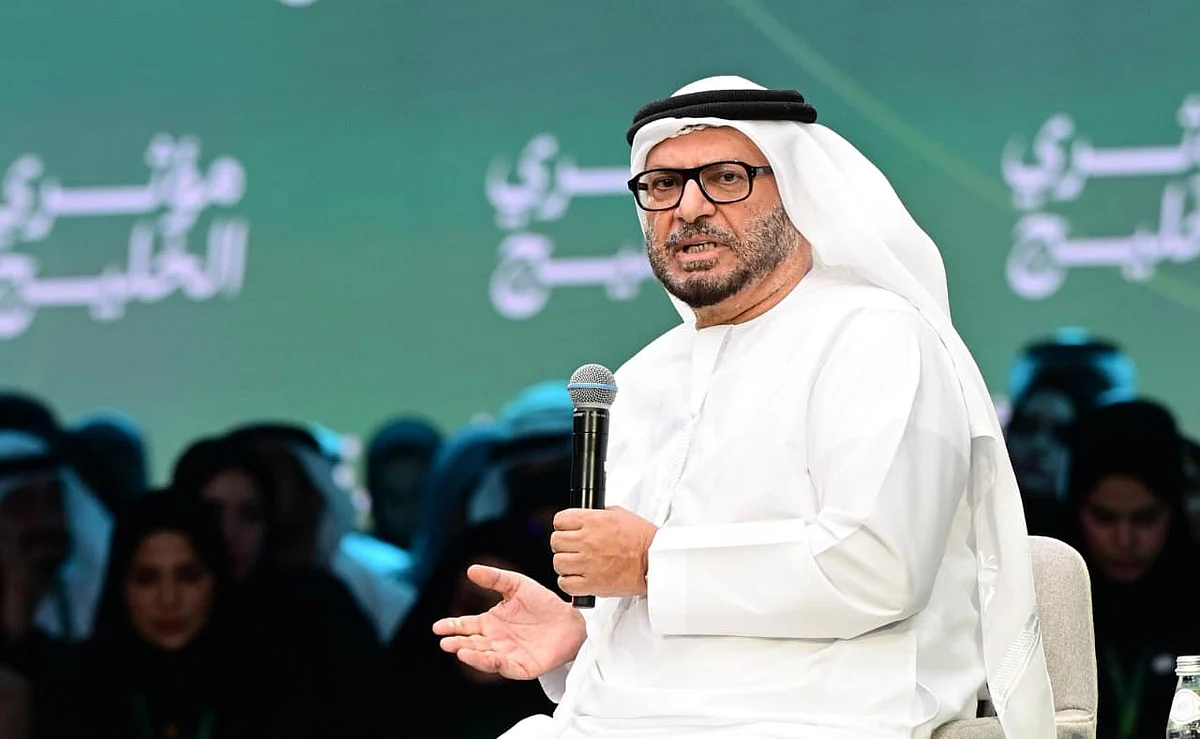
Arab League Weakness Expected, But Not From The GCC, Says Gargash


- By: Ruqayya Al Qaydi
[Editor's Note: Follow Khaleej Times live blog for the latest regional developments with the US-Israel-Iran ceasefire now in effect.]
Dr Anwar Gargash, Diplomatic Adviser to the UAE President, affirmed that“Relations will return, but trust takes a long time,” with Iran, as he called for a rational reassessment of regional alliances following recent Iranian attacks in the GCC.
Recommended For YouSpeaking at a session titled 'Reassessing Alliances in Times of Tension' during the Gulf Influencers Forum in Dubai on Monday, Dr Gargash highlighted that the region is facing a profound breach of trust that will require significant time to heal.
Stay up to date with the latest news. Follow KT on WhatsApp Channels.
The review of the region's stance towards Iran, he emphasised, will be“rational and not emotional,” taking into account that the geopolitical landscape following the brutal aggression will not return to what it was before.
The UAE official likened the magnitude of the recent events to the 1990 Iraqi invasion of Kuwait, describing it as a defining, pivotal moment in modern Gulf history. He pointed out that the ferocity of the Iranian aggression had exceeded expectations, revealing that Gulf nations had actively worked to avoid conflict by maintaining an implicit agreement not to allow Gulf territories to be used against Iran.
However, he stated that Iran's aggression against its neighbours was a“planned” move rather than a momentary reaction.“Today, we are facing a review after the failure of the containment policy with the Iranian side,” he said, noting that various approaches to containment, whether through mediation, shared energy fields, strategic agreements, or commercial ties, had ultimately failed.
A 'long-term threat'Dr Gargash warned of Iran's regional posture, noting that it currently acts like a superpower even without a nuclear arsenal.“How would the situation be if it possessed a nuclear weapon?” he questioned, stressing that the issue cannot be resolved through mere statements.
He noted that the long-running debate in the Gulf between“hawks,” who view Iran as a primary threat, and“doves,” who advocate for containment, has now been decisively settled in favour of the hawks. In every planning or operations room across the Gulf today, he said, the primary threat is recognised as coming from Iran.
Despite the tensions, he reiterated that the region, which has been searching for stability for 20 years, understands the severe repercussions of war.“We want a political solution that addresses the interests of all countries,” he affirmed, adding that any solution must not merely plant the seeds for future crises.
The stance of Gulf countriesDiscussing the region's internal dynamics, Dr Gargash offered a candid assessment of the collective Arab and Gulf response. While acknowledging that Gulf Cooperation Council (GCC) countries supported each other logistically, he noted that political and military cooperation remained weak, describing the GCC's stance as historically weak given the magnitude of the threat.
“I was not surprised by the weakness of the Arab League, but what surprised me was the stance of the Gulf countries,” he remarked. He urged that the Gulf narrative must evolve, moving away from being“shy and complimentary” to becoming strictly“realistic.”
On the other hand, he praised the positive stances taken by several Arab nations, specifically mentioning Syria, Morocco, and Egypt. He also strongly defended the United States' role in the region's security architecture.
Responding to Iranian criticism of the US presence, he noted:“The missiles that were launched came from Iran, and the air defences were American. This is a reality.” He predicted that the US role in the region would only become more essential, encompassing not just military facilities but integrated defence systems, political backing, and economic ties.
Lessons learnedDr Gargash outlined three vital lessons drawn from the current crisis: first, the necessity for regional states to rely on their own capabilities; second, the urgent need to restore Gulf solidarity and cohesion; and third, the importance of independent decision-making, refusing to allow external actors to dictate the region's security priorities.
When asked about the Muslim Brotherhood and ideological threats, Dr Gargash stressed that national interest must override any ideological lens, whether religious, nationalist, or sectarian. He reiterated that the ultimate compass for the region must be national unity and sovereignty.
He also shared a personal observation from a recent visit to Bahrain alongside the UAE President. He noted the solid and unified stance of the Bahraini people in the face of the aggression, demonstrating how such profound challenges can galvanise national unity.
ALSO READ- 'No cheap peace': 8 key things Gargash said on Iran and the UAE's position UAE's Gargash says didn't expect Iran to attack, reveals long-term impact of regional war Open or shut, the Strait of Hormuz may not go back to normal

Legal Disclaimer:
MENAFN provides the
information “as is” without warranty of any kind. We do not accept any
responsibility or liability for the accuracy, content, images, videos,
licenses, completeness, legality, or reliability of the information
contained in this article. If you have any complaints or copyright issues
related to this article, kindly contact the provider above.
Comments
No comment