




403
Sorry!!
Error! We're sorry, but the page you were looking for doesn't exist.
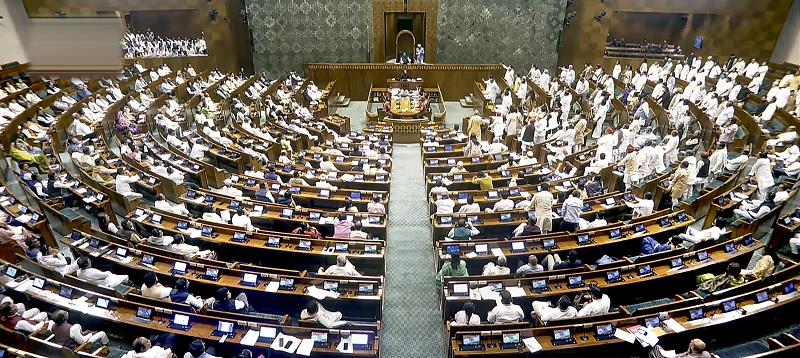
Govt, Opposition Set For Face-Off Over Delimitation, Women's Quota
(MENAFN- Kashmir Observer) Srinagar- A high-stakes political confrontation is set to unfold in the Lok Sabha as the government prepares to introduce key legislations aimed at implementing the women's reservation law and undertaking a fresh delimitation exercise, with the Opposition uniting to resist the move.
ADVERTISEMENT
The Centre has listed three major bills for introduction on Thursday-the Constitution (One Hundred and Thirty-First Amendment) Bill, 2026, the Delimitation Bill, 2026, and the Union Territories Laws (Amendment) Bill, 2026-during a special three-day sitting of Parliament scheduled from April 16 to 18.
ADVERTISEMENT
Union Law Minister Arjun Ram Meghwal will introduce the Constitution amendment and Delimitation bills, while Union Home Minister Amit Shah will table the legislation concerning Union Territories.
The proposed Constitution amendment bill seeks to increase the strength of the Lok Sabha from the existing 543 to a maximum of 850 seats to operationalise 33 per cent reservation for women ahead of the 2029 general elections. The expansion is proposed to follow a delimitation exercise based on the 2011 Census, with a similar increase in seats envisaged for state and Union Territory assemblies.
The seats reserved for women in the Lok Sabha and legislative assemblies are proposed to be allotted on a rotational basis across constituencies in states and Union Territories. The bill also seeks to amend Article 81 of the Constitution to reflect the revised composition of the House.
However, the delimitation provisions have triggered widespread concern, particularly among southern states, where leaders fear that a population-based redistribution of seats could reduce their political representation despite better performance in population control.
On the eve of the special session, Opposition leaders convened a meeting at the residence of Congress president Mallikarjun Kharge to chalk out a joint strategy. The meeting was attended by senior leaders including Rahul Gandhi, along with representatives from DMK, RJD, Trinamool Congress, Shiv Sena (UBT), NCP-SP, Samajwadi Party, CPI, CPI(M), AAP and other parties.
After the meeting, Kharge said the Opposition supports women's reservation but would oppose the delimitation provisions, alleging that the move is politically motivated.
Leaders across parties reiterated that one-third reservation for women should be implemented based on the current Lok Sabha strength of 543 seats for the 2029 elections, without linking it to a future delimitation exercise.
Read Also New Bills May Trigger Sixth Delimitation In J&K Mehbooba Hopes Delimitation Not Undertaken in 'Illogical Manner'Rahul Gandhi described the proposed amendment as an“attempted power grab,” warning that delimitation and gerrymandering could distort the federal balance and disadvantage southern, northeastern, and smaller states.
ADVERTISEMENTConcerns have also been voiced by southern chief ministers, including Tamil Nadu's M K Stalin and Telangana's A Revanth Reddy, who have cautioned that the proposed exercise could dilute their states' representation in Parliament. Reddy has written to Prime Minister Narendra Modi seeking an all-party meeting to deliberate on the issue, while Stalin has warned of a“massive agitation” if the state's interests are affected.
The ruling NDA, however, has rallied behind the move, projecting it as a historic step toward greater representation of women in governance. Prime Minister Narendra Modi has said that implementing the women's quota will strengthen democracy and accelerate the vision of a developed India.
The Business Advisory Committee has allocated 18 hours for discussion in the Lok Sabha, with debates likely to extend into Friday before the bills are sent to the Rajya Sabha for consideration.
Passage of the Constitution amendment bill will require a special majority-more than 50 per cent of the total membership of the House and a two-thirds majority of members present and voting-making the outcome of the debate politically significant.
With numbers closely watched and positions sharply defined, the upcoming session is expected to shape the future contours of representation and federal balance in the country.
Legal Disclaimer:
MENAFN provides the
information “as is” without warranty of any kind. We do not accept
any responsibility or liability for the accuracy, content, images,
videos, licenses, completeness, legality, or reliability of the information
contained in this article. If you have any complaints or copyright
issues related to this article, kindly contact the provider above.
Most popular stories
Market Research

More Story


Comments
No comment