




403
Sorry!!
Error! We're sorry, but the page you were looking for doesn't exist.
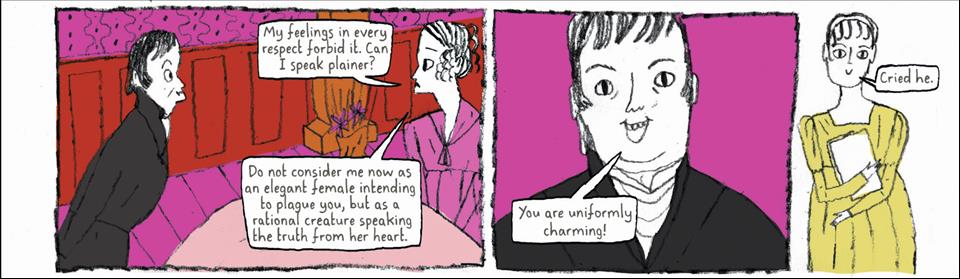
Jane Austen In Pictures: Two Graphic Biographies Bring The Novelist's Life To The Page
Author: Alex Fitch
(MENAFN- The Conversation) To coincide with the 250th anniversary of her birth, last year saw the publication of two graphic biographies of Jane Austen.

These books take different approaches to the novelist's life. The Novel Life of Jane Austen: A Graphic Biography, by Janine Barchas and Isabel Greenberg, is a slim volume in a cartoony style that begins in 1796. Kate Evans' painterly book Patchwork: A Graphic Biography of Jane Austen, meanwhile, starts with Austen's birth. The latter also includes historic digressions to give her writing additional context.
Both are handsome editions. The Novel Life of Jane Austen is slightly more approachable for the casual reader due to its brevity and smaller focus. But Patchwork may be more rewarding to graphic novel fans thanks to the painted artwork and a mixed-media collage approach that incorporates fabric cuttings into its pages.
PatchworkInspired by a patchwork coverlet sewn by Austen, her sister Cassandra and their mother, now displayed in Jane Austen's House in Hampshire, Evans' book shows how the bits and pieces of Austen's life were recycled as material for her novels. Patchwork is an apt image for Austen, who “lopp'd and cropp'd” her prose as deftly as her cloth.
Some of Austen's early biographers were fond of putting emphasis on the domestic tasks she undertook such as needlework, often deflecting attention from her desire to write and make money. As Austen researcher Kathryn Sutherland has recently observed in writing about Austen's quilt:“Sewing, like letter writing, is not redundant work; it is necessary to social functioning.” It is apt that Evans' includes this activity in her biography.
Evans also brings the bookish and close-knit Austen family vividly to life. The sense of the mischievousness and rebellion that brought Austen's early work into being is present here. The comic strip renderings of her teenage skits and her spoof Plan of a Novel are wonderfully exuberant.
The texture of Austen's life, and the threads that connect one life to others, is a distinct aspect of her approach. Evans' shifts of focus add context to the author's life. The material that Austen sews links ordinary domestic practice to the horrors of British colonialism which delivered cotton thread to Britain.
This incorporation of fabrics that Austen showed interest in during her life – with her family having to make do and mend during periods of impoverishment – is an continuing technique used by Evans in her graphic work. An earlier graphic novel by the artist – Threads: From the Refuges Crisis (2017) – included comic book documentation of interviews with women in the Calais“Jungle”. It embedded their embroidery and needlework in the book, made as a way of escaping the horror of their situation.
Patchwork uses the Austen family's interest in fabric as a metaphor for their changing domestic experience in different decades and patchwork as a medium which gets added to over time. This works well as a visual leitmotif to accompany the narrative. It shows Evans' continuing interest in depicting textiles alongside her artwork as a rich storytelling technique.
The Novel Life of Jane AustenThe structure of The Novel Life of Jane Austen echoes the typical triple volume publication of novels at the time. Budding Writer, Struggling Artist and Published Author indicate distinct phases of Austen's writing life. They begin with a letter from August 1796 and end with Cassandra's destruction of some of the correspondence in 1844 (the last pages acknowledge how her final house in Chawton has become a pilgrimage site for fans).
Barchas and Greenberg give a strong sense of Austen's links with other writers, such as Shakespeare, whose“stunning literary celebrity” prefigures her own. For Evans, fictional influences can be seen in the presence on Austen's bookshelf of those professional women authors (Frances Burney and Maria Edgeworth, for example) who did so much to set the stage for Austen's success. However Samuel Richardson, whom Austen both revered and parodied, Henry Fielding, from whom she derived much of her facility with the burlesque and Samuel Johnson, an important influence on her sentence structure and tone, are either absent or fleetingly mentioned.
Like Evans, artist Isabel Greenberg uses a technique to contrast one aspect of Austen's creative practice with another. While Evans contrasts Austen's making patchwork fabrics with her writing, as two different but related creative pursuits, Greenberg uses different colour schemes to delineate ways that the author's imagination operated at different times.
Most of the colour scheme is a combination of yellow and blue, including renditions of both Austen's biography and performances of her novels. However, for scenes where the novelist enters a moment of reverie – imagining her characters' inner lives – the colours used become red, purple and yellow. This signifies heightened feelings in contrast to the more muted emotions observed in her everyday life.
As with Evans' mixed-media approach to graphic novel art, Greenberg's use of heightened colour to separate everyday experience from imagination, is often found in the artist's work. Her first two graphic novels The Encyclopedia of Early Earth (2013), and the recently adapted One Hundred Nights of Hero (2016) both contrast everyday experience in different historical time periods with characters' storytelling activities.
Her previous project to illustrating The Novel Life of Jane Austen, was Glass Town (2020) which like the contrast between fantasy and reality in Austen's life, took a similar approach to biography of Charlotte Brontë and her sisters.
Both of these Jane Austen graphic biographies are, in their different ways, reinvigorating guides. They emphasise different aspects of Austen's life and times, using different visual techniques to bring the writer's history vividly to life on the page. Most importantly, they both give prominence to the force of her imagination, and the innovative fiction it produced.
This article features references to books that have been included for editorial reasons, and may contain links to bookshop. If you click on one of the links and go on to buy something from bookshop The Conversation UK may earn a commission.
Institution:University of Birmingham

Legal Disclaimer:
MENAFN provides the
information “as is” without warranty of any kind. We do not accept
any responsibility or liability for the accuracy, content, images,
videos, licenses, completeness, legality, or reliability of the information
contained in this article. If you have any complaints or copyright
issues related to this article, kindly contact the provider above.
Most popular stories
Market Research

More Story






Comments
No comment