




403
Sorry!!
Error! We're sorry, but the page you were looking for doesn't exist.
FX Daily: Failed Peace Talks Give The Dollar A Brief Lift
(MENAFN- ING)
USD: Dollar need not rally too much
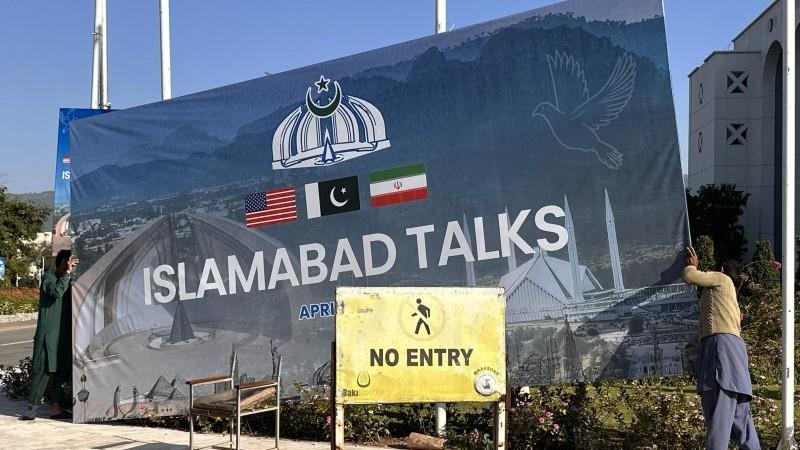
The DXY dollar index is up around 0.4% today after US-Iran peace talks failed to make any progress this weekend in Islamabad. Oil prices have understandably risen 7-8% on news from Washington that the US Navy would today start a blockade on shipping into and out of Iranian ports. Reports had suggested that Iran was managing to export as much as one million barrels per day of oil during the crisis. Should the US Navy prove effective in curbing these exports, Asian customers will have to chase global oil supplies, resulting in higher energy prices. Presumably, Washington's plan here is to deprive Iran of funds, while at the same time encouraging the likes of China and India to push Iran into a ceasefire.
Perhaps the reasons that energy prices are not higher and that equity markets are not lower today are that: a) at least the Iranian delegation showed up in Islamabad, and b) the alternative of a renewed destruction of energy infrastructure in the region – delivering lasting damage – has so far been avoided. The focus now shifts to whether the naval blockade encourages another round of negotiations, whether the Iranian-backed Houthis in Yemen try to block the southern end of the Red Sea and what the likes of China make of interference in their oil imports.
Away from the geopolitical headlines which will bounce the dollar around this week, the market focus will likely be on central bank reaction functions. Spring IMF meetings taking place in Washington will deliver a plethora of central bank speeches. With oil prices remaining elevated and the jury still out on whether they will lead to second-round effects, expect central bankers to continue talking tough. That could prove mildly dollar negative in that policymakers in Europe and Asia may be forced to talk tougher than the Federal Reserve. Here, the Fed will be mildly encouraged by Friday's release of March CPI data, which largely showed the energy price shock being contained.
In terms of US macro data, this week's calendar is very light, but we will be interested in Wednesday's release of the TIC data for February. Recent releases here have shown softer foreign interest in US Treasury purchases.
Expect DXY to continue to be dragged around by energy prices, although we think good selling interest should emerge should DXY get near 99.50 – the top of a gap left last week when news of ceasefire talks first emerged.
Chris Turner
EUR: Hungarian news might provide a reprieve to the euroEUR/USD was hit in Asia as oil prices spiked after failed peace talks. As above, the fact that the combatants have not immediately resumed destroying energy infrastructure in the region suggests it could have been worse. That is why EUR/USD is not trading closer to 1.1600. Also limiting EUR/USD downside today are probably events in Hungary (see below). The convincing pro-EU turn among the Hungarian electorate will be very welcome news for Brussels and may prompt a pause for thought among populist Euro-sceptic political parties across Europe. It will be interesting to see whether the Hungarian news delivers some independent euro strength today – e.g., in the likes of EUR/GBP and EUR/CHF.
Barring another major leg higher in energy prices today, we think something like 1.1700 looks a comfortable level for EUR/USD in the near term. The data calendar is light, but Luis de Guindos will be the first of many European Central Bank speakers this week. It looks too early for the ECB to completely rule out a rate hike in April (which looks unlikely), but we expect the pricing of a June ECB rate hike to hold up. 22bp is currently priced for that meeting.
Chris Turner
HUF: Super majority is another reason for extended rallyThe results of the Hungarian general election show a victory for the opposition with a surprising super-majority in parliament. Although market positioning is difficult to read after the US-Iran conflict, the return of EUR/HUF to pre-conflict levels last week suggests that the market was pricing in a simple majority victory for the opposition.
From the market's perspective, the constitutional majority allows for a smooth transfer of power for the opposition and a faster path to unlocking EU funds, which are the main focus of investors, giving Hungarian assets another reason to extend their rally.
The situation in the Middle East significantly obscures the situation, with the expected market opening in a risk-off mood and pressure on the entire CEE region. However, if we were to assume some calm in this, we expect EUR/HUF to stabilise at levels of 355-360 and the bond and IRS curve to move down by about another 30-40bp in the coming days. In our view, the long end of the curve should benefit most from the result, benefiting from a better GDP outlook due to the expected inflow of EU funds and, at the same time, the topic of euro adoption, which the opposition emphasised in its election campaign. On the other hand, the short end will continue to be burdened by the US-Iran conflict and higher energy prices, which will not allow the central bank to cut rates in the coming months despite FX outperforming CEE peers. This will result in curve flattening.
However, another unknown and a factor increasing volatility in the coming days will be the timing of profit-taking. Given the significant global uncertainty these days, it can be expected that investors will want to realise profits earlier than usual, which is likely to lead to higher volatility.
Frantisek Taborsky
UZS: potential IPO may further support capital inflows in UzbekistanAccording to media reports, Uzbekistan's authorities are considering an IPO of the National Investment Fund (UzNIF), a state‐owned holding company with net assets valued at $2.44bn. Earlier government guidance suggested that up to 30% of the holding could be offered, implying a potential deal size of around $0.7bn (about 0.5% of GDP), as part of the broader privatisation programme. The listing is expected to include an international tranche in London alongside a domestic offering in Tashkent.
From a macro perspective, such a placement is relevant primarily for the balance of payments and fiscal position. Uzbekistan runs a structural current account deficit, which reached $5.8bn (3.9% of GDP) in 2025, despite high gold prices. This deficit was financed by a sizeable $7.8bn in net capital inflows, of which $4.6bn reflected a net increase in public external debt, with the remainder attributable to private‐sector flows. A capital inflow via privatisation would therefore serve a dual purpose: reducing reliance on foreign debt in financing the fiscal deficit – public external debt reached $37bn, or about 25% of GDP, in 2025 – while also supporting the financial account.
This reinforces the defensive case for UZS. After showing 7% appreciation to USD in 2025, the currency has remained broadly stable since the outbreak of the Middle East conflict and amid a 10% correction in gold prices. Alongside some scope to increase gold export revenues, privatisation‐related capital inflows could provide additional support to the balance of payments. We remain constructive on UZS in the near to medium term.
Dmitry Dolgin

Legal Disclaimer:
MENAFN provides the
information “as is” without warranty of any kind. We do not accept
any responsibility or liability for the accuracy, content, images,
videos, licenses, completeness, legality, or reliability of the information
contained in this article. If you have any complaints or copyright
issues related to this article, kindly contact the provider above.
Most popular stories
Market Research

More Story








Comments
No comment