




403
Sorry!!
Error! We're sorry, but the page you were looking for doesn't exist.
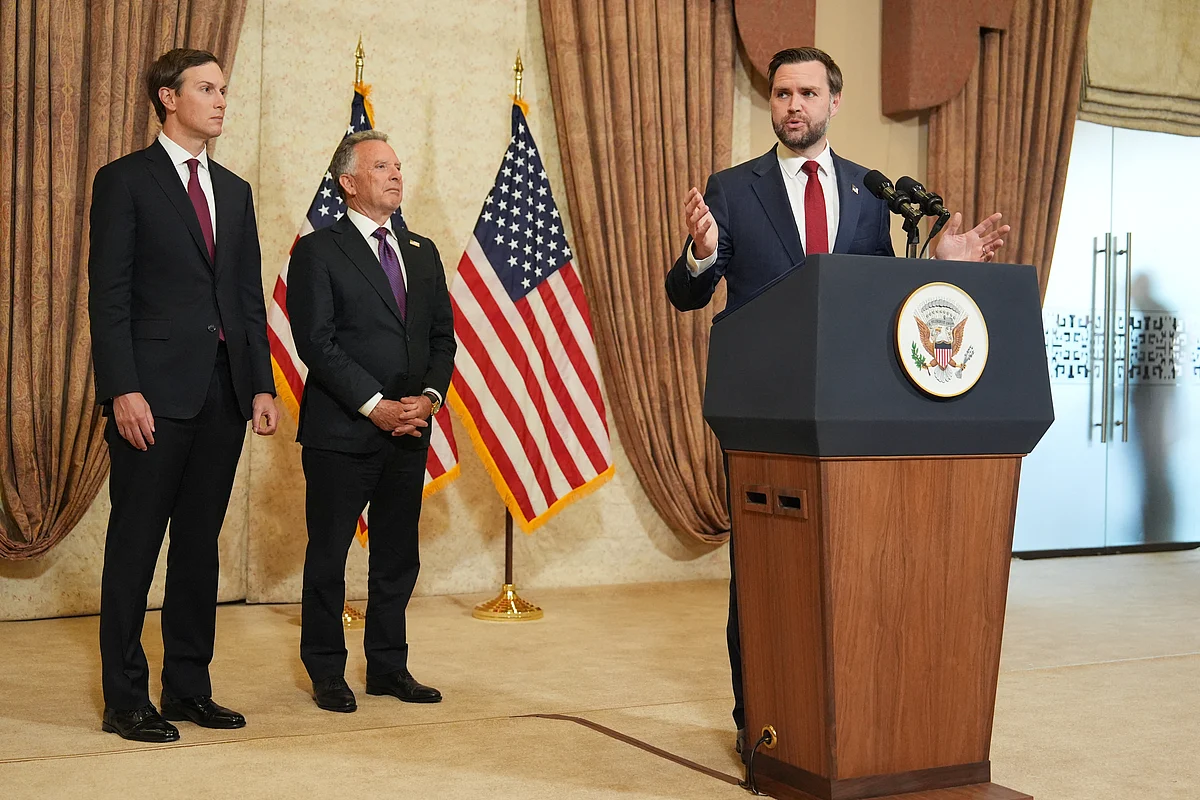
Usiran Talks: Vance's 'Best, Final Offer' After 21 Hours, Key Sticking Points Explained
(MENAFN- Khaleej Times) Vance signalled the US was still giving Iran time to consider its offer, as attacks paused under a two-week ceasefire pending negotiations
- By: AFP
Editor's Note: Follow Khaleej Times live blog for the latest regional developments with the US-Israel-Iran ceasefire now in effect.]
Iran and the United States failed to reach an agreement to end the war in the Middle East, US Vice President JD Vance said Sunday after marathon talks in Islamabad, adding that he was leaving after giving Tehran the "final and best offer".
Recommended For You Asha Bhosle's Dubai restaurant closes in tribute after iconic singer diesVance said Washington was seeking a "fundamental commitment" from Iran that it would not develop a nuclear weapon, but that "we haven't seen that" after holding the highest-level meeting between the two sides since the 1979 Islamic Revolution.
However, he signalled that he was still giving Iran time to consider the offer from the United States, which on Tuesday said it would pause attacks with Israel for two weeks pending negotiations.
Stay up to date with the latest news. Follow KT on WhatsApp channels.
The United States and Israel attacked Iran on February 28, sparking retaliation from Tehran that has plunged the Middle East into conflict and the global economy into tumult.
Pakistan, which hosted the talks and whose leadership had ushered the rival sides to the table, said it would keep facilitating dialogue and urged both countries to continue respecting the temporary truce.
What is Iran saying?Iran's Parliamentary Speaker Mohammad Baqer Ghalibaf said on Sunday that his country's delegation raised "forward-looking" initiatives during negotiations in Pakistan's Islamabad, but the US failed to gain the trust of the delegation in the talks.
Earlier, Iran's state broadcaster IRIB said negotiations stalled over "unreasonable demands of the American side", though the country's foreign ministry spokesman Baghaei later noted that "no one" could have expected that after 40 days of war, they would reach an agreement within one session.
Baghaei also said that the two sides agreed on many points but differed on two important issues - one of them likely being Iran's building of nuclear weapons.
He also added that talks between Iran, Pakistan, and Iran's 'other friends' in the region will continue.
'Negotiating met with broken promises'Ghalibaf, speaking shortly after landing in Pakistan, made clear that Iran remained highly suspicious of the United States.
"Our experience in negotiating with the Americans has always been met with failure and broken promises," Ghalibaf said.
What is US saying?After 21 hours of talks in the Pakistani capital, Vance told reporters that no deal could yet be struck.
"We leave here with a very simple proposal, a method of understanding that is our final and best offer. We'll see if the Iranians accept it," Vance said, before departing for a nearby airport and flying out of Pakistan.
He also said before leaving for Pakistan that if Iran were willing, the United States would "negotiate in good faith" but would not be receptive "if they're going to try to play us".
US President Donald Trump had also insisted several hours into the talks on Saturday that the United States had already triumphed on the battlefield by killing Iranian leaders and destroying key military infrastructure.
"Whether we make a deal or not makes no difference to me. The reason is because we've won," Trump said.
Pakistan's role in mediationSuggesting efforts to keep the sides talking would continue, Pakistan Foreign Minister Ishaq Dar said his government would "continue to play its role to facilitate engagement and dialogue between the Islamic Republic of Iran and the United States of America in the days to come".
"It is imperative that the parties continue to uphold their commitment to a ceasefire," he added.
The high-stakes meeting had unfolded in Islamabad with intense mistrust by both sides.
Major sticking points in the talksIran's foreign ministry spokesperson said that of all the points discussed in the 21-hour negotiations, almost all were agreed upon by the two parties, except for two important issues.
According to an earlier post on X from Baghaei, the issues discussed included the Strait of Hormuz, nuclear weapons, war reparations, lifting of sanctions and the complete end to the war.
Nuclear Programme
Vance has said that Iran did not accept the US demand that the Islamic Republic stop building nuclear weapons. He added that the US made it clear what its "red lines" are.
Iran was in the middle of negotiations on its nuclear programme in February with Trump's real-estate friend Steve Witkoff and son-in-law Jared Kushner when the United States and Israel launched their attack. The first salvos of the war killed Iran's supreme leader, Ayatollah Ali Khamenei.
Both Kushner and Witkoff were part of Vance's team in Pakistan. The 70-strong Iranian delegation was led by Mohammad Bagher Ghalibaf, the powerful speaker of parliament, and included Foreign Minister Abbas Araghchi.
Iranian assets
Iranian demands for any agreement to end the war include unfreezing sanctioned Iranian assets and ending Israel's war against Hezbollah in Lebanon, which Vance has said would not be up for discussion in Islamabad.
Strait of Hormuz
The opening of the Strait of Hormuz has also presented a key friction point.
Iran throughout the war exercised its global economic leverage by asserting control of the important maritime route, sending oil prices soaring and piling political pressure on Trump as Americans complained of rising costs at the pump.
The US military said Saturday that two Navy warships transited through the strait to begin clearing it of mines and ensure it is a "safe pathway" for tankers.
The Iranian military denied that any American warships had entered the waterway and threatened to respond if they did so.
The Revolutionary Guards' Naval Command said Iranian promises of safe passage during a two-week ceasefire applied only to "civilian vessels under specific conditions".
"We'll open up the strait even though we don't use it, because we have a lot of other countries in the world that do use it that are either afraid or weak or cheap," Trump said.
Israeli attacks on Lebanon
A major complicating factor has been Israel's assertion that the ceasefire does not affect Lebanon, where the Israeli military has launched massive strikes and a ground invasion in response to fire from Hezbollah, the Iranian-backed Shia Muslim movement.
Lebanese authorities said Israeli strikes on the country's south on Saturday killed 18 people, bringing the death toll from Israel's operations since the war broke out past 2,000.
Israel and Lebanon will hold their own talks next week in Washington. Israeli Prime Minister Benjamin Netanyahu said on Saturday that he wanted a peace deal with Lebanon that "will last for generations".
But Israel has ruled out a ceasefire with Hezbollah, signalling it will instead seek to pressure the historically weak central government in Beirut.
ALSO READ- Ceasefire talks in Pakistan: How do Iran's 10-point, Trump's 15-point plans compare? Trump announces 10-day pause in attacks on Iran's energy plants, says talks 'going well'

Legal Disclaimer:
MENAFN provides the
information “as is” without warranty of any kind. We do not accept
any responsibility or liability for the accuracy, content, images,
videos, licenses, completeness, legality, or reliability of the information
contained in this article. If you have any complaints or copyright
issues related to this article, kindly contact the provider above.
Most popular stories
Market Research

More Story





Comments
No comment