




403
Sorry!!
Error! We're sorry, but the page you were looking for doesn't exist.
Time.Now Sets Its Clocks To Spanish: 500 Million New Users Can Now Tell Time In Their Language
(MENAFN- GetNews)
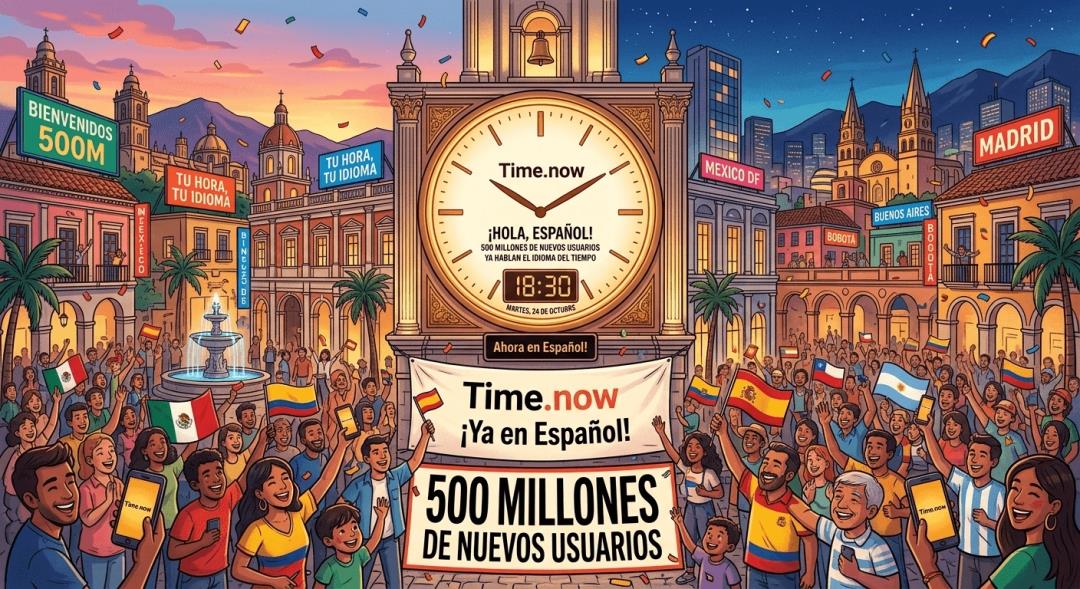
"Time is in Spanish, and more than 500 million people can finally experience time in their own language."Time has added full Spanish-language support across its platform, giving 500 million+ Spanish speakers access to localized clocks, time zone tools, sunrise and sunset data, eclipse calendars, and holiday information. The update improves usability, trust, and accessibility for users across Spain, Latin America, and other Spanish-speaking communities.
"Time is in Spanish, and more than 500 million people can finally experience time in their own language."Time has added full Spanish-language support across its platform, giving 500 million+ Spanish speakers access to localized clocks, time zone tools, sunrise and sunset data, eclipse calendars, and holiday information. The update improves usability, trust, and accessibility for users across Spain, Latin America, and other Spanish-speaking communities.
For hundreds of millions of people around the world, Spanish is not just a language. It is the lens through which they experience daily life, make plans, and stay connected. Yet for years, many of the most reliable online time tools have defaulted to English, leaving a massive global audience to navigate menus, settings, and data in a second language. That changes now. Time has launched full Spanish-language support across its platform, putting accurate, real-time time data squarely in the hands of over 500 million Spanish speakers worldwide.
Key Takeaway: Time has rolled out comprehensive Spanish-language support, making its suite of time tools, including clocks, sunrise and sunset data, eclipse calendars, and holiday information, fully accessible to over 500 million Spanish speakers across more than 20 countries. This marks one of the most significant expansions in the platform's history, closing a long-standing gap in digital time tools for Spanish-speaking communities globally.
Why This Moment Matters
Language shapes how we relate to information. A tool that tells you the time in a language you are still translating in your head is a tool that creates friction. For casual users, that friction is mildly annoying. For professionals coordinating across continents, for families managing schedules across time zones, or for travelers planning trips through Latin America or Spain, that friction has real costs.
Spanish is the second most spoken language in the world by native speakers. It is the official language of 21 countries. It spans from the southern tip of Patagonia to the streets of New York City, from Madrid to Mexico City. The demand for localized, accurate, culturally relevant time tools has always been there. The supply has lagged behind. Until now.
What Time Is, and Why It Has Earned Trust
If you have not used time no before, it is worth understanding what makes the platform different. It is not simply a digital clock. It is a comprehensive time intelligence platform, covering everything from local times in thousands of cities to astronomical data, time zone converters, and regional calendar information.
The platform has built its reputation on accuracy and simplicity. No clutter. No misleading advertising. Just clean, precise, dependable time data. That commitment to clarity is exactly what makes the Spanish-language launch significant. It is not a translated homepage with a few buttons relabeled. It is a full localization of the experience, meaning the content, the interface, and the underlying data presentation all reflect how Spanish speakers actually think about time.
What Spanish Speakers Can Now Access
The Spanish version of Time brings the full platform to life in a new language. Here is a breakdown of what is now available:
Real-time local clocks for hundreds of cities across Spanish-speaking countries, updated continuously and displayed in local formats
Time zone tools that make it easier to coordinate across borders within the Spanish-speaking world and beyond
Astronomical data, including precise sunrise sunset time for cities throughout Latin America and Spain
Eclipse tracking, with a dedicated eclipse calenda that gives Spanish speakers access to upcoming celestial events in their language
Holiday and observance data, pulling from a robust world holiday database that includes national and regional observances across all Spanish-speaking countries
An interactive time zone map that makes it intuitive to understand how time flows across borders, particularly useful across the geographically spread Spanish-speaking world
Each of these features has been adapted, not just translated. The distinction matters. A translation changes the words. An adaptation changes the experience. Time has done both.
The Human Stories Behind the Numbers
Numbers like "500 million users" are hard to feel. So consider a few of the real scenarios where this update changes things.
The grandmother in Guadalajara who wants to know when the sun sets so she can plan her evening walk. She does not want to read a site in English. She should not have to.
The small business owner in Buenos Aires scheduling a video call with a partner in Barcelona. He needs a reliable time zone tool that works in his language, with the right country formats, without guesswork.
The student in Bogota writing a school report on solar eclipses. She wants to look up when the next one is visible from her city. Finding that information in Spanish, accurately, and without leaving the page, is a small miracle.
The expat community in Miami managing family ties across multiple Latin American countries, dealing with different time zones and different national holidays. A single platform that handles all of that in Spanish is not a luxury. It is a practical tool.
These are not edge cases. These are the 500 million.
How Localization Builds Trust
There is a broader principle at work here that goes beyond any single platform update. When a tool speaks your language, it signals something. It says: you were thought of. Your context was considered. The people who built this understood that your needs are specific, not generic.
That signal matters especially for time tools, where precision and trust are everything. If you are relying on a website to tell you when to catch a flight, when to expect the sunrise on your wedding day, or when a business closes in a foreign city, you need to trust what you are reading. Localization is part of what builds that trust.
Time has long been regarded as one of the more reliable time platforms on the web. Extending that reliability to Spanish-speaking users is not just good business. It is a form of respect.
The Scale of the Spanish-Speaking World
It is worth pausing to appreciate just how geographically and culturally vast the Spanish-speaking world is. Consider:
Spain sits in the Central European Time zone
Mexico spans three time zones
Argentina runs on a single national time that does not observe daylight saving
Colombia stays on the same offset year-round
Chile adjusts seasonally, and its rules have changed multiple times in recent years
The United States has tens of millions of Spanish speakers distributed across multiple time zones
Managing time across this landscape is genuinely complex. The holidays are different in every country. The observances vary. The sunrise and sunset times shift dramatically between Santiago and Monterrey, between Seville and Havana. A platform that handles all of this in Spanish, accurately, is addressing a real and underserved need.
What This Means for the Future of Time Tools
This launch signals something important about where digital utilities are heading. For years, English-first design was treated as a neutral default. It never was. It was a choice, and one that carried costs for billions of non-English speakers.
As platforms mature and as the internet becomes more genuinely global, the expectation is shifting. Users want tools that feel native to their language and their context. They want to stop translating. They want to stop estimating. They want to just know.
Time is meeting that expectation for Spanish speakers in a way that feels comprehensive rather than cosmetic. The platform has not bolted on a translation layer. It has rebuilt the experience with Spanish-speaking users at the center.
Setting the Clock for a New Chapter
The launch of Spanish-language support at Time is a signal, plain and simple. It tells 500 million people that the tools they rely on for something as fundamental as understanding time are now built for them. Not adapted as an afterthought. Built for them.
That is what good technology does. It finds the people who have been underserved and says: we see you, here is something built with you in mind.
For Spanish speakers around the world, the clock has just been set to a new standard. And it is about time.

Legal Disclaimer:
MENAFN provides the
information “as is” without warranty of any kind. We do not accept
any responsibility or liability for the accuracy, content, images,
videos, licenses, completeness, legality, or reliability of the information
contained in this article. If you have any complaints or copyright
issues related to this article, kindly contact the provider above.
Most popular stories
Market Research

More Story








Comments
No comment