




403
Sorry!!
Error! We're sorry, but the page you were looking for doesn't exist.
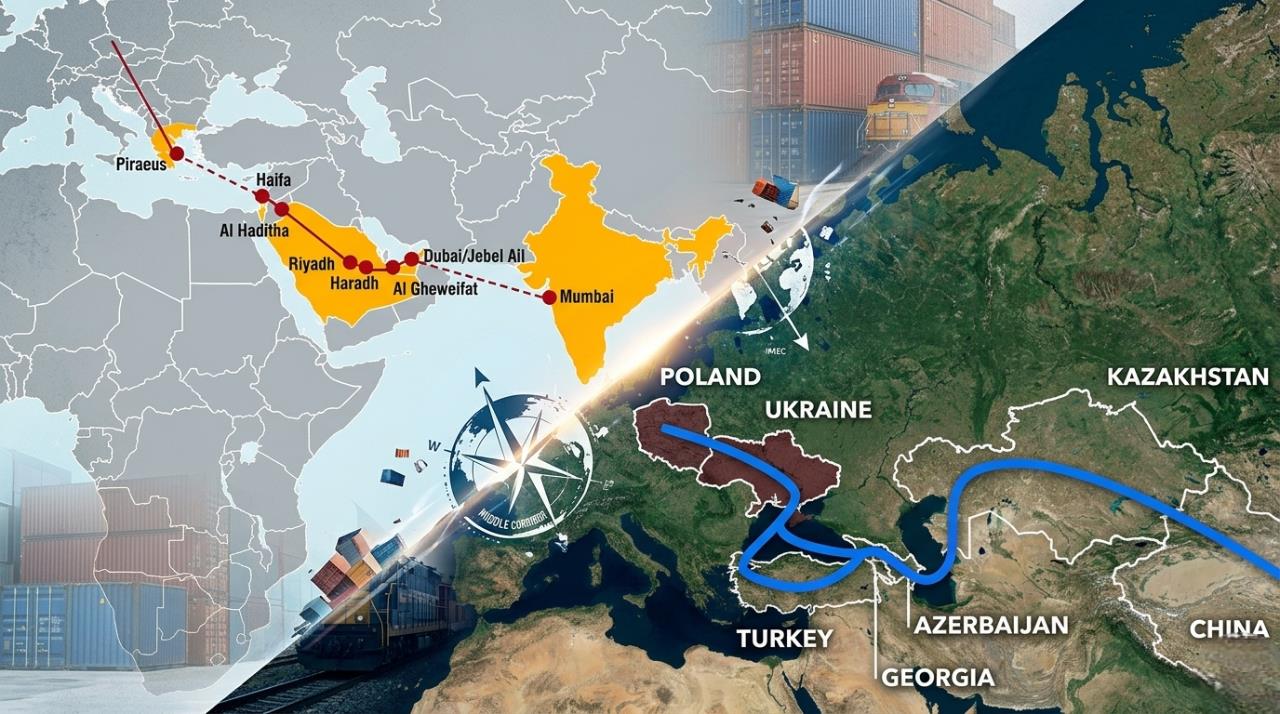
Middle Corridor Moment: How Crisis Rewriting Global Trade Paths
| Factor | IMEC | Middle Corridor |
|---|---|---|
| Current operational status |
Western leg non-operational | Fully operational, accelerating |
| Conflict exposure | Direct (Haifa, Hormuz, Houthis) | Bypasses all active conflict zones |
|
Regional peace conditions |
Saudi-Israel normalisation stalled | Armenia-Azerbaijan peace agreed Aug 2025 |
| Infrastructure readiness | Eastern leg functional; western leg paper-only |
BTK modernised 2025; Poti terminal opened |
| Insurance environment | Prohibitive in the Gulf/Red Sea/Israel | Stable; Caspian/Black Sea route unaffected |
| Political backing |
US, EU, India committed; implementation fragmented |
US, EU, China, UK all invested; joint venture operating |
The distance between the Barents Sea to the north and the Arabian Sea to the south is around 5,000 kilometers. However, only 190 kilometers of the total distance – a land route called the Ganja Gap located in Azerbaijan – can accommodate transportation from one point to another without passing through either Russia or Iran. Azerbaijan plays a pivotal role in one of the world's most significant but unknown logistic chokepoints.
Indeed, the security profile of this route corridor has significantly improved since last summer. Thanks to the Armenia-Azerbaijan peace agreement initialled in the White House back in August 2025, the only serious source of potential conflict for the South Caucasus has been eliminated. This is why Aliyev stressed in his recent Tbilisi speech that "the South Caucasus is becoming a region of peace, calmness, security and cooperation." According to Kobakhidze, "global geopolitical changes have further strengthened the significance of the Middle Corridor" and made the Black Sea and South Caucasus "a strategically important space." While the wars rage in Ukraine to the north and in Iran to the south, the territory that links China's supply chains with Europe has been consciously protected from military interference. Indeed, wars continue to the north of Azerbaijan, as well as to its south. In this case, the international cargo carriers cannot help choosing the Middle Corridor, as it is their safest way of transportation.
The constraint within the corridor is currently on the supply side rather than on the demand side. The pressure is greatest on ports in Azerbaijan, Kazakhstan, and Turkmenistan, where ferry capacity on the Caspian Sea has failed to keep up with booking requests due to the ongoing Iran war. KTZ Express plans to purchase six new ferries, while the Azerbaijan Caspian Shipping Company is commissioning a new Ro-Pax ferry and considering two new container vessels. A new multimodal terminal was inaugurated in Poti, Georgia, in June 2025, with the capability of handling 120 wagons and 200,000 twenty-foot equivalent units per annum. The Baku-Tbilisi-Kars railway, a 826-kilometre route between Azerbaijan and Türkiye through Georgia, finished upgrading its Georgian segment in 2025, increasing its line capacity considerably. The World Bank and EBRD have concluded that investments worth €18.5 billion in infrastructure would be necessary in Central Asia alone to unlock the corridor's full potential until 2030.
TRIPP Corridor (Trump Route for International Peace and Prosperity), which entails the construction of a railway line and oil/gas pipeline along the southern part of Armenia from mainland Azerbaijan, passing Nakhchivan to Türkiye, will create an additional layer to the capabilities of the Middle Corridor. Azerbaijan's section will be almost complete soon, while Armenia's part is scheduled to start in the latter half of 2026.
In operation, TRIPP would practically turn Armenia into a transit state in the very same corridor network that had never included it before, expanding the Middle Corridor and bringing in redundancy along the route. Azerbaijan has spent $21bn on OTS countries, including Türkiye, where work on the Kars-Iğdır-Aralık-Dilucu railroad line, which runs 224km from the Turkish border down to the border of Nakhchivan, is underway. The Iran conflict has certainly delayed TRIPP, but it hasn't changed the rationale behind it.
The fight between IMEC and the Middle Corridor has, over the last three years, been seen as a fight between two equally grand plans. It's no longer as such. While one corridor cuts through active battlegrounds, relies on normalizing relationships that are not progressing, and moves cargo via a sea dominated by Iranian naval strategy, the other one avoids Russia and Iran altogether, has settled down its most serious regional conflict, and sees growth rates not seen before in its history.

Legal Disclaimer:
MENAFN provides the
information “as is” without warranty of any kind. We do not accept
any responsibility or liability for the accuracy, content, images,
videos, licenses, completeness, legality, or reliability of the information
contained in this article. If you have any complaints or copyright
issues related to this article, kindly contact the provider above.
Most popular stories
Market Research

More Story





Comments
No comment