




403
Sorry!!
Error! We're sorry, but the page you were looking for doesn't exist.
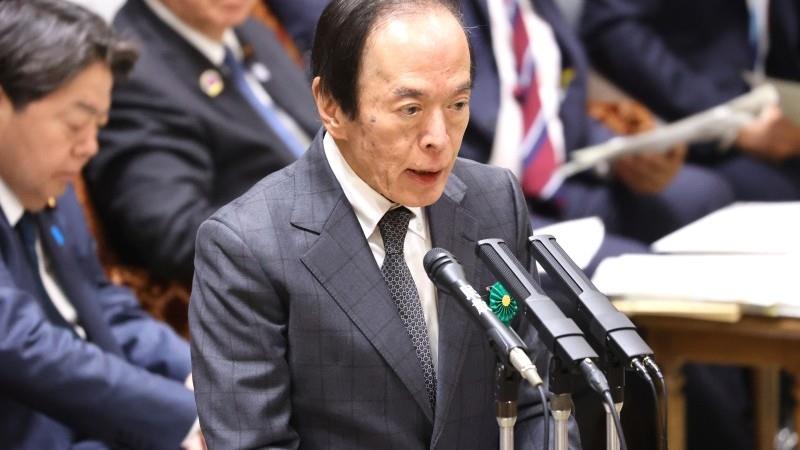
Bank Of Japan Holds Rates And Offers No Signal About Its Next Move
| 0.75% | Target rate |
| As expected |
As widely expected, the Bank of Japan kept its policy unchanged, with one dissenting vote from Takata Hajime, who favoured a 25bp hike. The BoJ's analysis on economic conditions was tilted toward optimism as the BoJ expects the economy to continue growing moderately and inflation to rebound after a temporary deceleration.
Despite previous rate hikes and US tariffs over the past year, financial conditions remain accommodative, and the positive cycle between wages and inflation has continued. The BoJ acknowledged the risks surrounding the Middle East situation, but its outlook on the economy hasn't differed much from the previous meeting. We think this analysis sets the stage for potential rate hikes in the months ahead.
No clarity over near-term policy decisionAs we expected, Governor Kazuo Ueda did not drop any hint on the timing of the next rate hike at the press conference, as the BoJ would like to remain flexible amid the Middle East war. He repeated the directional guidance that if the economy continues to recover and inflation approaches to 2% in line with the BoJ's projection, then the BoJ will continue to adjust monetary policy accordingly.
But his remarks throughout the press conference were extremely cautious. He mentioned that the BoJ would make an appropriate policy judgement while examining available data at each meeting, and underlying inflation could move in either direction. He mentioned that a slim majority of board members see more upside risks to inflation, but we don't think this means that the board's stance has shifted toward being more hawkish. Meanwhile, he was much clearer about other prerequisites for rate hikes: robust spring wage negotiations alongside a virtuous cycle of wage growth and increased consumer spending. This time, he added that the BoJ would keenly look for strong wage gains for small businesses.
Regarding the inflation outlook, he promised that the BoJ would communicate with markets on price developments. Thus, we will closely monitor the BoJ's communication going forward. This may be a better indicator to gauge the timing of the next rate hike.
BoJ watchSumming up today's meeting statement and Governor Ueda's comments, we continue to believe that the BoJ will need more time to assess the impact of the recent supply-shock-driven price gains and how this may change the underlying inflation trend. Meanwhile, government measures are likely to help alleviate some price burden.
The government's verbal interventions also appear to be keeping USDJPY below 160 levels for now. This will buy more time for the BoJ to be patient about the next rate hike. It is a close call, but we believe that the BoJ will make its next move in June.
The government has set a fuel price cap to help offset some price increases Macro outlook updatesAs we have revisited our base-case scenario for the Middle East development, we have adjusted the key macro outlook for Japan too.
We anticipate that a month-long closure of the Strait of Hormuz could impact growth primarily in the second quarter of 2026, followed by a steady recovery in the second half of the year. Activity data from January and February support our projection of continued GDP growth in 1Q26, building on the recovery seen in 4Q25. We have trimmed down 2Q26 and 3Q26 GDP, and the estimated 2026 GDP growth was lowered from 1.0% year-over-year to 0.8%.
The biggest decline comes from the widening of the trade deficit, while the impact on domestic demand should be limited thanks to various government measures. The burden of higher energy prices will be partly absorbed by government subsidies while wages are expected to rise modestly. Thus, private consumption is likely to continue growing. As robust global AI investment continues amid heightened geopolitical tensions, defence and semiconductor-related investments are expected to grow as well. With the release of oil reserves and an increase in non-Middle East energy imports, interruption of industrial activity should be limited and temporary.
For inflation, we believe the upside pressures will accumulate and spread throughout the year. Under our new oil forecasts, we have added 0.2ppt of CPI to the annual average so that we now see 2.2% YoY growth from 2026. We believe that fuel price rises will be limited thanks to the price cap, and energy prices will also remain stable thanks to government subsidies. However, the second round impact and weak currency will continue to add to price pressures until 2H26.
Headline inflation is expected to stay below 2% due to base effects and energy subsidies; however, it is expected to rebound above 2% the rest of the year. Core inflation excluding fresh food prices is also expected to stay below 2% but see a gradual pick up to above 2% in 2H26.

Legal Disclaimer:
MENAFN provides the
information “as is” without warranty of any kind. We do not accept
any responsibility or liability for the accuracy, content, images,
videos, licenses, completeness, legality, or reliability of the information
contained in this article. If you have any complaints or copyright
issues related to this article, kindly contact the provider above.
Most popular stories
Market Research

More Story




Comments
No comment